[written down by Johana Passerin]
“From the north, a mist is pressing against our city, so thick it seems to be almost a kind of fine jelly. My sister cannot build a defensive wall against this danger on only one side of the city. And so, while we are sheltered here, we are simultaneously trapped. Our supplies will only last us for two more weeks,” said Taro. The council meeting continued, and restlessness prevailed among the attendees, stemming precisely from the fact that resources were dwindling.
“But outside the city, there is also danger in the south. The pastures in the suburbs there are covered in a mold that spreads to everything it touches. But there is also a kind of jelly,” added Klaes, and described the encounter with a giant sphere, absorbing everything that got in its way.
“If I understand correctly how my sister protects the city, then you weren’t actually south of the city, but somewhere in the illusory belt that stretches around the city,” said Taro. “However, that doesn’t change the fact that we cannot afford to wait here and hope for some miracle. We must head north and find the cause of the trouble.”
“The temple fire helps cleanse; I think we should take plenty of torches,” said Loverd.
“And wine! Don’t forget that wine protects against the effects of the jelly,” Taro pointed out.
“So it is decided that you will come with us, my lady?” asked Loverd. When she assented, he also asked about her sister: “Will she stay there, in the shrine?”
Taro shrugged her shoulders.
Loverd looked at her sympathetically: “Perhaps it would be better if, before our departure, I spent the evening with your priests and taught them to sing Auranian chants. Rather than endangering that precious garden, you had better bring your sorceress closer to the fire.”
“A rare case of self-reflection,” Vedrax muttered.
“Not at all. Common sense. Where the sun and fire do not reach, madness hides,” exclaimed Loverd.
Vedrax shook his head. These pyromaniacs from Arka, he thought to himself, our Xalgon is constantly in darkness, and yet it is the most advanced city on Qurand. Madness, they say. Let him call it madness!
“Speaking of madness – what are we going to do with that poor wretch in the barn?” Taro mentioned.
“Yes, how can you help him? That poor wretch is my nephew Fitzkir!” exclaimed Gorwir the blacksmith.
“Something tells me he is no longer your nephew,” noted Klaes.
“I thought he would recover from it,” sighed Gorwir. “But they say… they say it affected his eyes.”
“Unfortunately, yes, that is the case. Most likely, the infection is past the point of no return. You need to isolate him even better. And keep an eye on the one who was guarding him until now. If you underestimate this, the whole city could become infected. This isn’t mold like you find on bread or in a pantry. This is the result of magic, some potion that breaks down the very fabric of reality. It is almost certainly connected to Talantius,” Loverd warned.
“And couldn’t Talantius’s potions have leaked out when his tower came down?” said Fox.
“That is possible,” Klaes pondered, “but I think there is something more to it than just broken potions. We all saw it in the Lunapark in our vision: his tower crashed into something in the darkness somewhere up there among the stars, and at that moment it began to fall. I’m wondering if, at that very moment, it didn’t bring that something down here to the ground with it. Something from the celestial sphere. Something alien.”
Taro and the council members were hearing this piece of the story for the first time, and they stared at Klaes with terror in their eyes.
“Why us, of all people, why our peaceful city? What did we do wrong to suffer such a fate?” Taro wailed.
“Why should it be a punishment for a sin? It’s possible that Talantius was heading here, but his flight was disrupted,” Klaes shook his head.
“Suffering is always the result of a transgression against the gods or the order of the world. That’s just how it is,” Taro threw her hands up.
The people gathered around Radwis began to mutter and grumble. From their words, it was clear that their resentment was turning against the sorcerers.
“Once again it is confirmed,” spoke Radwis on behalf of those around her, “that magic and sorcery that have gotten out of hand are to blame. How long will I have to repeat that things used to be peaceful. I would ban all this hocus-pocus.”
“Radwis, I would like to remind you that it is exactly thanks to magic that misty monsters are not running around the city. Thanks to my sister, these horrors—the slime and the mold—remain outside the walls. Our mother sacrificed her life so that flaming debris from the sky wouldn’t fall on the city. And you dare to accuse mages of being the cause of the problem!?” Taro flared up.
“Quiet down, quiet down!” exclaimed Loverd.
“It is highly probable that Talantius is indeed behind your problems, and more likely by unfortunate accident. We must track him down and find out what happened,” added Klaes.
“Here in the city, measures need to be taken against the spread of the infection. I suggest you dig a trench around the barn and surround that poor wretch with fire,” recommended Loverd. This advice was unequivocally accepted as something that could be executed immediately. It gave a larger number of inhabitants the opportunity to do something to defend against an incomprehensible threat. Taro decided that the priests from the fire temple should start the fire.
“Who will care for my sister and manage public affairs while I am gone?” asked Taro. Radwis immediately puffed out her chest and raised her hand. Who else but her should take on such a thing? After all, she was already taking care of things.
“You, of course, Radwis,” said Taro. But she appointed one more priestess from the water temple, Siakis, to watch over her sister.
“And then you must also decide what you will do if we do not return,” Taro continued.
“Couldn’t they perhaps take refuge in the Inn?” Klaes turned to Fox.
“Certainly, I’ve already experienced the inhabitants of all of Iacana entering the Inn, and even refugees from Viasse. The Inn can accommodate whole multitudes. However, it depends on the Lord whom he lets in. And the people of Svittynis would also have to somehow get to the doors of the Inn. After all, we experienced ourselves that instead of being in the city, those doors were located somewhere in the fields,” Fox replied.
“But that’s the interspace created around the city by Ziaranis, Taro’s sister. The doors to the Inn found themselves outside the city because they are also a gateway between the city and the rest of the world,” explained Klaes.
“Ah, I see,” nodded Fox, trying to comprehend this fact. The Inn itself was one of the significant phenomena of space-time magic, but for Fox, it was simply the center of the world, and it seemed incomprehensible to her how someone dared to move the doors of her Inn somewhere they shouldn’t be.
“If my sister died or for any other reason stopped holding the protective boundary, the Interface would cease to exist and the doors of the Inn would return to where they were – into the city. It is good to know that the city’s inhabitants could take refuge there,” said Taro.
“If we have to flee, we must take the seedlings with us!” shouted a representative of the kolchrup growers, which were locally renowned nuts.
“And the ivy and vine saplings!” added Radwis.
“Yes, everyone prepare yourselves for the possibility that you might have to leave your homes. Take the most valuable things with you – seedlings, seeds, and saplings of the good things we have. Do not take useless items or mementos of the past. Now, let us disperse to our duties!”
When Taro concluded the assembly, they agreed to set out the following morning. Loverd went to the temple to teach the priests to sing the songs of fire better. Klaes went to prepare the alcohol supplies for their expedition – for it had been proven that mild intoxication protects against going mad under the influence of the mist. Everyone received a ration in their backpack. Loverd declared that he would not drink alcohol, but would fill his heart with an Auranian song. Vedrax reconciled himself to consuming alcohol, but he now craved blood and tried to procure some somewhere. It disappointed him that there was no slaughterhouse in the city. He had to settle for a thick, sweet wine. Taro went with Radwis and the chosen priestess to her sister.

At dawn, two days before the November full moon, they met at the northern gate. The sun was rising from behind the mountains beyond which they suspected Xalgon lay. The peaks were illuminated by a pink glow. Pearlescent clouds adorned the horizon.
“Let’s drink to it!” exclaimed Taro. Everyone took a swig from their wineskins; only Loverd began to sing. Everyone had Auranian torches, and Klaes had a lantern.
“Let us go out to meet our destiny!” Vedrax proclaimed grimly.
Fox remembered Jarn and his verses. “Jarn – he wouldn’t be afraid to set out into the darkness. And he would sing us a nice tune for it.”
“Ah yes, Jarn. He is no more. There is only Saguin,” Klaes sighed.
“You had a friend who died?” asked Taro.
“You could say that,” nodded Klaes.
Then they opened the gate. A soft jelly-like mass clung tightly to it. It was transparent, opaque like a mist. Taro closed the gate again.
“Ugh. Let’s light the torches and fortify ourselves one more time. Then we must pass through the gate quickly,” said Taro, and took another hearty swig from her wineskin. They did as she said and opened the door again. Vedrax went first. A moment later, his muffled voice rang out: “Follow me!”
It hissed around the torches, and the smoke dissipated like ink in water. Loverd placed his fire rune into his torch, and his torch created a mist-free space around him, but it smoked all the more. Fox hesitated to enter. This was simply too much for her. However, Klaes returned for her, poured wine into her mouth, and dragged her into the slime. The gate closed behind them.
They walked in a single file line, Taro first. Thick smoke rose from the torches. Despite the season, there were still leaves on the trees, but they were also heavily overgrown with light green, mistletoe-like twigs. In some places, they were chewed on.
“I have never seen this here before,” Taro pointed to the trees. “And it seems that something lives here, something that chews on these twigs.”
“Could it be the scouts who never returned home?” Klaes suggested.
Taro shuddered. Those who hadn’t returned home were her friends, her neighbors.
They continued on their way. The outlines of a large tree emerged from the mist.
“That is a memorial tree,” said Taro.
“Someone is sitting in the branches,” Loverd alerted them. And indeed, at a height of about three swords above the ground, a corpse was wedged in the branches.
“Oh no! That is Sanwir, one of those who didn’t return! And his eyes! He has no eyes!” cried Taro.
“The poor wretch is holding something in his hand. Some kind of notebook,” noted Vedrax. “Shall I climb up for it?”
“Yes, please. Perhaps we will learn something that will help us in our search. But put on gloves!” said Klaes.
Vedrax climbed the tree and took the piece of the notebook from the dead man’s hands. They opened it and read the last words he had written down. “I mustn’t sleep…. I climbed up here, because below they were all already standing….”
Then there were some drawings resembling children’s scribbles and pictures of caterpillars.
“I’ve seen this somewhere before,” said Klaes, pointing to the caterpillars.
Everyone preferred to take a drink of wine and continued on their way. The mistletoe on the trees was increasing. On one such tree, they spotted a giant caterpillar. The diameter of its body was half a sword. The caterpillar had a human face.
“Zmizir? Is that you?” Taro cried out in horror and stepped back.
“Sweet, sweet,” the caterpillar mumbled, grinning at Taro with its mouth full of green sprigs.
Vedrax pushed Taro aside. “No, that is no longer Zmizir.” He stepped forward and approached the caterpillar with his halberd ready. “Speak and tell me what you have done with the poor wretch Zmizir!”
The caterpillar merely grinned again and, with a mumbling of “sweet, sweet”, turned towards Vedrax. Without hesitation, he drove the blade between the creature’s eyes and ripped its face open with a jerk. White phlegm and entrails spilled out of the leathery body.
“Your friend is freed from suffering, Taro,” Vedrax declared, wiping his halberd on the grass. Taro turned away, suppressing a gag with great difficulty.
“It’s strange… everything is strange, different. Plants, caterpillars, none of this was here before. Everything is different, strange,” Taro groaned.
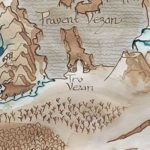
They climbed further into the hills. Their peaks were also immersed in the jelly-like mist. Svittynis was under the influence of warm air flowing from Pravent Vezan, the former center of the ancient Vezanian empire. From crevices in the ground, filled with mists, a constant breeze of warm air flowed towards Svittynis, and this made the basin around the city a very fertile area where the best wine and fruit grew. Despite being situated far in the north, they could even grow figs and kolchrups, rare nutritious nuts. Beyond the ridge of the hill, however, the influence of the warm air from the west ceased. Snow began to crunch under their feet, and it grew bitterly cold. They had been walking for about an hour and a half when they came across an overturned sleigh, from which two horses had been unhitched. The footprints of about eight people came from the right, perpendicular to the road. The snow around the overturned sleigh was trampled, and then the tracks departed to the other side of the road.
“There were about ten or twelve of them here, and the horses,” said Fox, after thoroughly inspecting the place.
“Do you use sleighs in Svittynis?” Vedrax asked Taro.
She shook her head. “Not at all. We never have snow. But in the foothill hunting villages to the north of us, sleighs are used. These must have been from Dregan or Kilvi. Northwest of here. Or I don’t know. This place doesn’t make sense. That sleigh looks entirely too ornate and expensive.”
Fox, sniffing around the sleigh, said: “These are tracks from this morning. When we were leaving the city, they were here. I smell an old scent here that I know. I smell Iacana and the Free Land and Xalgon.”
“What? Then let’s go find out what old acquaintances we might find,” exclaimed Klaes, and they set out on the trail. Soon, the footprints lined up in a single row, as if everyone were placing their feet in the tracks of the one walking first. At the end of this track lay a body in black, resembling a Xalgonian knight.
Vedrax ran to him and turned him over. It was a man with graying hair, Vedrax’s father, Serkvaeth.
“Father!” he groaned.
The lying man spoke: “Son, son, is it you? I thought I would be whole, that the sacrifice would make me whole. You must know things. Our lineage has powerful blood. Our blood closes wounds and gates; therefore, it must be in the Horologium. One day you will return there.”
“Father, rest assured that your sacrifice will not be in vain,” Vedrax whispered.
“It was not in vain, because you live. You have a greater destiny than I can see.”
“Who brought you here?” asked Vedrax.
“A dream. I am broken. I am not here. You must know that the Horologium is not a machine. It is a wound that must be closed again and again. I am now standing in those doors for a moment, and I see things that the tongue cannot tell. We have the curse-glow. The Lords of Xalgon need us,” whispered Serkvaeth.
“Father, how will I fulfill my destiny?” Vedrax asked tremulously.
“You must shed blood. Your blood can heal a wound, wherever you are. Now come, kiss me, kiss me on the mouth,” Serkvaeth croaked and opened his mouth wide, wider than would be possible for a human face. Inside was darkness.
“Father, I will do my utmost so that my blood does not go to waste,” said Vedrax, bringing his face closer to his father’s and preparing to kiss him. Loverd jumped in and thrust a burning torch with an Auranian flame between them. Serkvaeth disintegrated and burned with a yellow-green fire. Only clumps remained of him, as if someone had burned a few sheets of paper in the snow.
“No! What have you done!” Vedrax cried. “I saved your life!” Loverd retorted. “That wasn’t your real father! He died a sacrificial death in the Horologium, after all. We all saw that. This phantom here would have bitten your head off in the next instant.”
Vedrax turned away in silence and observed the trembling ashen clumps. He drew his dagger and cut his wrist. Red drops of his blood dripped onto the pure white snow. At that moment, the jelly-like mist around them dissipated, and from the clumps of black scorch marks on the ground, a purple flower assembled itself. Vedrax picked it and hid it in his breast pocket.
“All right. That phantom might not have been making things up,” Klaes remarked, watching the dissipating mist.
“What phantom,” Vedrax said slowly.
“The one… that looked like your father. Everything here is weird. But look – around your hand, around the drops of blood – the mist is gone.”
Taro looked at it and then remarked: “You wanted the blood of our lambs. We want yours.”
“My father said that moment is far away,” said Vedrax.
“Your father spoke of your blood healing wounds and closing gates. Interesting. My journey here was not in vain,” Klaes noted.
“What is this Horologium of yours?” asked Taro, for whom the word held no meaning.
Vedrax straightened up proudly and declared: “The greatest work of this age. The Lords of Xalgon once moved the stars in favor of the city, and one day they will move the stars again, and then everyone will be saved. The Horologium is a basilica, the heart of my city, which the Order of Xalgonian Knights guards against the destructive forces of the forest elves and the pyromaniacal Arkinians. Until the Savior returns, it is necessary to feed it with the blood of those who possess the curse-glow.”
Loverd pretended not to hear these words and examined the tracks, how they merged into one. After all, he knew the teachings of the Xalgonians, having spent some time incognito in the city.
“Will someone explain to me where they went? Did they fly away, perhaps?”
Taro looked around. “Or they had a lot of legs! … Maybe I’m already very drunk, but… where are your parents? Klaes? Loverd? Are they also lost? Sacrificed? It fits into the story… could this phantom not have been the father of us all?” “It certainly wasn’t my father, I know my parents,” snorted Fox.
“My father is the Lord and my mother is a Fox, what else.”
“That must have been some party, then,” Klaes laughed tipsily.
Vedrax shook his head as if wanting to sober up, and then said: “Let’s get out of here. We should see where those tracks came from.” No one objected, and so they all turned and returned to the overturned sleigh and followed the tracks of the arrivals. After about half an hour, a wooden structure with blades like a windmill emerged from the mist. The tracks led around the mill and behind it. There was a rock fissure and the ruins of a bridge that had recently collapsed into the depths. On the other side, the tracks continued on.
“Bad luck. They destroyed the bridge,” Fox muttered in annoyance.
“These fissures lead to Pravent Vezan in the west,” Taro gestured a bit too sweepingly, “they stretch far and are as wide as this one, or even wider. We certainly aren’t going around or jumping over this one.”
Vedrax and Klaes went to look into the building, where they discovered the mechanisms for the bridge, which was a drawbridge. Thus, the mill did not grind grain, which didn’t grow in the area anyway, but was meant to power the lifting mechanism. Now the blades weren’t turning because everything was immersed in the jelly-like mist and the wind wasn’t blowing. They searched the storerooms and found plenty of materials. Growing increasingly drunk, they then built a footbridge structure, which, against all odds, they successfully laid across the chasm using ropes and pulleys. The result did not look trustworthy in any way, but there was no other way.
They fortified themselves with a late lunch, but primarily they were putting off the moment when they would have to cross the fissure. Taro again offered wine to pass around, but they only drank symbolically; most of their heads were already quite spinning. Which is not an ideal state for crossing over a chasm.
Finally, they mustered their courage and ran across the footbridge one by one. Fox, being the lightest, ran first, and finally Vedrax went in his armor. To their surprise, it went well. The wood creaked menacingly, but it held them. The hardest part was not losing their balance in their intoxicated state.
They followed the tracks until they saw a group of people ahead, conversing in hushed tones in Lebarian. When they saw the newcomers, they huddled together and raised sticks and stones.
Vedrax spoke to them in Xalgonian and Garionite, but they didn’t understand him. “Does anyone here speak their language?”
“I do!” said Fox.
“Me too,” Klaes chimed in and immediately turned to the group to address the people in their native tongue.
“Are you lost?”
The people nodded.
“Have you seen a certain… do-gooder sorcerer around here? An alchemist?” asked Klaes, searching for the right expression for a mage in Lebarian.
“Yes! Talantius. Come sit and chat with us,” called out the suddenly very friendly people.
Vedrax, who only understood the word Talantius and realized the people were agreeing, turned to Klaes: “Translate this for them, ask them if someone separated from them. And what they did to that bridge.”
Klaes translated the question for them.
“We are lost. Sit here with us,” was the answer, and Klaes translated it.
“They’re a bit weird,” he noted.
“They are,” Vedrax agreed, but offered the people wine.
“Thank you. Sit here with us,” the people repeated. They were all blinking at the same time. Fox ran around them and sniffed.
“They don’t smell like humans. It doesn’t smell right. Something is wrong with them,” she whispered to Klaes.
Vedrax asked Klaes to interpret again: “What do you want to talk to us about? We are in a hurry to find Talantius, we don’t have time to chat.”
“Which way is home?” one person asked.
“Maghon? That is no longer a place you can return to. I am sorry,” said Klaes, and then interpreted what he had said to the others.
An eight-year-old boy with eyes red from crying separated from the group and reached his hand out to Klaes. “Sir, please help me. I don’t want to be with them anymore. They aren’t them anymore. They keep repeating strange things over and over. Take me with you,” he pleaded.
“Alright, come. Lead us to Talantius,” Klaes replied. The boy looked back. The people stared as if right through them. “Sit here with us,” they kept repeating over and over.
The boy burst into tears, but stepped away from the group.
“What is his name?” Taro wanted to know. “Ask him who those people were…”
Klaes interpreted.
“Lucius,” the boy replied.
“Who are those people? Are they your relatives? How did you get out of Maghon?”
“I don’t remember anymore. There were more of us. Others stayed behind. Mom, Dad, they couldn’t fit into the tower anymore but they shoved me in there alone. I want to go home.”
“Lead us to Talantius and we’ll see what can be done about it. He is responsible for this,” said Klaes. They walked where the boy led them.
Even from a distance, clumps of smoke could be seen drifting in the jelly, and the dark outlines of ruins shaped like a tower. The lower part was broken, and the tower stood askew. A fissure gaped in the body of the tower, from which colorful molds crawled and flew out like bubbles from a bubble wand. Jelly-like air radiated from there, and twigs similar to mistletoe flew out. The opening into the tower led into a colorful, glowing world. Next to this radiant fissure was a second, smaller one, which led into the dark bowels of the leaning tower.
A group of people stood before the fissure in the tower. They were singing. The sound of the word “sweet, sweet, sweet” vibrated through the air in a powerful chorale. The singers had no eyes.
“Klaes, give me a drink!” Fox pleaded. Klaes poured wine into her mouth and took a hefty swig himself. “Now it’s time for those three drops of blood. At minimum,” said Fox.
Loverd nodded: “That is a good plan. We’ll charge in there, unleash fire, and you, Vedrax, will close that gate – that wound.”
“I was wondering why they didn’t have a slaughterhouse in Svittynis,” Vedrax noted, gripping his halberd firmly.
“Apples? We have apples,” Taro mumbled back, but Vedrax didn’t have time to answer her.
At that moment, an old man emerged from the dark fissure in the tower’s wall, wearing a long, worn robe embroidered with star signs and the insignia of a master of the alchemical arts. Talantius. “Welcome! Welcome!” the mage said, smiling warmly at the arrivals.