Colorful legends circulate about the Solar Hall, and in the Inn at the Three Foxes, many a tale is told of those who wandered into the Solar Hall by chance, as well as those who set out for it and never returned. One thing remains clear—the Hall possesses much of the nature of the sun, upon which its power rests. Like the sun, it can be kind and warming, but also like the sun, it can punish the unwise and the unworthy. He who stares too long into the blissful light of the sun shall go blind. By this, the sun declares one thing—that which is the source of all vision is, for vision itself, a ruin. The eye, and with it the mind, may feast upon that which is brought to life by light, but the source of life itself is forbidden to it. Thus, the secret of the Solar Hall is no less revolutionary and terrifying than the secrets of other Halls—at its core lies the ancient antithesis of light and darkness, life and death, locked in the amorous embrace of war.
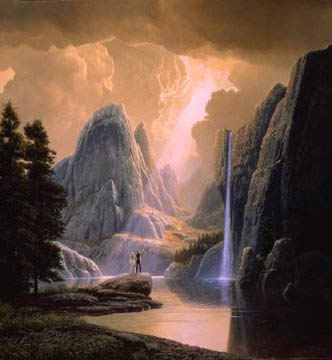
The Fragrance – The fragrance of the Solar Hall is the day itself in its jubilant radiance. Just as a man dwells in houses and rooms, the sun inhabits days and years. The day is the dwelling and temple of the sun, smelling of the Hall, of which it is but a distant imitation. The sun is a master painter, and its fragrance is intended for the eyes. In the moment when clouds part after a cleansing rain and the air is clear as glass, the rays of the sun pierce through like spears and swords of light-brigades through the barricades of bubbling celestial waters. They bring the fragrance of the Hall, which is strongest in its hint and apparent muffledness. The thinner the blade of light, the more menacingly the receding clouds tower, the more clearly the Hall smells, revealing a path that few believe in. Some tell of mystical experiences in the heart of a storm, when a thundering rock of clouds suddenly cracked, and through the fissure, one could glimpse the golden treasure hidden within. Others saw shining cities and majestic figures in the rift, and it is said that it was then that the view of the Solar Hall was revealed to them.
The Antechamber – There are not many who would not be frightened by the bright blade of light penetrating the clouds, and so various legends circulate about the Antechamber. Silent Travelers, known to visit the Hall, occasionally reveal a little, and upon that, we dare to rely. That bright blade cutting through the clouds is not only a flaming weapon of the sun and its wind-borne hosts, but it is also the path upon which the brave must set out. Doubtless, it is difficult to find an edge as sharp as a sunbeam itself, but according to the wise, for those who have trust, it is firmer than the earth itself, while for the fearful, it is a fall personified. He who sets his foot upon the blade of a ray can be said to have stepped into the Antechamber and left the world of mortal men. He still sees it, but only as cloudy shadows, a gray void to which only the golden hand of the sun gives shape and face.
The Threshold – There is talk of three gates that the Hall possesses, and thus three thresholds that may be crossed. They are called the Threshold of the Singing Cradle, the Threshold of the One Laughing in the Storm, and the Threshold of the Squinting Eye.
The Threshold of the Singing Cradle is open at the moment of dawn. The fair Aurora dances over the forests, removing the veils of mist from the newborn sun. Choirs of stars shake the vault woven from cosmic laws in a celebratory song for the solar hero, who has once again defeated the serpent and risen from the dead to save the world from eternal frost. The horizon rings as the melting icy bonds crack—bonds with which the serpent entwined the sun during the nightly battle to extinguish its flame forever. This is the moment when the sun touches the horizon, making it possible to reach it by a direct path. A golden path woven from the hair of a newborn Cyclops, heir to the bluish pastures and white flocks, winds through the kingdom of mists. One must take this path and not look back, otherwise the path will bend and cling to the twisted furrows of iron plows.
The Threshold of the One Laughing in the Storm is a path only for the bravest of heroes, for it offers itself in the blink of an eye and a stroke of lightning. He who falters shall find his life blinded, but he who is determined shall cross the threshold with the speed of an angry gale and stand inside the Hall, which was always but a single step away.
The Threshold of the Squinting Eye can be crossed at sunset, and the path to it winds between red crags under a darkening sky. He who watches the end of the road closely has hope of entering the Hall, but he who hesitates too long will be swallowed by the converging shadows of the nightly assembly. For as the golden water flows to the delta of the west, it gives way to a dark carnival in which there is neither name nor memory.
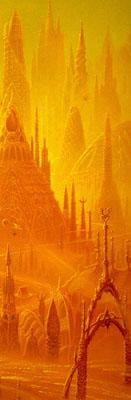
The Inner Hall – Not even the Travelers speak of the interior of the Hall, so we rely on the reports of those who went astray and “midday sleepers” who, during the first spring storms, peered through the curtain of rain and saw the hidden Hall. Their words contradict each other and sound like the chants of delirious maidens, yet they are all that has reached mortal ears. Inside the Hall, the grass is said to be the color of green amber, the leaves of the trees are of jade, and their veins are woven from golden vessels in which the life of solar runes pulses. There are wide undulating plains where a fresh breeze blows, carrying clouds of golden down in its arms. In the landscape tower spires and cities of warm stones, flashing their golden domes and cupolas from afar, and whose busy marketplaces teem with beings from the most diverse worlds. Above the cities float balloons and castles-in-the-air inhabited by solar djinns, the guardians of that place. Above all, however, arches a majestic sky whose vault is rolled from grayish clouds and whose windows are stained-glass rainbows and clear blue, in which stellar signs flicker despite the brightness of the midday sun. The sun itself is ten times larger than the sun in our cold world, embracing the entire land in its golden rays.
Inhabitants of the Hall – It is said they are golden djinns, the ancient guardians of this place. Their food is sunlight, and therefore they are loath to move far from the Solar Hall to places they call “The Gloom,” which, however, correspond to our world. Yet there are those among them who did not live up to the strength of spirit and the laws of the Hall, and these were cast out beyond its borders. They wander the twilight lands on the edge of the Hall and the Gloom, grasping for light or any source of power. Over the ages, many of them have turned into hungry demons, and their minds—unstable and treacherous from the start—have changed into vessels of lies and hatred. It is these fallen djinns who lurk on the paths leading to the Hall, posing the greatest danger to one heading there. It is said that it was once possible to enter the Hall by many different ways, but ages passed and the passage through the twilight became increasingly dangerous due to its demonic inhabitants, who began to call it their home. Then, three firm thresholds were established through which one may enter the Hall by clear paths and avoid the dwellings of the twilight inhabitants.
Magic of the Hall – Solar magic surely has its origin and center right in the Solar Hall. The power of the sun is great—according to those who worship it, the sun is, after all, the father of all life on earth, the giver of all sustenance, and the only just god, for it shines equally upon the poor man and the rich, persecutes no one, and gives gifts to all from its golden basket.
The golden solar runes are the knots of solar magic, and their power is similar to both the sun and gold in that it does not change, does not diminish, does not weaken, and does not devalue, but is always the same, like the indelible memory of the golden djinns. After all, the solar runes are said to be their runes, the letters in the language of the djinns. Many of them, therefore, make no sense to mortals, as they are closer to the life of beings that feed directly on the sun—trees, herbs, and djinns.
There is yet another magic for which the Solar Hall is famous: scattered across the plains are shrines that weave braids from sunbeams—from hair—and under the hands of smiths, these braids are transformed into a warm metal similar to gold: Solar Metal. It is from this very metal that everything in the Solar Hall is made (for it is not permitted to bring any of the impure metals of the Gloom into the Hall) and which provides the power and protection of the sun to those who carry it away to other Halls and lands.