Player: I kick open the door and burst into the room.
Narrator: On the other side of the room, a filthy, ugly goblin—a head shorter than you but pure muscle—stands up from the table. He lightning-fast grabs a two-handed axe and shouts something at you in that gibberish of his. You don’t understand a single word, but it’s completely clear what his intentions are. What do you do?
Player: I attack.
A classic situation has arisen. The game will continue, but for now, nobody—not even the Narrator—knows how. How do we find out which way to go?
Somewhere out there are thousands of systems, and each answers this simple question in its own way, weighing different factors, assigning them varying degrees of importance, and placing them on different sides of the equation. Yet, all these systems stem from just three fundamental paths.
The Path of Story
Player: I attack.
Narrator: You clash for a moment, but he is just a guard and you are an experienced warrior. Even though he puts you in danger a few times during the fight, he ultimately falls, and behind him, a path opens up into the depths, following the footsteps of your father’s killer.
Making decisions based on the story stems from the fact that each of us knows plenty of stories, and everyone has an awareness and a sense of how a narrative can progress. A story can be logical or fairy-tale-like, optimistic or dark, but every story has its own laws and conventions. It can be a cliché (one hero is better than an entire army) or a logical consequence (if you don’t clean the wound, you might get blood poisoning); the important thing is that the narrator senses how the plot should unfold to produce a good story.
Although it may seem so at first glance, this approach is not necessarily passive—not for the player (what kind of story do I want my character to experience?) nor for the narrator (instead of making friends with him, they challenged him to a duel—what does that change about the whole situation?), though sometimes it does happen.
In the narrative approach, it becomes highly evident that the entire plot is driven by a human being, giving the narrator immense power. They can use this power to craft an epic adventure tailored precisely to the players, or abuse it by using the players as mere pawns in their own fantasies. In the first scenario, the narrator is unconstrained in executing their grand design. In the second, the narrator considers the story they want to tell more important than the fact that this is a game they are not playing alone.
Paradoxically, this approach is often very unpleasant for players (they feel helpless and without influence over the plot) and often very pleasant (it’s about conversation and co-creating a story that cannot be ruined by a bad roll). The outcome depends heavily on all participants—both the narrator and the players—and the trust between them.
The Path of Rules
Player: I attack.
Narrator: Your Combat is four, his is two. Although he has high resilience, you ultimately defeat him. Add four fatigue points.
Proceeding according to the rules is a method where the narrator makes decisions based on pre-conceived and agreed-upon guidelines. This can involve exact, mathematical rules (e.g., if my Strength + Sword Mastery value is higher than the enemy’s Agility + Evasion, I hit and inflict damage equal to the difference) or a vaguely formulated agreement (e.g., I am a vampire, so I am stronger at night and weaker during the day). The essential thing is that the rules are established beforehand, and everyone can familiarize themselves with them, understand them, and be prepared for how they will affect any given situation.
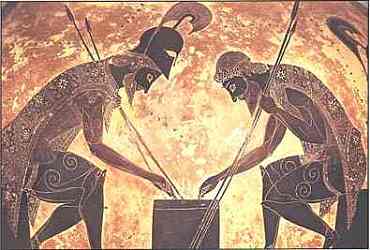
Numbers and rules lay out a clear battlefield before the player and the narrator. They allow the player to state plainly what their character is good at and what they aren’t, while also telling them exactly how good they are. However, they can distract attention from the game toward the mechanics themselves. They influence player behavior in a direction different from what the events in the game would dictate on their own—this can be good (motivating players toward an appropriate playstyle) or bad (the player focuses more on the rules than the game). Rules are simultaneously neutral, as they measure everyone equally, and malleable, because during character creation and gameplay, players choose which input variables to present to the system—what attributes their character possesses, what they improve in, and how they behave.
Rules do not have to be limited to defining the inner workings of the world and its inhabitants. They can also include guidelines governing the behavior of the narrator or the players, or the game itself (e.g., no character dies unless their player wishes it). But that would be a longer discussion.
The Path of Chance
Player: I attack.
Narrator: (flips a coin) Heads, you win.
Chance is anything that introduces elements into the story independent of the players, the narrator, the characters, and the game’s authors. It can be a roll of a die or a flip of a coin; it can be a drawn joker or tarot card. The latter demonstrates that chance does not need to have specific, predetermined outcomes—chance can also be an external input from which the narrator derives a result through association.
Chance is beyond the control of both the player and the narrator—fair, yet unpredictable. It injects tension into the game, often becoming a mini-game of gambling within the larger game. Some need chance to enjoy the game at all, relishing their battles with the narrator over who will be lucky this time, while others dread bad luck and fear every moment they have to pick up the dice. From the narrator’s perspective, chance spices up the game and relieves them of some responsibility for what happens to the characters; at the same time, there is a risk that a single unfortunate (or unexpectedly fortunate) roll at a critical moment could shatter the entire game.
Direction
The path we choose has an extensive impact on the game that doesn’t stop at merely deciding what happens in a given situation. The system also dictates what we make decisions about, in which situations, and how important each situation is.
In a game ruled by chance, there are no small or large events; at any moment, a character can easily die or achieve a monumental success. Furthermore, the player can do nothing to influence the outcome; they can only try to approach or avoid situations that require the intervention of chance. In a rules-driven game, an encounter is important if the opposition is strong, and the more powerful the adversity a character overcomes, the more crucial the decision becomes. The player risks a harsher penalty in case of failure and must exert greater effort to tilt the system in their favor. In a narrative-driven approach, a peculiar anomaly occurs. There is the least uncertainty in entirely trivial situations (Conan and a rat) and in the most vital situations (the hero against the Dark Lord). In the first case, there is no need to resolve what happens—the hero simply succeeds; in the second case, the moment is so narratively potent that it leaves almost no room for alternative outcomes. The greatest space for the plot then lies in situations that are neither minor nor monumental—those that place the hero in danger and uncertainty, lining their path toward the end of the story.
At the Crossroads
No game belonging to the RPG family can rely solely on just one of these approaches. At least two, and in the vast majority of cases all three principles, always converge. However, each game also assigns a different level of importance to the various paths, differing in the order in which elements appear, or which one is used in what situation and how. Their mutual interaction gives rise to different games and, within them, all the diverse adventures each of us has experienced. And that, dear children, is what we will talk about next time.
© 2006 Pieta
With massive thanks to Jonathan Tweet and his game Everway for the immense inspiration.