In this short summary, we shall list only the types of money a traveler is likely to encounter within Sirania itself. The Siranian Empire is a crossroads of trade routes and a major link between East and West; therefore, one may come across many different currencies here, though certainly not all of them. The geographically closer a state is to Sirania, or the more stable and reliable its currency, the more likely it is to appear in Siranian marketplaces, on moneychangers’ tables, and in banks.
IMPERIAL
The Imperial is the currency of the Old Empire from the time when the Emperor sat upon the Throne of the Gods in Garion and the age was young. Imperials are coins made of a special alloy with a high silver content and are protected against counterfeiting by magical charms. Although the Empire has long since crumbled into the dust of the earth, Imperials continue to circulate and remain a hard and reliable currency. During the time of the Empire, a certain amount of Imperials was minted every year, especially to mark victories or significant events. Imperials are thus like tiny “newspapers” of the past, and an expert can determine the exact age of any coin. Few coins remain from the “midday” of the Empire; most date from the twilight era. As the decline of the realm progressed, the quality and value of the coins decreased. Therefore, the “type” of Imperial is crucial. The vast majority of Imperials in circulation are from the late period and have the lowest relative value. Imperials from the Imperial era are graded by age and quality into the Common Imperial (80% of all available), Probatus, Excelens, Anticus, and the rarest, Arcaicus, whose value is fifty times that of a Common Imperial and which corresponds to the historical era of the Empire’s flowering. Besides Imperials, there are also Provincials—copper coins with a 20:1 ratio to the Common Imperial.
SIRANIAN THALER
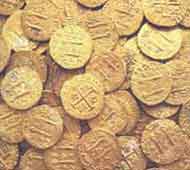
The Siranian Thaler is the stable currency of the Siranian Empire. Given its stability, accessibility, and widespread use, it serves as the primary benchmark and common currency for all parts of Sirania, the Free Land, and many cities northwest of the Ma Sarit. The Thaler is a silver coin with a small hole in the center, allowing it to be strung on a cord. Twenty Thalers bundled together on a leather cord are called a Grivna. Besides the silver Thaler, there is also a small bronze coin called a Flock. Approximately one hundred Flocks equal one Thaler.
SEA CURRENCY
During the era of Mantrin’s maritime hegemony, a common currency spread among the nations of the Kira Samudran, which maintains its popularity to this day—even though its value (especially that of pearls) is quite volatile depending on the fortune of pearl hunters. The highest value in this currency is the rare Blue Pearl, also known for its magical properties. Its value is approximately ten White Pearls, whose price is the most variable. Surprisingly, the most stable are the so-called Shellies, which are coins manufactured through a special process from a specific mother-of-pearl shell; their value is twenty to one White Pearl. The smallest denominations are Scales, valued at one hundred to one Shelly.
THE THREE FOXES INN
The Three Foxes Inn, whose branches can be found not only in every city of Qurand but also unexpectedly in the middle of forests, at crossroads, and sometimes even in subterranean dungeons and demonic rifts, introduced its own currency ages ago. Regulars quickly grew accustomed to it, and due to its incredible consistency, it eventually spread for use outside the inn. Some smaller states have practically lost their original currency because Fox Gold became so prevalent among the people. Indeed, the coins are made of shiny, glinting Fox Gold, whose value is far below that of true gold. The largest coin is called a Three, featuring the likeness of three sitting foxes—the symbol of the Inn—on the obverse. For a Three, one can buy a decent and hearty meal at the Inn, including an appetizer and dessert. The smaller coin is called a Vixen, featuring a fox’s head; it buys a proper tankard of beer. The smallest coin is called a Paw, with four Paws equaling one Vixen. Occasionally, an even smaller denomination is needed, and so a Paw is sometimes broken—then we speak of a Broken Paw.
Standard Exchange Rates:
1 Thaler = 2 Common Imperials = 5 Shellies = 10 Threes
In Sirania, certain obscure currencies may also appear:
GANDHARAN SEAL (ZIKIL)
The Zikil is an iron coin whose value does not correspond to its material worth but is dictated by the government in Gandharnagara. Each Zikil is stamped with symbols, including the numerical value of the coin in Gandharan numerals, which most foreigners do not understand. The Zikil is rarely used outside the borders of Gandhara; however, within the Eastern Empire, nothing else is used, as Gandharans are forbidden from accumulating gold and luxury items. Therefore, anyone traveling to Gandhara must exchange all their money for Zikils at the border, as no gold is allowed into the Empire. Upon returning, however, no one will exchange Zikils back, as everyone prefers to keep their Western coins.
FOREST CURRENCY
Though it might not seem so, trade occurs even in the forest. Old Elven kingdoms use their own currencies (rings of various metals), but the forest folk and Druids use renewable forest resources. The highest denomination is the Acorn—a rare, golden acorn from a rare Primal Oak, a tree that grows only occasionally in sacred places. Besides its monetary value, the Acorn is a fruit; if planted, it grows into a beautiful oak. One Acorn is worth ten Gold-Green Leaves (or Gold-Greens), which are special tough leaves that the Primal Oak sheds from time to time. One Gold-Green is then equal in value to ten Gold-Red Leaves (Gold-Reds).