The city-state of Arkagas is one of the full members of the union that, under the sceptre of the Empress, forms the Siranian Empire. Although it is not as potent in magic as Sairis, nor as overflowing with diversity as Sir, it is nevertheless a great and wealthy city, whose current glory and mysterious past rival those of any other city-state in the Empire.
Arkagas is called the “Pillar of the South,” for it has from time immemorial defended the Empire against threats from the southwestern powers. No other city in the Empire can boast such a large and well-trained army—Sairis is defended by its magic, Sir and Sirgon are secured by the Imperial Legions, the strength of Adamas lies in its fleet, and Asvittara is perfectly protected by its location. Arkagas is not defended by the Empress’s legions; rather, it possesses its own standing army, a traditional and dignified force of Arkagantian citizens.
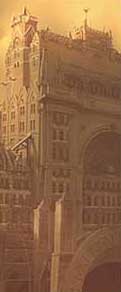
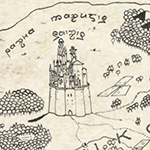
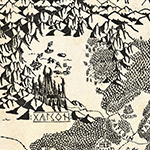
The city itself is built upon four steep crags, which originally formed three separate towns, but are now interconnected by bridges and encircled by a shared, double-layered rampart of unprecedented height. The Arkagantians have always delighted in defensible outposts, the building of castles, and impregnable strongholds; therefore, their city resembles one vast fortress, composed of several other smaller fortresses. In times of peace, however, the city gates are open, merchants set up shops selling fabrics and amulets within the gatehouses, and many come to admire the sheer stone beauty of the walls, strongholds, and houses. The idea of a fortified refuge is not unique to the governance but belongs to every citizen; thus, the city houses themselves, constructed variously of greenish, bluish, or whitish granite, resemble small keeps. They have thick walls, narrow windows near the ground, and often battlements surrounding their courtyards. The homes of kinsmen are connected by stone bridges high above the streets, giving rise to a tradition of visiting without leaving the safety of the home, and thus a complex life “within the walls of the homes” developed.
Arkagantians truly like to guard their privacy. They welcome guests, cautiously admitting them through a partially opened gate into the house, and entertain them in a reception chamber or a greenery-overgrown courtyard; however, they never allow them further, into the heart of the house—into their cellars, storehouses, armories, bedrooms, and family halls.
Many houses are connected not only by bridges at the level of the third and fourth floors, which are open expressions of kinship or friendship, but also by many subterranean passages hewn into the granite, crossing deep beneath the cellars of the houses. These underground passages are expressions of secret connections and conspiratorial societies. Given that the territory of a house is sacred, and not even the city ruler has the right to enter without the permission of its master or mistress, these passages are unmappable, and their hewing and use cannot be forbidden. Nevertheless, both houses, bridges, and passages form a permanent bond that engages their owner in a specific network of relationships inherited within the family, for few would dare to tear down a bridge or fill in a passage. Therefore, even these secret alliances in time become the quietly known tradition of many old families.
The mighty stone houses of fathers, great-grandmothers, and great-grandfathers, passed down from generation to generation, thus form a kind of hard shell for the family members, which both protects them but also, by its location and shape, forces them to accept a certain traditional position and maintain old family relationships expressed by the passages and bridges. The houses do not change; from time to time they are repaired, and only exceptionally is a floor or a roof turret added. In the city, they are so crowded together that it is impossible to expand them outward. And so, when the eldest child takes over the role of master of the house, those who do not fit depart to build their new home in a place where it is possible. It is traditional that they build their new house as far as possible from the house they came from, thus resembling Arkagas as a whole, which, when overcrowded, sends colonists to distant lands, fearing to be further expanded and to overflow from its hard and immutable shell.
The four crags upon which the fortresses of the original towns tower are named Arka, Carhain, Darika, and Diruvran. You can read about the populations that inhabit these peaks in the “Nations” section, but here we shall briefly mention the appearance of these places.
ARKA is in the very center; it is the brightest, highest, and steepest peak. Although it is built upon wherever possible, some precipices are so sheer that in place of suspended houses, there are cave dwellings within them. Anyone journeying from the foot of Arka to its summit would pass through perhaps a dozen walls, guardhouses, and tunnels, ascending a steep, winding road with steps in which grooves for wagons are carved. Wagons are not pulled up by horses; rather, due to the steepness of the slope, they are transported up along these tracks hauled by a system of ropes and windlasses powered by water. On the summit of Arka are the palatial homes of the oldest families, the assembly grounds of the Senate, and the temples of ancient gods, some of whom have already been entirely forgotten, only their priests still remembering the old chants and tirelessly and faithfully bringing sacrifices to them through the ages. The palaces on Arka are noble yet simple and unadorned. Their beauty is achieved by simple curves soaring toward the sky. On the gables of the houses and on the gates, you would find no gold fittings nor colored paintings. Even the interiors of the homes of this old nobility are spartan and perhaps even bleak. The sole decoration of their corridors and halls are weapons and spoils of ancient battles; the only adornment that tradition allows, and is abundantly used, are magically colored stained-glass windows in the windows of even the lowest servants.
CARHAIN is lower than Arka, lying north of it but very close. It is connected to it by suspension bridges, and here live the descendants of families from Arka, younger nobility, and many brave citizens of the middle classes. It is the most classical quarter in the sense that it lacks the stiffness of Arka while not yet having fallen into the extravagance of Darika. Its houses are mighty, solid, built in times of honest labor and wartime experience. There are also many old traditional family shops and several narrow but picturesque squares.
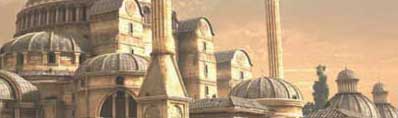
DARIKA is the name of both the large, elongated hill south of Arka and the entire space beneath the walls of Arka, Carhain, and Diruvran. The hill itself and the regions directly beneath and between the other peaks are called Old Darika, and it is the part of the city most admired by foreigners. The houses here are magnificent, richly decorated with gold, built of imported rare marbles, and surrounded by statues, fountains, squares, parks, and arcades. The palaces of the Darikan wealthy far surpass the stark beauty of the noble houses on Arka in their extent and magnificence, attracting the eyes of merchants, travelers, and capable thieves. The markets, shops, and taverns of Old Darika are famous and heavily visited. While Arka awakens shortly before sunrise and falls silent shortly after its sunset, Old Darika sleeps long into the morning, lives in a pulsating afternoon, and above all, during the long evenings and nights. Nightly drinking bouts, romantic strolls in the parks by the fountains, and risky operations by Darikan thieves fill the Darikan evening, which often stretches into the morning.
Even further below Old Darika, beneath the mighty three-tiered ramparts of the city, where, according to all inhabitants of Arka, Arkagas has long since ended, lies YOUNGER DARIKA—a partly stone but primarily wooden city of thievery, drunkenness, miserable trade, and false tinsel. Here all dissolute elements gather, here gambling flourishes, and here they indulge in intoxicating substances and unrestrained whoring. In the past, Old Darika used to have a similar function; however, even there the influence of Arka penetrated, solidified the houses into stone, turned common rich men into petty nobles, and introduced some semblance of traditions and principles. Younger Darika, then, is a community of outcasts, expelled from its midst even by the quite benevolent Old Darika, and thus it is inadvisable for a virtuous person to enter, unless perhaps with a weapon and a hand on their purse.
To the west of Arka, closer than the Darikan hill but further than Carhain, lies DIRUVRAN. It is not a single rock, but actually a pair of rocks—given the immense proximity in which they stand to each other, Diruvran is also called Fivanau, that is, The Twins. Both rocks are connected by many sturdy bridges and form a single whole. Unlike other parts of the city, stone does not prevail here as much as wood—not dead wood, however, but living wood. The stones of the old houses here are overgrown by mighty roots of oaks and ash trees, within which many families live. The tree city soars, mingled with the stone city across both summits, and is distinguished even from afar by bright greenery from the stone grey and red of the roofs of the other quarters. The tree houses here are tended by Drúvi and Drúviades, kinsmen of the Arkagantians among the Forest Folk. The trees here grow in strange shapes and giant sizes, and many live within their trunks, many within their branches. Some stone houses are merely overgrown by the tree, other houses are entirely without stone, only arboreal. The roots of the great house-forest, growing over both hills and holding fast even on the steepest slopes, are said to be very deep and, in the end, perhaps form a single root.