History
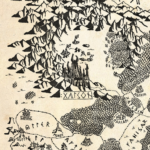
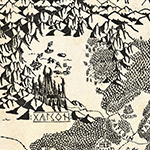
The city of Xalgon stood even in the days when celebrated Valarkagas was but a settlement on a rock hidden in the woods, and when the walls of Uldar were still a mere wooden palisade. Not only did it stand, but it waged mighty wars that gripped the West of Qurand before the dawn of the current age.
It was a time when, north of Garion, stood the ancient city of Vezan, renowned for its gardens, palaces, temples, and immense power. Old Vezan, as that empire is called today, ruled most of the known world, but it gradually succumbed to darkness, and a servant of the Zilaths ascended its throne. For hundreds of years, the Zilaths, through the power of Vezan, held their finger on the pulse of Qurand. Their sowing was abundant, and so was the harvest: the world fell into demonic tendencies, and only in the far East stood the eternally closed fortress of Gandhara, which at that time refused to extend a helping hand beyond its borders.
Only a single city resisted the seductive power of wealthy Vezan: an old fortress in the far North named Qasalgon. It became the seat of rebels who revolted against the tyranny of the Zilaths, swore loyalty unto death, and tirelessly fought the endless hosts of Vezan in unequal clashes, of which legends circulated among the people—legends the government vainly sought to ban. To this day, elders in remote valleys know those ancient chants, and the names of the heroes of Qasalgon can still be heard. They sing of the brave Ocelot, the wise Carisvand, the silent Uthaen, the mighty Valmont, and many others, but above all of their chieftain, the faithful Qasamikil. Qasamikil was both the King of Qasalgon and the leader of the resistance against the tyranny.
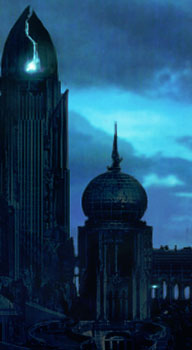
In the time before the fall of Old Vezan, much occurred that is now hidden from mortals, yet scholars agree on these points: the Zilaths exceeded their authority and gave the Azhars the opportunity for a free move in the Great Game. A great storm broke out, and battle was waged on earth and in the heavens; the maghavans entered both earthly and celestial oceans and struck against the fleets of Vezan. Burning wrecks of Vezanian cruisers fell from the sky, and smoke shrouded the sun. In the decisive hour, however, Qasamikil was seduced by the Zilaths and, in a terrible ritual, became one of them: Kosomakh. The city of Qasalgon was enveloped in eternal darkness and inhabited by monsters from the spaces beyond the darkness of the new moon. Forevermore, it became Xalgon, the City of Darkness. In response, the city of Sairis and the Order of Paladins were established at the instigation of Qasamikil’s betrayed friends, Ocelot and Valmont, so that the malevolence of the Black City would be eternally guarded.
So says history, though in the archives of Xalgon and Sairis, we would find many discrepancies in the depiction of these events, and few scholars are permitted to glimpse the words of both traditions. The city’s present, however, is less dramatic; or so it seems to the people in Sirania, for whom Xalgon is but a distant northern city against which they have never stood in open conflict. Indeed, some merchants and students of magic have even visited it and returned home safely, telling of its many wonders.
In conclusion, one should mention a saying popular in Xalgon: “All the famous cities of Qurand have a great past—but only Xalgon has a future!” The astrologers in Sairis remain silent when asked to refute this claim. It is true that few cities are as open to the future as Xalgon, perhaps only Sairis. Yet many feel that while Xalgon’s orientation toward the future is part of its nature, for Sairis, it is only by compulsion—from the effort to always be prepared for the day toward which both cities are hastening.
City
Nightlife
Xalgon is a city of basalt and obsidian; its colors are purple and black, and its day is the night. The city truly lives at night and sleeps by day, made possible by artificial lighting—a special technology the city developed centuries ago in cooperation with Mantrin. Nighttime Xalgon is an unforgettable experience—its cramped streets pulse with life, green-white crystals glow in the streetlamps, and multicolored symbols and signs flash on every temple and shop. If we ascend one of the observation towers, we see a flickering sea of colors beneath us, distantly resembling a terrestrial rainbow. High towers and domes of the temples of demonic lords, entertainment centers, black magic research institutes, and banking institutions tower into the night above the city.
Architecture
Over the ages, Xalgon has cultivated a number of traditional elements. Aside from the aforementioned nightlife, its unmistakable architecture stands out, having followed its own evolutionary path. While the oldest stone buildings belong to the era of Old Vezan—characterized by a bloated ornature that, in the empire’s decline, resembled a cancerous growth of ornaments inspired by the macabre aesthetics of rotting delicacies from a grave-feast and the erotic dimensions of the protruding organs of lovers sacrificed upon the altar of the gods of doom—a significant shift later occurred, leading to the establishment of its own aesthetic tradition.
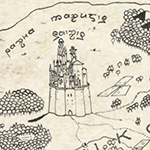
The hallmark of classic Xalgon “Gothic” is dizzying verticals resembling frozen waterfalls of black basalt, within which slender windows open, decorated with delicate, ghostly stained glass of crystal violets and water lilies. Buildings of this classical period are considered one of the pinnacles of world architecture, regardless of their dark background, and they belong to the style in which all seats of the Order of Xalgon Knights are built to this day.
This architecture is also famed for the ruthlessness of its aesthetics, which clearly triumphs over utility—the construction of buildings in this style is an immensely costly affair, and most of the interior space is devoted not to habitable or functional areas, but rather to long, melancholic corridors, endless flights of stairs with many landings, and giant halls drowning in somber gloom. The interior cladding of polished purple marble and granite radiates icy waves of alienation that cut deep beneath the skin. Most rooms are intentionally designed to evoke a bleak or even menacing impression. An important part of the interior furnishing is also gigantic statues depicting scenes of pain, loss, cosmic horror, and infinitely futile heroism.
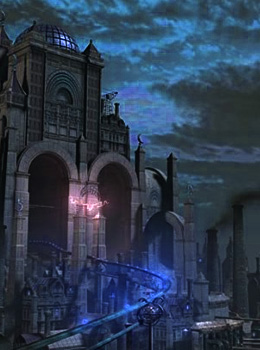
In reaction to this style—which perfectly suits the psychology of demonic lords and Xalgon knights, but less so the simple merchant or perhaps a sprite from the first nether-dimensions—a style emerged in which the city is still being built, though experts distinguish dozens of epochs within it. Its materials are steel, glass, and obsidian; these are bold, sculptural structures that significantly utilize progress in magic and technology. Some buildings of this kind are directly dynamic in nature—that is, they are mobile and periodically rearrange themselves. The crowning work of this kind is the terrifying Horologium.
Inns
The city contains a large number of high-quality coaching inns providing accommodation for wealthy travelers from far-off lands. It is almost difficult to speak of “inns” and “travelers,” for the reality is somewhat different: travelers often reside in Xalgon for years, and an inn (Xalgon: dib’al) generally provides a certain suite to its customer for a period of several months. It is customary to change one’s residence after a time, and the dib’alan (inns) accommodate this custom with the variety of their locations and the diversity of specialization and equipment they provide to their guests. Even many long-term residents eventually prefer staying in a dib’al; many cases are known among the old nobility where a young heir, after the death of their parents, sells the ancestral seat to a wealthy merchant and begins a comfortable and effortless life as an eternal guest.
The Horologium
The Temple of the Devouring God forms the gigantic center of Xalgon and is its highest point and most significant sanctuary. The original Horologium was built over a hundred years ago by Lundir Alaronion, but a few years later, it was heavily damaged during a great battle in the city center. For many years it lay in ruins, but then it was restored to its glory.
Its original terrifying purpose, which depended on a specific constellation of stars and the life force of the builder, could no longer be restored, yet it still serves as a massive source of magical power and the religious center of the city.
Inhabitants
The population of Xalgon is no less diverse than that of Sairis. Every day, entire throngs of visitors come to the City of Darkness from Qurand and elsewhere, and many soon become permanent residents. Nevertheless, we can speak of several groups of traditional inhabitants.
Xalgonians
Most Xalgonians originate from the boundless mingling of races occurring within the city’s borders, yet there is such a thing as a typical Xalgonian: black hair, darker skin, sharp features, and deep-set eyes. Some lineages still maintain their traditions and live in ghettos among those ethnically similar. There are lineages that still preserve the bloodline of the descendants of Vezan, those that preserve their origin from Kaal Charmat, and those that preserve their origin from the Dark Elves.
The Nobility
Unlike the common folk, the nobility takes great care of its blood heritage and rarely resorts to marriage outside defined ancestral orders. The reason is prosaic—the main old houses that still survive are bearers of so-called Traits (Rysy), which are special abilities preserved in the blood of the purebred. The thinner the ancestral blood, the weaker the Trait, and the lower the descendant is in the family hierarchy. There are three ancient houses that can boast a Trait in their blood—the baronial House of Vezan, the ducal House of Xalgon, and the comital House of Falas. Additionally, other noble houses exist which, though ancient, wealthy, and respected, lack a Trait in their blood. In an effort to achieve the same reputation as the three mentioned houses, these families devote much effort to the education and training of their heirs. Rarely, however, can they compete with the power of a Trait.
Demons
For millennia, beings of demonic lineage have also inhabited the city of Xalgon. Houses of demonic nobility occupy ancient palaces in the city, and in the eyes of many, it is they who form the most active segment of the population regarding the inclination toward governance, the development of magic, and urban culture. Wealthy demonic lords, who have their vast estates in distant hellish spheres, often serve as patrons and instigators of the city’s cultural development. Many demons also dedicate themselves to art and literature, constantly bringing something new to the people.
The Undead
In the year 588 of the Siranian Era, a pivotal event occurred: full rights were officially recognized for the undead inhabitants of the city. Discriminated minorities of vampires and undead mages accepted this edict with understandable enthusiasm, and to this day, that spring day—called “Resurrection Day”—is a public holiday. The undead soon integrated into urban life and became valid and productive members of society.
The Order of Xalgon Knights
Xalgon knights serve as the city’s protectors and guardians of order within its walls. Few maintain such authority as they do. The inhabitants are well aware that the city still stands only thanks to them, for the knights of this order have many times stood as the city’s last line of defense, paying with their lives so that the city might remain. They are known for their somber decisiveness, their bravery, and their knowledge of spells and magic. Their main chapter house stands near the city center.