Jan Kozák – (The same text in verse)

The story of the king is the story of a fisherman. He was a nameless foundling, a little floater brought long ago by the river of time in a stork’s nest. Perhaps the Pool herself bore him; wrapped only in the parchment of his own skin, he floated, cradled on the breasts of waves and nourished by their milk. His little boat was a wreath woven from straw and grey feathers, teased by the wind and ruffled by the rapids.
From the lap of his foamy nurse, he was torn by the bony thorn of an old man’s line. The fisherman’s rod, braided from the seven colors of the rainbow, bent into an arc—a bridge over the underworld river. On that day, the man could not call his catch food. “Who are you, my lord, and from whence do you come?” asked the fisherman of him who sat upon the straw throne.
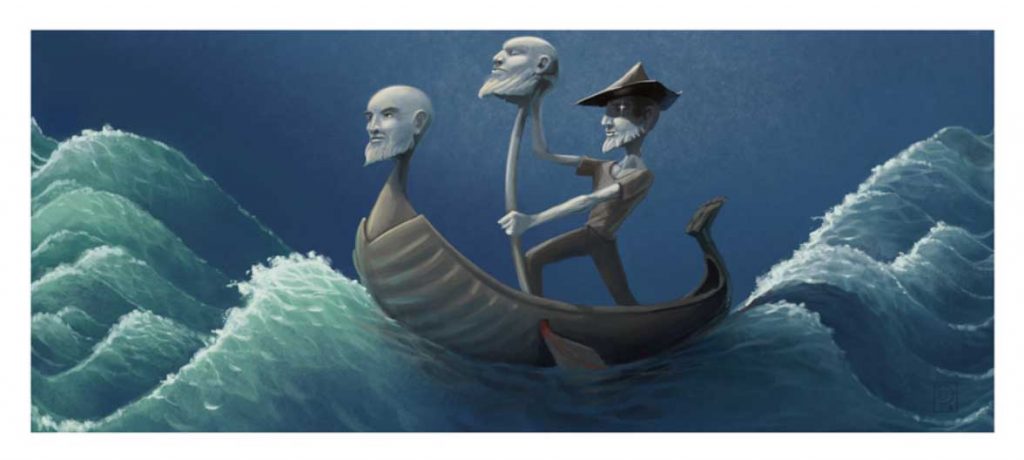
The Caught One grew from the water and took from his rescuer the rod, the line, and the thorn. On the first spring morning, a bumblebee flew out of the old man’s mouth to seek flowers, and with it, his life departed as well. The Son stripped the skin from the old man and stretched it over his boat. Its keel was a spine, and upon the prow, he set a skull. He sailed in the current, fished, and listened to the speech of the river. He was a seducer of fish, an implacable master of nets and sweet promises in which a hook always lurked.
A thousand years passed like the blink of an eye. It was dusk; the river danced like living crystal, the ripples were scales of a quartz serpent. Suddenly, the Son of the River saw a flash in the depths—a golden coin or a hidden treasure. Again and again, he plunged his hand into the icy churning of the current, but the shimmer nimbly escaped as if it were but a ray of the vanished sun, reflected by a nymph’s mirror as bait.
Finally, one hand clapped, closed around the fiery fish, and lifted it from the crown of a seaweed tree. But then the fish opened its mouth and spoke: “Hail, blue-eyed sailor. The vortex of your celestial eye fills me with fear; it is like a mill that grinds the golden branches of Life into the rock salt of Truth.” The man marveled greatly at this speech. “Who are you, my lady, and from whence do you come?” asked the fisherman of her who knows the secret of horned shells and black pearls.
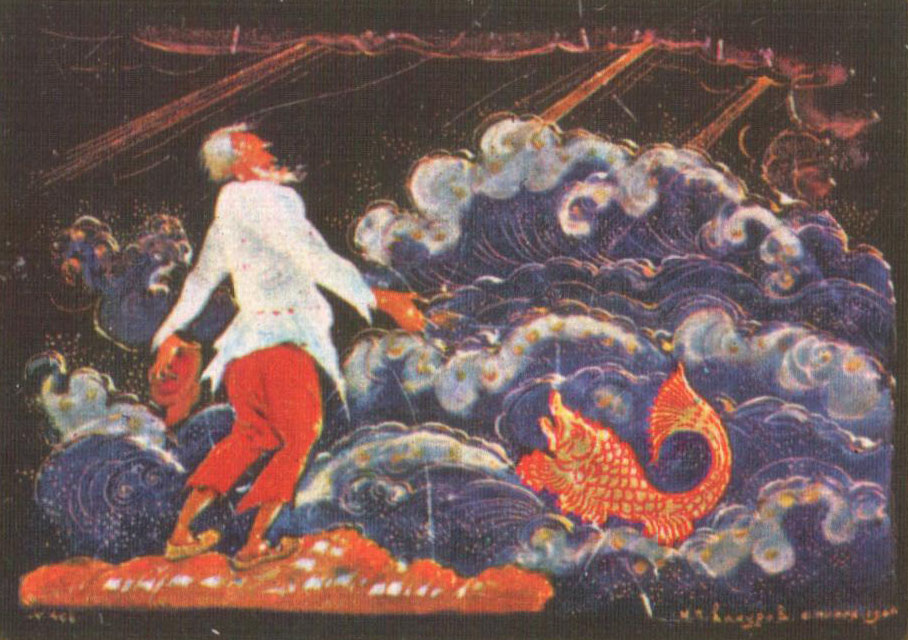
“I am The Living One,” said the fish, “and I come from the Source.” “I am a fisherman,” the man replied, “and my livelihood is fish.” “Spare me,” the fish pleaded, “let me be your Living One and not your Livelihood.” The fisherman, just as his father once had, for once betrayed his name and let the golden-haired fish live. As a witness to this deed, he turned his father’s skull on the boat’s prow crown-side down. He filled it with river water and placed the fish inside as if in a bowl, so that she might show him the way during his voyage.
In the fisherman’s care, the fish thrived and grew until the skull was too small for her. The fisherman fashioned four wheels from the wood of a yearning beech, inscribed them with the words of a song, attached them to the hull of his boat, and made of it a wagon. He filled the wagon with water, placed the fish inside, and—being himself the draft horse—set out on a voyage across the mosaic of roads.
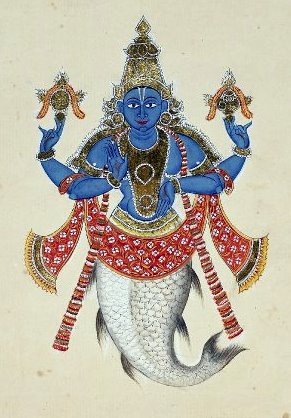
To all, he was a fool; he stirred wonder in people, laughter, and passing scorn. But the man knew no malice and walked his path followed by a ship which, alone of all ships, had water washing its sides not from the outside, but from within.
Much time flowed in the rivers; a hundred times the blue skirt turned in its dance—the iris of the motionless maiden, the northern star—when the fate of humanity reached its fullness and the dam at the mills of God was just about to burst. By then, the fisherman’s golden fish was so large that she filled the entire boat, and not a drop of water remained.
Then she said to him: “My dear, long have you walked the world as a fool, yet the day approaches whose azure radiance will be seen only by the eye of one who, like you, has cast aside the net and accepted my yoke. The mythical deluge shall come—a torrent that will sweep away palaces and temples, reason and diligence, readiness and failure.”
“Will I not then be able to set you free,” the fisherman asked, “and survive the flood myself in my little boat with my pipe and rod?”
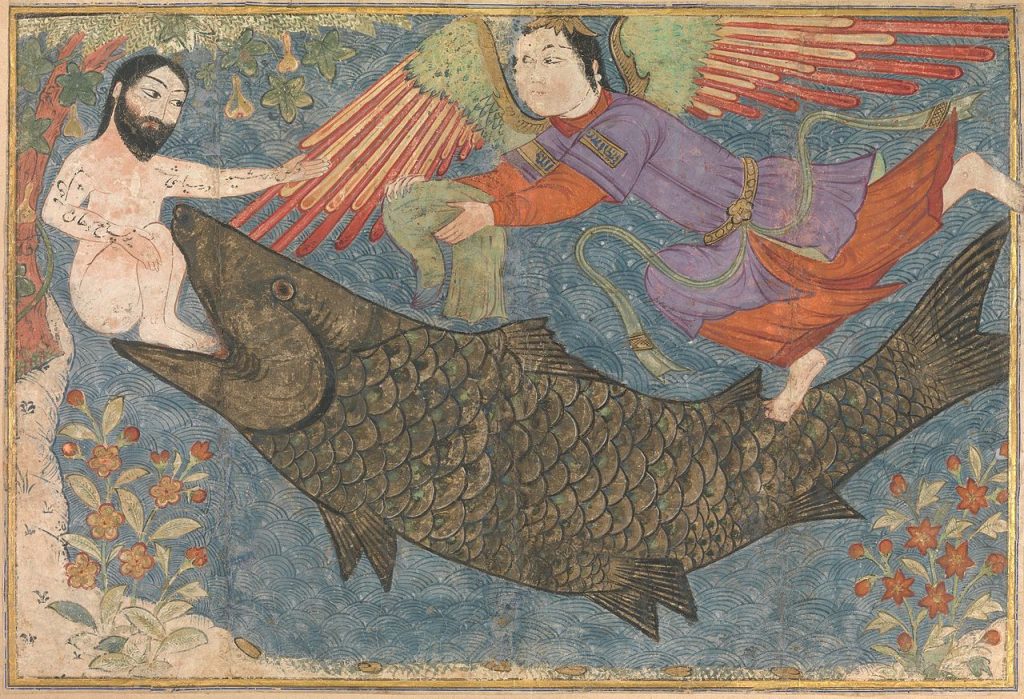
“There is no ship,” said the golden whale, “that could survive this deluge, in which the water will be like a wolf’s maw gape from horizon to horizon. Human ships are like human temples—mere works of hands and diligence that easily succumb to the waters of time. But there is one vessel, the ancient Ark, the guardian of Life, a lighthouse with a golden fire in the heart of the storm. I am the Ark. Enter into me, hide in my womb, for I am the Living One, the pearl-oyster, the motionless pupil, the eye of the storm.”
And so it happened. The fish swallowed the fisherman; he thus took her place, and she took his. Inside the fish, the sailor saw a bed of straw and stork feathers; he lay upon it, drew his knees to his chin, and put his thumb in his mouth. He listened to the song of the fish—quieter than the moment before a lightning strike and so powerful that the noise of the storm seemed but the rustle of wood-sprites at a weir.
Then there was only darkness.
ιχθυς