On the occasion of the relaunch of the Sirania website, I decided to write a reflection on how the world was and is created in the case of Sirania. And how, in my opinion and experience, worldbuilding actually works or should work, and what makes it interesting. Eighteen years have passed since the website was founded, and significantly more since the first Siranian games. Sirania is therefore officially “of age” and can look back at itself with a certain distance.
On various websites dedicated to RPGs and on YouTube, you will find many different guides on how to build a fantasy world. Most of the time, more or less experienced and qualified people tell you how to have a meaningful geography, that rivers shouldn’t run perpendicular through a mountain ridge, and how economics worked in traditional societies. Often, they also have some observations on how magic should function, and usually, they don’t venture very far beyond generally known concepts, whether it’s AD&D or other similar systems.
I would call this level of problem-solving “engineering-level”—a person doesn’t think about why they are actually doing it, what is really happening here, or what governs their choices and preferences, but instead jumps straight to solving technical problems. But I am eminently interested in why I find the creation of a fantasy world so incredibly exciting in the first place, and how one ultimately ends up with the cosmology they do.
Furthermore, it seems like a shame to try and make realistic fantasy maps at all costs. We have the real world for realism. Fantasy should—with intelligence and sensitivity—transcend the boundaries of reality. Go ahead and put a river right across a mountain ridge; we just need to find out what mysterious and ancient event made it possible. Let a river run uphill; that is a wonder that is interesting and demands exploration. It demands a story.
The Birth of Sirania
Personally, I prefer narratives and stories over structured treatises, and I would rather speak from personal experience than about something abstractly general, so allow me to begin by telling you how Sirania actually came to be and what methods of worldbuilding it passed through.
Sirania began with an illness. I was about 13 years old, naturally a passionate reader of sci-fi and fantasy, and I was on a week-long stay in the mountains, where on the very first day, I came down with a high fever. I spent the whole week lying under the covers, but except for the first day, when I truly felt on the brink of death, I surprisingly enjoyed my fever. It caused a strange state of semi-waking, semi-dreaming with incredibly realistic fantasies or hallucinations, where I was suddenly transported into a magical world in which I traveled and undertook many adventures.
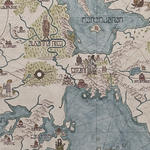
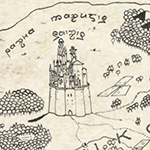
I remember very vividly, above all, a pearlescent white city with high towers in the middle of a vast green plain. I remember walking along the footbridges and streets of that city, and that right there lay the beginning of many stories that I set out upon in my feverish dreams. The city of Sairis, which you can find on the website, is based on the city I experienced there, and so it remains somehow half-real to me. I still have a faint memory of the approximate shape of the landscape that fanned out from the city in various directions, and a strong impression that I wasn’t making the landscape up, but rather discovering it. I was always curious myself about what was hidden behind this or that mountain range, or in the woods, and I was sincerely surprised by what place, character, or story I found there. I also found many friends and enemies in that world, both wise and cruel beings. Stories of immense importance unfolded there. I remember how, daydreaming under the covers, I would sometimes weep bitterly over the necessary and inevitable fate of this or that being or place.
When the fever broke, I was actually immensely sad, because it cut off the quick and easy path to the Otherworld. Later, I developed a different, more arduous path, which consisted of long, solitary walks in nature. On a solitary journey, after about an hour, I was able to induce a meditative state where I could see the stories again and enter that world. Around graduation and the start of university, however, real life swallowed me up (bleh…) and, except for rare occasions, I lost this second path as well. I remember how, around the time of my graduation, my heroes and friends from the Otherworld said goodbye to me; I could see them only from afar, as if through frosted glass, sitting around a fire in the forest near the paths I used to walk with them.
The Siranian Game
When we then started playing games in the world of Sirania (as I named that Otherworld), I always tried to sense, to “discover,” how things were in that world rather than rationally inventing them. This process was never perfect, so the result is, of course, a certain mix of external invention and internal immersion, sensing the “right answer.”
But the game of Sirania proved to be miraculous in that a third path emerged after I lost the first two. Because the game takes place within a circle of people who share it, it elevates the imagined world into a special state akin to reality. Ultimately, the only measure of reality is collective sharedness. If only one person perceives something and others do not, we say that person is hallucinating; if the majority of people perceive something, it is considered reality. Reality, therefore, is synonymous with collectivity. The fact that a fantasy world (through our shared imagination and verbal description) is suddenly in our collective possession makes it suddenly feel almost real.
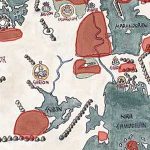
Players are an absolutely essential component of this new form of worldbuilding, because it is they who determine which parts of the world will be uncovered and, in part, what will be found within them. Furthermore, the players of Sirania and the Clans specifically are often experienced Narrators or creators and artists themselves, and they possess a very fine sense for how carefully one must tread when “seeking the truth” in a story. Without them, the world of Sirania would have remained a mere potentiality, an ancient fever and a dream. It was the players who co-birthed the world, often literally, by writing stories and drawing maps. Thus, the third path surpasses the previous two in some ways. For it brings the joy of sharing and collaboration, and is surprising and enriching for everyone involved.
How I Build the World
Essentially through two main avenues. First is the path of epiphany. Suddenly, I am possessed by an image, such as “The Realm of Masks” or “The Eternal Battle,” and I work with it by asking myself: what does such a Realm of Masks look like? (I truly always have it in my mind with capital letters).
In the best-case scenario, answers to this question begin to occur to me—I know that a mask conceals, that it holds a threatening potential, that it is insincere, that it displays a role rather than an internal state… so let’s play these things out literally! Yes, in that land, a mask expresses your role—you are an accountant, you have an accountant’s mask; you are a watchman, you have a watchman’s mask. Then it hits me: we actually have something similar here, just without the masks. In the Realm of Masks, it is possible to play this out ad absurdum, to let that archetype rise in its extreme. And that is what makes worldbuilding interesting. Through it, one gets a feel for how symbols, concepts, and culture actually function, playing with them, exaggerating them, pushing them to the extreme.
And stories present themselves naturally from this: the people behind the masks can change. The fact that someone wears the garb and mask of the queen doesn’t mean it is the same woman every time. Maybe it isn’t even a woman. How does a murder investigation work in such a society? Is it even significant that someone died, if they can be replaced behind the mask? So perhaps the true crime is not murder, but the “loss of face.” The characters enter such a society tasked with tracking down a hidden outlaw. A plot with so many possibilities! And thanks to the omnipresent metaphor of the mask, it makes you think deeply about how things actually work in your own culture.
The second avenue is the path of external inspiration. Instead of an image that just possesses me out of nowhere, it might happen that I notice a certain motif or atmosphere in a book or a movie. Then I start asking myself: why did this strike me? What is the core of this motif’s magical appeal? Usually, I experience a certain motif as incomplete, or not quite fitting me personally, so I look for a way to adjust it to capture the core of my fascination. I roll it over in my mind for so long until a polished archetype drops out—one that I feel was in the background all along. From then on, I work with the motif in the same way as if it had appeared out of nowhere.
Psychological Reflection
With increasing education, I naturally lost spontaneity and creativity, but in return, I gained the capacity for reflection and theoretical understanding. Today, I look at worldbuilding through the prism of depth psychology. The feeling of “discovering” something that is there somewhere beneath the surface of my consciousness, just waiting to be uncovered, I perceive as an exploration of psychological complexes of varying depths. Shallower complexes might merely react compensatorily to something in our world that I dislike and wish were different—it is a kind of compensatory fantasy in the style of “fan fiction” or alternative history:
“What if, for once, the heroes’ antagonist had a completely sensible reason for their actions and didn’t behave like a foolish, cackling maniac?”
“What if the Romans had a powerful priestly class similar to the druids?”
“What if the ancient Celts/Slavs had a hidden city similar to Gondolin or Asimov’s Foundation, in which all their lore was concealed?”
But also questions of a more cosmological nature:
“What if Sauron were actually a positive character?”
“What if the Deluge were the consequence of an ancient rebellion against the Creator, in which the rebels succeeded in killing the Creator and drenching the world in his blood?” and the like.
The last two questions in particular are no longer just simple compensatory fantasies dealing with a purely personal complex or playing with alternative history; they are concepts that strike a deeper layer of complexes usually called archetypes. That is, ancient, shared, mythical structures in consciousness that manifest as specific clusters of images. They always carry something eternal within them. When working with these images, one sometimes experiences strange feelings—shivers down the spine, a sense of wonder, awe, fascination.
But what is this very process of “discovery”? While building the world and during the game itself, it is occasionally necessary to handle mundane, everyday details and events like trade and warfare, which require practical and rational thinking. But then there is the majority of the world, where imagination reigns—and should reign—and there, I do not invent answers; I “discover” them. That is, I ask a question and wait for the answer from within. This process of “inner divination” has much in common with what psychology calls active imagination. This means leaving the imagination in such a state that it begins to find its own way without active conscious interference. It is probably not exactly the same thing, but it is very close.
I would be very interested to know how other worldbuilders create their worlds. Is it similar for you? Completely different? How do you create a world?
© 2019 Jan Kozák