Not everyone who feels like a hero truly is one. A peasant boy may climb trees, fence with a stick, and imagine himself a great knight, but no one but he knows it—and therefore, he is not. The wise patron of arts and sciences, Falath Sinaropis, without whose enlightened selection and attentiveness the world would be poorer by many a thrilling saga, beautiful statue, and scholarly discovery, is also not a Hero, even though he may have influenced history more than some to whom the title belongs.
Who then is a Hero, and what is it that makes a Hero what they are? It is neither age, nor wisdom, nor beauty, nor moral purity, nor any other value we might expect—though many Heroes are virtuous, beautiful, or wise.
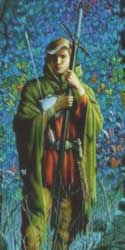
What, then, is the essence of heroism?
It is Glory. But let us not be misled by a word that means something different in our world than it does in the world of Qurand—for here, Glory means something powerful and sacred. Something that does not stand alone but is wedded to other things. For instance, Glory is wedded to Fate. He to whom Glory belongs has also earned a Fate. While the cruel eye of Fate does not rest upon most common folk, a Hero is driven by Fate with unprecedented force. One moment, against all expectations, they are carried to immense heights; the next, they are trampled in the deepest darkness. Fate does not spare the Hero, for it is a constant trial of their heroism.
Another thing related to Glory is that every Glory has its color, and that color originates from one of the gods. Every Hero is thus a champion of one of the gods, with whom—either with the help of or in spite of Fate—they have united in a wondrous bond.
A Hero fights and acquires Glory as a strange force or energy that opens doors, bringing them closer to the gods and, consequently, distancing them from men. Therefore, another companion of Glory is Solitude. To common people, the Hero appears as a mysterious and immensely attractive superhuman; they either love him, hate him, or merely admire him in silence, but they cannot remain indifferent. Unlike the gods, who remain invisible to most, Heroes are visible and real.
In the very core of their being, the common man longs to touch the Hero, to see him, to bask in his presence, to speak with him, to please him, to affirm him. Sometimes the longing is so great or so directed that it crosses its natural boundaries, and a person desires to kill the Hero—to literally tear him apart with love and hatred and devour him, driven by a cannibalistic urge to “acquire” him at least in the form of a “sacred feast.” Women dream of the Hero falling in love with them, and men dream of friendship with the Hero. Yet everyone in his true presence is stripped of words, staring with sacred awe at the living miracle that has brought a piece of the world of legends into their daily lives. For with the Hero comes Legend, and everyone who occurs near a Hero enters the Legend in their own way, even if only as an extra.
One could speak of Heroes for a long time, but words will be but dust and ashes to those who have never met a true Hero. Therefore, we shall conclude our talk with a brief classification of Heroes according to the way they “work.” Heroes, of course, have different natures and different Fates, yet we can divide them by one key—by the degree of Solitude that permeates their path.
The Hero – Lone Wolf
This kind of Hero is accustomed to facing all perils alone. From early youth, these Heroes resist many snares and overcome them. They are knowledgeable in many things, and their dialogue with Fate is a matter that takes place strictly between four eyes (granting Fate two eyes for the sake of the metaphor). They may share a piece of the journey with someone for a short time, but they are unable to endure someone’s equal company for long. They are too used to having their own mind and their own path, forcing the second/third/etc. to adapt or leave. In someone’s company, they feel uneasy and either withdraw completely into themselves or, conversely, dominate and suppress others. Internally, they are most comfortable with their own pace and their own way. Once they are alone, they can be themselves, needing to adapt to no one, and thus they are at their best. On their own, they are phenomenal players of the game of Fate; in a group, they create conflict and never fit in. They achieve the greatest Glory in solitary performance, facing danger alone without having to look back at anyone.
The Hero – Good Companion
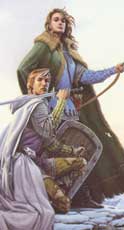
Good companions, or adventurers, are Heroes who are excellent in one single art but lag behind in many others. However, that is not their main characteristic. Their main trait is that, when in a party of other Heroes of similar caliber and, above all, the same Fate, they are capable of forming a harmony of a higher order. This harmony reaps the benefits and strengths of each participating Hero and mutually covers their weaknesses so that they vanish. These Heroes need to be in a good collective, and only within it can they truly give their best. Without a collective, they are like a bee without a swarm—lost and aimlessly, unharmoniously leaning toward the side that is their strength, with no place to balance and aim. These Heroes are not famous alone, but as members of famous companies. Everyone knows by heart the great names that made up that company, but those names cannot stand alone, for they have no meaning that way. They always stand in a canonical list and customary order, resonating with the others.
The Hero – Jack of All Trades
Heroes of this kind can stand alone as well as fit into a party of adventurers. They are versatile sources for Legend and remain an eternal inspiration for songs. Their independent action has a different character than when they are members of a fellowship; thus, they seem to magically transform and appear to be multiple persons at once. People remember all the parties the Hero appeared in and all the places he went and contributed to a heroic deed, marvelling at the scope of his influence and interests. In the end, however, he always departs and is alone in the manner of a wolf. Yet at any time, he can return to the glowing embers of his friends’ companies and reminisce with them about the great deeds performed together. Sometimes he returns to an old company for only one last task, in which ancient and legendary figures unite after years to face the last great challenge and look into the eyes of Fate one last time.