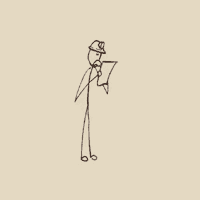
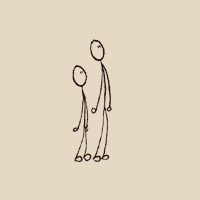
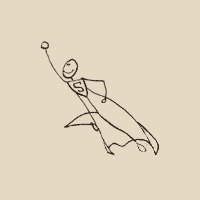
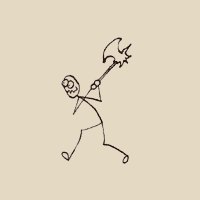
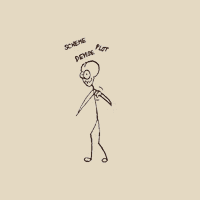
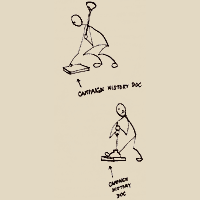
Sometimes it is interesting to look at playing RPGs from a psychological or social perspective. It is nowhere near as bad as it sounds. On the contrary, you can learn a lot about yourself and your fellow players or opponents. A popular way of viewing players is dividing them into specific types. In the following text, you can amuse yourself with the so-called “Stick Figures,” drawn by Chris Avellone (author of “Stick Figure Theatre,” a comic strip based on RPGs) based on Aaron Allston’s (in)famous list of player types. The descriptions for each image are taken from the book Aaron Allston’s Strike Force (I.C.E. / Hero Games, 1988). Those were adopted from the book “The Fantasy Role-Playing Gamer’s Bible,” which I can highly recommend.
The Builder
Such a player wants their character to have an impact on the surrounding world—to establish institutions, clean up a city, change things. If your campaign is completely static (when player characters cannot invent new technologies, cannot make the environment of your world more pleasant to live in, or independently change anything through their own diligence), the Builder simply won’t be satisfied; they must achieve some lasting successes, otherwise they will be frustrated.
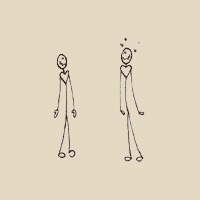
The Buddy
Such a player participates in gaming primarily because their friends are participating. They would probably rather be at the movies or watching football, but when everyone else is playing, they will tag along to support the group. Usually, they are not deeply invested in the game and won’t cry much when it finally ends. The GM has two options for how to deal with such players. First, they can ignore such a player—after all, the Buddy doesn’t really care much about gaming. The situation can take a more interesting direction when the GM draws the player into the game (sometimes against their better judgment). Inside almost every Buddy, there is a different type of player lurking, trying to get to the surface. If you manage to find out what the Buddy enjoys and give it to them, they will likely become more interested in the game and may even become a dedicated and regular player.
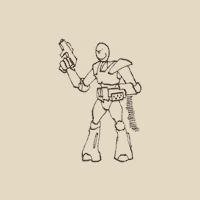
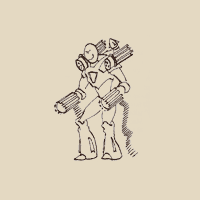
The Combat Monster
Such a player wants their character to fight, fight, fight. This does not mean that the game has to be one big combat encounter, but if there is no battle in each episode, or if the character cannot participate in conflicts, their player won’t be satisfied.
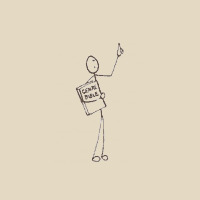
The Genre Fiend
This player’s motto is: “No, do it right!” They are an expert on the genre being played, and if the GM doesn’t know the rules or lacks an opportunity, the Expert will surely point it out. The GMaster’s task in this case is to understand the genre, find out what encounters, situations, and themes the Expert expects to be played, and use them at every suitable opportunity.
The Copier
Such a player likes to play characters in worlds identical to those they know from somewhere—from movies, books, television, or comics. The trouble is that they also expect their hero to be just as amazing and universally respected as the original one. The GM must work very hard to understand the goals the Copier wants to achieve; if it seems to the GM that they are not possible, they must explain this to the player as soon as possible. A subtype of the Copier is a player who creates a single character and plays variations of this character in every game they participate in.
The Mad Slasher
Such a player spends a long, hard week in the office or at school, and when they sit down at the table to play, the only thing they want is to kill. When a villain threatens a hero, the Mad Slasher kills him. If a police officer opens his mouth to the hero, the Slasher kills him. When a villain hides behind the body of a DNPC (Dependent Non-Player Character), the Slasher blasts right into the DNPC to get the villain. The Mad Slasher says: “I deal with nonsense in real life; in the game, I want to do what I want to whoever I want.” The problem, of course, is that the Mad Slasher belongs in a game where everyone is a Mad Slasher. If all your players want to play killer maniacs, you have no problem. If some of them want role-playing, the GM must get rid of the Mad Slashers.
The Mad Thinker
Such a player loves it when they outsmart the villain. Even if the trouble is best solved with a punch to the villain’s nose, the Mad Thinker will still spend time figuring out how to outsmart them. This player has good and bad sides: Best side: They think, hungrily considering every situation, offering interesting solutions to problems that require analytical deduction. Bad sides: The GM has to work very hard to keep up with them (the GM has to think for a large number of non-player characters, whereas the Mad Thinker only thinks for their single character), and the Mad Thinker sometimes slows down the development of the situation while figuring out how to outsmart the villain. As long as there is a logical problem to solve in each episode, the Mad Thinker should be satisfied.
The Plumber
Such a player likes to create a character with a detailed and complex personality, and then spends all their playtime deepening their character. The GM must provide the Plumber with a variety of different situations, including moral dilemmas and emotional performances, to react to; if these are lacking, the Plumber won’t be satisfied.
The Pro From Dover
Such a player creates characters who must be the best at what they do. If the hero is a “brick” (a strong, tough character), they must be the strongest and toughest in the world. If the character is a scientist, they must be a master of their field—having the best chance on a dice roll, and they must also have the greatest fame among the experts in their field. The GM must ensure the Pro has an occasional opportunity to show their importance, and must be careful that no new player character exceeds the Pro’s area of interest.
The Romantic
This player is most interested in the relationships between their character and others. If the Romantic doesn’t pair up with another player character, the GM must provide enough non-player characters for the players to meet, get to know, and develop relationships with—not just romance, but also professional relationships, family relationships, etc. If the Romantic cannot develop any relationships, they won’t be satisfied.
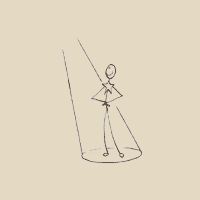
The Showoff
Such a player wants to be on stage under the spotlight at all times. Their character can be brilliantly and inventively created, or completely ordinary and without imagination; the only thing that matters is the amount of attention they receive and the number of faces turned toward them. The GM will have a tough time with the Showoff; they must either let this player be dominant in the game, or ensure that all players get equal time until the Showoff outgrows this phase or leaves the game.
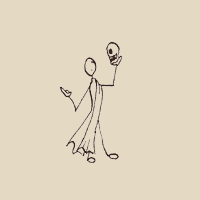
The Tragedian
Such a player likes literary tragedies and wants to play something similar with their character. The GM must be ready to give this player what they want: the Tragedian’s character must be betrayed, must lose all their loved ones, make mistakes that result in disasters, and alienate those they care about. This, of course, shouldn’t happen all at once—the tragedy must be scattered throughout the entire game. Although they are a bit of a masochist, the Tragedian creates interesting characters and backgrounds and is a certain relief valve for the GM’s cruel impulses.