Part I: The Arrival of the Child

Chapter I: The Arrival of the Child
When Súlin and Jezar were investigating the secrets of an old forge at the foot of the Barazgir Mountains, they heard a distant song among the trees. Drawn by the melody of a magical river, they stood upon its bank and saw a basket with a child floating upon the waves.
Jezar waded determinedly through the river rapids toward the basket bobbing on the water. That which was thought impossible had become reality. In that moment, both felt the weight of the occasion. From the union of a White and a Black Siranian, a new scion had emerged for the first time. The newborn of a new race looked upon those who found him with eyes that radiated not only childlike innocence and playfulness but also the wisdom of vanished ages.
His arrival was like a sunrise over an abyss. It could bring the world not only new hope but also a fall into eternal Eclipse. For the powerful rulers who move the pieces on the chessboard of worlds never sleep.
Chapter II: The Hiding Place
To hide the child from the prying eyes of these rulers, his finders sought out a lonely dwelling in the forest wilderness. The child was taken in by the family of a simple charcoal burner, who were moved by the orphan’s fate. Yet, despite all the kindness with which they received the child, the brave and selfless paladin Jezar remained on guard in the deep forest surrounding the homestead.
Súlin set out on a return journey to the white-gleaming city of Sairis to uncover the hidden meaning of the mysterious sign.
Upon his return to Sairis, the air mage summoned all his closest friends to secretly inform them of the miraculous discovery. After weeks of separation, the Travelers met again in a meditation hall within one of the thousand towers of the City of Mages. Standing in the circle among them was the fire mage Ignis, who had accepted Súlin’s invitation to the secret meeting. They listened in silence to Súlin’s narrative, and each felt the resolve to fully fulfill their role in this story. Because the physical trace of the child’s origin was lost, they first turned to the Master of Dreams and Dreaming from the lineage of dark elves—Night Butterfly.
The joint dream-journey of Omerin and the Dream Master was intended to help reveal the child’s fate. The dream led them into the past, to the moment the parents abandoned the unwanted offspring of whom they were afraid. Before his birth, Omerin and Butterfly caught a blurred image of an unknown house and, within it, white-clad figures. Their robes were fastened at the breast with brooches in the shape of a bee. Then they went further, almost to the very edge of the dreaming mind, where they saw a great black shadow obscuring the stars. It moved slowly and menacingly. They had to turn away in terror. When they turned their gaze back, they peered into the future. They saw the life of the child as a parable of a small tree floating on a raft down a river, protected by a company, slowly growing in strength and size. Yet, around the river walked unknown people with axes and saws, waiting for the moment the raft would stop on a shoal or in a bend to prematurely end its life.
With this image, the dream-journey ended, but its dark omen remained.
Chapter III: Adventure in Sairis
Upon arriving in the city, the companions already felt a tension and discord that vainly tried to escape their senses. Súlin headed to the peaks of the Tower of Air, one of the five main towers of Sairis elemental magic, to restore his strength and consult with the mages of his guild. Omerin headed to the library in the royal palace, seeking answers to the images that appeared to her on the dream-journey. She discovered that the bee-shaped brooch is one of the family crests of the Arkagantians from the far southwest. Ignis, still in female form at the time, visited her native Tower of Fire and, after consulting with comrades, sought out one of the local astrologers to request a horoscope for the unknown child and ask about the significance of the disturbing event that was relentlessly approaching—the Solar Eclipse. Súlin’s steps also later led to the astrologers in an effort to learn the same as Ignis. The astrologers’ reports confirmed one thing: during the child’s presumed birth, a conjunction of five significant planets occurred over the place of his birth. The extraordinary alignment of the planets also determined the extraordinary character traits of the newborn. The most prominent among them was strength of spirit, but also a kind of split personality with which he would have to contend in the future.
Chapter IV: The Astrologers’ Ball
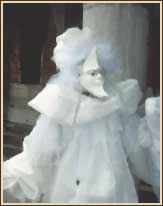
One of the stargazers gave Súlin and Omerin two invitations to a formal ball for members of the astrologers’ guild, dedicated to the theme of the upcoming Eclipse. All participants wore masks representing celestial bodies. The Guild Masters represented the Sun and the Moon, while others had roles proportional to their status. Despite fountains placed on the terrace intended to disrupt magical eavesdropping abilities, Omerin succeeded, through her cultivated mastery over the water element, in penetrating the consciousness of a glass of wine being sipped by the Moon. What she discovered was disturbing: high intelligence, the ability to manipulate, perfect pretense… and a connection to his mind closed by a shadow consuming the stars. These were the main character traits of Master Gamol.ojení s jeho myslí uzavíral stín pohlcující hvězdy. Toto byli hlavní charakterové vlastnosti mistra Gamola.
The peaceful flow of the evening was disrupted by the arrival of a messenger from the far north, carrying a letter specifically for Gamol. Súlin noticed a peculiar symbol on the scroll’s seal—an image of a snow leopard. They discovered it was the symbol of one of the northern shaman clans. Both ring-bearers watched Gamol’s reaction to the letter closely. Although he tried to control his emotions, his hands trembled slightly.
Then came the climax of the evening—a three-stage firework display. A waterfall of bronze and silver rain was followed by the most beautiful one—gold, accompanied by a thundering, deafening explosion. When they recovered from the shock, a man lay on the ground. Mastery of air magic allowed Súlin to be the first to recover from the sonic shock. He managed to hear, a fraction of a second after the explosion, the rustle of wings… The air mage was the first to rush to the aid of the fallen man—it was Gamol. In the emergency, the Sairian guards appeared immediately. There was no help for the fallen man, and the one kneeling over him fell under suspicion. No guest was allowed to leave the ball; all witnesses to the crime were questioned, but the culprit was not revealed.
Once Súlin defended himself against the heaviest suspicion, he established a connection with one of the Architects in Sairis, who tasked him with investigating this murder. Simultaneously, he granted him access to the Sairian information network until the case was closed. After receiving this valuable information, the entire company set out to scout Gamol’s dwelling, which, in hindsight, proved to be a turning point…
Chapter V – Lucie Lukačovičová: Shadows of Things, or Investigation in the House of Master Gamol
Súlin sat in the library, books on northern symbolism spread around him. He was alone in the room; only the morning sun peered inside, and dust motes danced in its rays. Omerin was with Ignis in the Tower of Fire at the time. Someone must have ordered the fireworks, and someone must have made them…
Suddenly, there was a knock. However, the air mage did not fail to notice that the sound did not come from the door, but from the inside of one of the cabinets built into the wall—which, naturally, should have been full of books.
“Enter,” the elf said cautiously, inconspicuously reaching for a weapon in one of the spheres of air magic that surrounded him.
The cabinet opened. On its other side, a spacious, austerely furnished hall could be seen, from which a tall, gray-haired, gray-bearded man with broad shoulders and the build of a warrior, dressed in white, entered the library. Súlin immediately recognized the newcomer. It was Valmos Ar Angiras, one of the eight Architects, the rulers of Sairis. The elf stood and bowed.
“For one who is among the suspects, you are quite persistently pursuing an investigation on your own,” Valmos spoke in his deep voice.
“The Architects know I am not guilty,” Súlin answered quietly.
“Yes. And you are certainly observant and persistent—you have a very good reason for trying to find the killer,” the Architect nodded. The air mage could not tell if Valmos was speaking of Súlin’s effort to clear his name before the Astrologers or if he knew the true reason for the search.
“Therefore, I entrust you with the further investigation of the entire case, along with access to the magical network that permeates all of Sairis. You may examine Gamol’s body and his dwelling. Omerin and Ignis will be at your hand,” the nobleman added.
Súlin could only manage another bow. This was apparently enough for Valmos, and he left the elf to his new duties.
“A spell that could kill Gamol so quickly and thoroughly can be crafted by perhaps five mages in the entire Siranian Empire. Of those, three are present here in Sairis, one of whom has made two such spells to order within the last month. That much I was able to learn from the Sairian network. In any case, a very reliable and immensely expensive means of murder was used here, but it cannot be triggered from a great distance,” Súlin announced as he entered Gamol’s study. Following him was Omerin in the blue robe of water mages, accompanied by Ignis, a tall, strongly built man with red hair and a beard in which flickered flames of living fire. Ignis was not an elf or a Siranian, but of a race of magical beings.
“We were not nearly so successful in the Tower of Fire. An insignificant secretary was in charge of the fireworks order, following the commands of the masters of the Sun and Moon themselves. In any case, I do not think Gamol was murdered by one of the Astrologers, because at the moment of his death, I felt only incomprehension and terror from everyone around. We will still have to verify whose hands—or near whose hands—the fireworks passed during production,” the dryad shared her news.
“We could really use Night Butterfly right now,” Ignis remarked, looking around the dim, windowless room that used to be the study of the deceased.
“There are only three of us left. Take things as they are and don’t make it harder,” Omerin turned away from him, as if intently studying the contents of Gamol’s library.
“Look at that, our dear departed was artistically talented,” the fire mage quickly changed the subject, pointing to several scattered statuettes that looked like they were made of black obsidian. Their shapes were partly abstract, but there was something insect-like about them. They looked like unborn, indistinct nightmares, just before they begin to truly resemble something… The elf looked at them closely:
“Those statuettes are not right at all; they reek of madness. It might not be wise for Omerin to try to read anything from them with her sensitivity. It could harm her…”
“Omerin…? Omerin, are you even listening to Súlin?” Ignis interrupted him emphatically.
“I am still wondering why Valmos entrusted the investigation of the death of our extremely un-mourned Astrologer specifically to us,” the dryad murmured.
“I think he at least suspects why we are determined to get to the bottom of it,” Ignis shrugged. “Not much stays hidden from the Architects…”
“Have you ever wondered why murders occur even in Sairis?” Omerin suddenly asked. “How is it even possible when the entire city, every stone and every wall, is interwoven with the magical threads of the network, through which the Architects always know what is happening where, what spells—including dark magic—are being used here, who is present within the walls, and for what reason?”
“There are fewer murders here than anywhere else, but the clearance rate for crimes that do happen is very low,” Súlin confirmed his assumption by querying the network.
“There are places that have an exception from monitoring,” Omerin continued gloomily. “In the Tower of Water, for example, it is the inner garden; in the Tower of the Moon, there are many more such places, because they deal with dreaming there, and the feeling that a student is being watched complicates study in that direction.”
“Gamol’s apartment certainly had an exception too,” Ignis added.
“With the justification that he is engaged in research into sleep and somnambulist states,” the elf discovered, eyes narrowed at the network records. “In principle, there was no reason to deny his request.”
All three exchanged looks and began to hurriedly sift through the Astrologer’s notes scattered on the table, in the library, and on the shelves. Súlin was the first to come across carefully archived correspondence—with a brown seal in the shape of a feline.
“Gamol was corresponding with some shaman from the far north, from beyond the border mountains. The snow leopard is a popular symbol there, after all,” the elf turned to the others, flipping through the letters. “It seems they both dealt with the same subject of study—a kind of plane of nightmares and unconscious states they called the somnambulist world. The northern border of the Siranian Empire is formed by the Kaal-Charmat mountain massif, and in those places, the wall between our world and the somnambulist one is said to be very thin. Gamol, along with the shaman, whom he addressed only by the northern title haugi, was interested in the permeability of this wall. Especially under the conditions of a solar eclipse…”
“Mr. Astrologer was clearly no innocent by nature. He was obviously very well-versed in dark magic, psionics, and runes—and he kept his knowledge carefully hidden,” Ignis sneered, throwing three academic books supplemented by a volume of highly skilled notes onto the table.
“This will be worse than we expected,” Súlin sighed. It seemed to him as if the entire room had darkened. “We must thoroughly go through everything he was involved in and what sources he had.”
The elf stood before the library, his two companions behind him. He felt their quiet support—the dryad’s emotional strength and Ignis’s martial presence. If I had to be here alone, I would have probably run away by now, he thought. He took a deep breath and began to pull out lists of research materials. He examined them and handed them to Omerin, who always scanned them only cautiously and very lightly with her perception to see if anything had stuck to them that could serve as a trail.
“Damn it… Why do I feel as if those statuettes were just shadows cast by something not yet visible…?” Ignis said suddenly. Súlin paused and looked back. Moreover, their shapes have changed, he realized. He immediately connected to the network. An urgent message and a request for the presence of Valmos Ar Angiras… It was an insolence to disturb an Architect from his meditations, but the elf was certain that this time there was no avoiding it.
“We must finish what we started. As soon as possible,” he decided. He stopped browsing the library systematically and looked around. His attention was caught by one very thumbed and frequently used book. When he leaned toward it, he noticed the title on its spine: Inversion.
Pensivly, he pulled it from the library and began to read. It was written in a neat hand. The complex, scientifically initiated notes on magic that was foreign to him confused him. Night Butterfly would probably understand this most easily, he thought, but he did not say it aloud.
A metallic click—the lock of the entrance door snapped shut on its own. And the contact with the Sairian network was lost.
“Look…” Omerin whispered tensely. Some smaller objects transformed into indistinct hints of monstrosities similar to the statuettes. The entire study was slowly sinking into shadow. And from the next room, slow footsteps were heard. They were approaching. Ignis pressed his hands against the lock; he began to purposefully radiate heat into the metal. Omerin stood nearby, ready to burst through the door as soon as the latch softened from the heat. Súlin strained his hearing. He was beginning to suspect, by the manner of walking, who was coming.
Soon, a figure with a pale face, shrouded in a black robe that blended with the darkness at the floor, appeared in the entrance to the room.
“I am the master of this house,” spoke Gamol Melisai Vinari. “Who are you and what brings you here?”
“We were supposed to investigate your murder,” Súlin retorted politely. He was playing for time. “Therefore, we are somewhat surprised to meet you here.”
Ignis and the dryad leaned their backs against the door; the latch gave way. Outside, there was no trace of Sairis. Only a long corridor full of cobwebs and black shadows.
“You will be surprised for a long time yet…” Gamol said. The elf wasn’t sure if it was an ironic question or a threat. A moment of frozen silence hung in the air.
Then the Astrologer slowly turned to Omerin: “You have already met Him. And perhaps you could even understand Him.”
Not a muscle moved in the dryad’s face, but her mind recoiled with anger at the memory of why she had left Night Butterfly.
“I do not like this resistance,” Gamol declared. “Soon, this world will no longer be limited to a mere demonstration in the place of my dwelling…” The shadows around him moved. From the blackness outside the room, the shapes of strange beings began to emerge. Omerin realized that their outlines were slowly transforming—because their form was being imprinted by the fear of the one looking at them. Mixed parts of human, predatory, and insect bodies, fragments of monstrosities that had never seen the sun…
At that moment, a fire-arrow flew through the air and hit Gamol in the face. The white expanse of his skin caught fire and began to collapse inward, as if it were only a paper mask. Ignis lowered his bow and turned toward the corridor, where two shadow monsters were stirring into motion.
The dryad looked around. Her sharpened senses examined the essence of the surroundings so she could cut through this nightmare with the blade of clear consciousness.
“This is not a dream!” she cried out. “Our bodies are present here too; we cannot wake up!”
Ignis summoned flaming armor for himself; the fire-bow in his hand turned into a sword. Súlin rushed to the second door, his gray cloak fluttering in the wind, although the air was motionless. From the air spheres, he began to call forth a weapon.
The first creature crossed the threshold and slashed its claws at the mage. Its talons sank into the shield of will with which he had surrounded himself. That thing would be only a weak pale shadow in our world. Here it is much more powerful, the wizard realized as the blow landed. The attack did not break through; the two struggling forces creaked silently. And behind the enemy’s back, the elf saw another monstrosity and a giant shadow similar to a snake’s head. He understood:
“We must get out—there are infinitely many of them!”
“We can hold them off for a moment! We need light! Hornets—to me!” the dryad shouted. From her sphere, a swarm of glowing blue sparks materialized and threw itself at the second creature, which was trying to squeeze through the door past the first. In their light, the shadow monster shimmered and shifted, the flashes of their attacks dancing on its surface.
Súlin slashed with an air-sword. Simultaneously, both the elf and dryad struck their opponents with intangible fists of will. The blade bounced off the creature without harming it—likewise the mental attacks.
“Vines!” Omerin called out when she saw the shadow in the doorway reaching for Súlin again. The entrance immediately began to grow over with blue-glowing plants, which simultaneously wrapped around the opponent to make him part of the emerging luminous wall.
All the brilliance that the dryad’s creations were able to emit, however, seemed only to draw light to themselves from the surroundings—which only grew even darker.
One of the monsters attacking from the corridor lashed a thorny arm at the fire mage. It hit him on the forearm, where his flaming armor did not protect him. Ignis staggered under the force of the blow. He felt that the attack was aimed not only at his body but at the very essence of his being, like black ice-water hissing in the furnace of his soul. Soon, he gave a loud cry. But it was not a cry of pain—the entire room filled at that moment with blinding light. The flash took everyone’s sight.
When they could look around after a moment, only their shadows remained of the monsters—motionless, two-dimensional black outlines imprinted by light on the surrounding walls. Súlin felt the familiar touch of the magical threads permeating Sairis. The obsidian statuettes were back to their original number, and the open book of Inversion lay on the table… empty.
The entrance door stood wide open; Valmos stood on the threshold, examining the melted lock with interest. Soon the broad-shouldered man entered, the afternoon sunlight falling from outside glinting on his wide belt and two swords. He watched in silence as Ignis and Súlin let their weapons vanish, and likewise as the vines and hornets returned to the dryad’s water spheres.
“I caught your message and also the network outage. It seems the investigation has gotten somewhat out of hand for you,” he said after a moment, eyes fixed on the shadows frozen on the walls.
“The deceased Gamol Melisai Vinari,” Súlin began, once he found his voice, “was studying a special plane of existence he called the somnambulist one. It is inhabited by unconscious fears, apparitions, and nightmares. In this matter, he maintained an active correspondence with a northern haugi, as the northern border mountains are exceptionally interesting for research—they have a thin dividing wall. This house, it seems, is also a gateway to the somnambulist world, which the deceased used extensively. We apparently unintentionally triggered some transition spell because we ended up there too. We met Gamol, who promised that his shadow world would soon burst into ours. He set apparitions upon us, and Ignis saved us—bright light does not suit them at all.”
“Perhaps Gamol did not die at all—he just left for the somnambulist world,” the dryad whispered.
“I would not overstate the somnambulist plane. An imprint remains of every person, but only in the case of those who reached a certain level of emotion does that imprint manifest as a poltergeist, for example. Nothing more of the deceased Astrologer remains here,” Valmos calmed her.
“I think Gamol Melisai reached that critical level of emotion the moment he met the shadow obscuring the stars. Omerin saw it in a vision,” Súlin decided to come out with the whole truth. Now he could be all too sure it was no false alarm.
“It was something very old, terrifying, tempting, and promising. It had no shape of its own, only a pitch-black shadow. I fled from it,” the dryad confirmed.
“A kind of demon?” the Architect inquired.
“I think it promised something that even most demons would not dare to come forth with. And I fear it almost touched even the lunar mage named Night Butterfly, of the dark elf lineage,” she added. Only a barely perceptible tremor of her lips revealed to Súlin how difficult it was for Omerin to utter that report—but he was glad she had done it.
“Did you find anything else?” Valmos asked.
“The book of Inversion, Gamol’s personal notes,” the air mage pointed, “but now it appears blank. It can only be read… there.”
The Architect closed the volume, whispered a few words, and when he opened it, the script again covered the pages.
“Do not touch it. It is in a somnambulist state now,” Valmos warned and briefly flipped through the pages full of neat handwriting. Soon he straightened up:
“You will surely not hold it against me if I now personally take over the investigation of this case. However, I must also ask you not to be present in the city during the eclipse. Moreover, martial law will likely be in effect here. I am sorry that Sairis cannot be a support to you at this hour.”
Ignis, Omerin, and Súlin bowed in silence.
“In connection with this, I also revoke Súlin’s access to the Sairian network. If the enemy were to capture you, the City of Mages would be in danger,” the Architect continued.
“It is also for my safety; I become less interesting to the opponent because of it,” the air wizard nodded.
“Very well then. May the Light be with you,” Valmos signaled to them, took the book on Inversion from the table, and walked out into the sunlight.
The three mages stood silently for a long time before they finally looked at each other.
“So that’s how it ended?” Ignis asked, though it was hard to tell from his voice if he was relieved or disappointed.
“Hardly,” Omerin shook her head. She pulled out a scrap of parchment on which was skillfully drawn a bee-shaped brooch. “This is the emblem of the Melisai family, one of the lineages of the city of Arkagant, far to the south. And we have only six days for the journey.”
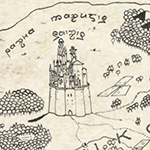
Súlin stopped his horse and looked back. In the distance, the eternal towers of Sairis were still visible, rising toward a sky full of heavy gray clouds from which a fine rain fell. The City of Mages was almost as vast in height as in width. The air wizard could distinguish the highest Tower of Light—the seat of the Architects—and to the south of it, the Five Towers belonging to the schools of the five elements.
Omerin stood beside the elf. Both rode without bridle and without saddle. Ignis accompanied them in the form of a blood-red lion, in whose eyes and mane unquenchable flames played.
None of them suspected that in an underground hall, deep beneath the Moon Tower, Night Butterfly was dreaming. He lay with white hands folded on his chest, the sleeves of his black robe contrasting with bloodless wrists, until it seemed that, aside from palms and face, the lunar mage was composed only of darkness. He listened to the whisper of the rain and the thickening clouds, although no sound from outside penetrated the cellar. The dark elf slept and wandered through shadow landscapes in pursuit of his goals. Though his body remained in Sairis, he planned to be at least a step ahead in mind—whoever he was facing. But the ringing echo of two drops falling onto the water’s surface kept returning to his dreams.
Súlin lightly urged his stallion.
“The Architects know of the threat, but even so, the hour of the eclipse will be exceedingly dark for Sairis,” he remarked into the silence. The dryad’s green eyes radiated determination, but beneath it huddled sadness:
“You know as well as I do what Valmos hopes for.”
Súlin nodded slowly: “Valmos Ar Angiras hopes that the shadow whose attention we caught will not be in Sairis at the moment of the eclipse—because it will follow us.”
—with thanks to Sulinar, V. K., and J. K.
Chapter VI: Return to the Woods
In Sairis, the company peered into the fate prepared for the child-boy by the stars and became acquainted with the various opinions of astrologers regarding the solar eclipse. Without anyone predicting it, they also became part of the story of the mage Gamol. Besides gloomy things, one welcome thing occurred.
The High Architect wisely judged that in the group of those carrying the child, there was no one who understood the magic of the fifth element and the game of space. By his command, the sorceress Arsia was chosen—initiated into this art, a member of a monastic order, proficient in fighting with a long staff—to join the expedition. She was received very cautiously among the adventurers. However, only in the coming days were they to appreciate the importance of her art.
There were six days left until the arrival of the great Darkness. By then, it was no longer possible to delay the return to the woods for the child, whom the brave Jezar was still secretly guarding. So that the journey would not take long, they decided to use the services of an ancient traveler order. One of the travelers led the company to a Sairian milestone. At the head of the company, he began to walk around it in circles, reciting the runes on the milestone. The landscape that emerged from behind the pillar before the group transformed its face several times. The travelers covered the distance one hundred and eight times faster than in reality. It did not take long before they stood at another milestone many miles southeast of the City of Mages. From there, they set out by a detour to their goal—the lonely dwelling of the charcoal burner’s family in the forest at the foot of the Barazgir Mountains.
The suspicion that they would be followed was fulfilled, though not as dangerously as most of the company imagined. Ignis stayed behind the company to hide at the edge of the forest and watch the road. Meanwhile, Súlin and the others walked a few “deer-runs.” However, he heard a local group of roaming bandits many steps before they approached to a dangerous distance. It was not hard to avoid them. The only thing that became inspiration for many subsequent local folk tales was the run of a fire lion, whom the bandits saw with amazement as it raced through the forest. That was when Ignis changed form to catch up with his comrades more quickly.
After a shorter journey through the woods and the village, they stood before the lonely house, gripped by trees on a small forest clearing. Their hearts stopped for a moment when they discovered it was abandoned. When they carefully searched the surroundings and found tracks leading to the cellar, they entered the building together to search it. The interior of the house looked as if it had been hurriedly abandoned. However, there were no observable traces of violence, but neither were there any that would lead them to the lost child. They wanted to enter the cellar, but Arsia, after inspection, warned them that the cellar had collapsed into the Inversion world. They would have almost lost all hope had Omerin not thought to connect to the consciousness of the forest. The forest showed them the way across a marsh to a hill with an oak grove standing near an ancient mill. There, the trail was lost. To find out more, the dryad had to connect with one of the mature oaks standing on the hill. It was a joking tree that dropped acorns instead of answers as a romantic invitation. Omerin had no choice but to connect with a grumpy old oak, from which she finally extracted that the tracks of a person in a hurry led to the mill. “He was supposedly in such a hurry that he jumped across the whole marsh in one leap,” Omerin turned to the others with a nervous smile.
Chapter VII: Enchanters of the Rib of the Earth
It was already deep into the night when Arsia finished her scouting of the stone mill.
“This is no ordinary mill. That which pretends to be a mill is in fact a well-locked magical milestone. A crossroads of worlds.”
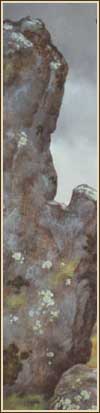
It was the work of ancient hands. There was no time to open it, and the adventurers were losing strength after a full day’s march without rest. Arsia and Ignis had already sunk into a drowsy meditation when Súlin heard a quiet song about two miles away. When he focused with his perfect hearing, he distinguished the voices of two people. Their melody wove the mesh of a path. Everything indicated that these were people possessing the rare abilities of Travelers. Omerin and Súlin set out in the direction the two were roughly heading. And indeed, after a certain time, the singers stopped and came to rest in one place. To get within sight quietly, the air mage and dryad used their cultivated abilities. Súlin levitated among the branches, and the dryad moved as quietly as the beings of the forest can when they wish. Through the branches, they slowly approached the light of a small lantern. There, in the low forest undergrowth, two white-clad people sat facing a stone. The stone had an elongated, slightly curved shape and jutted vertically from the ground. Gradually, in harmony with the rhythm of the quiet song, runes lit up on the stone. The stone resonated with the melody. It was the awakening Rib of the Earth.
“Look,” Súlin whispered, “the shadow of that stone is growing with the song.”
He and Omerin exchanged concerned looks.
When the people finished singing, they rose and went in the same direction they had come. Only now did the observers notice that their hair had a bronze-rusty hue. On the breast of one of them hung a bee-shaped brooch.
By the time the observers determined the approximate direction of their path, they were at the end of their strength. The remarkable pair vanished into the darkness.
They returned to the mill to spend the deep night together.
Chapter VIII: The Ruins of Arkagant
At early dawn, the company set out under Arsia’s leadership to investigate the Rib of the Earth. Along the way, Súlin and Omerin told them what they had seen that night. When they arrived at the spot, the sorceress carefully examined the stone and the entire area. Then she spoke:
“This place is one of the braids of a vast etheric net. The net is woven so that the affected area of land passes into another plane of the world during the Eclipse.”
“Indeed,” Ignis added, “the disruption of the orderly boundaries of this world and their collapse into chaos is characteristic of an Eclipse. These people knew well what they were doing.”
“This event should not remain hidden only among us,” the air wizard turned to the north and formulated an aerial message to inform the head Sairian architect Valmont of the things they had uncovered here.
“I think the purpose of their work was not, so to speak, crystal clear,” Ignis noted grimly, standing near the stone.
Arsia fixed her gaze on the stone surface; it seemed as if she were reading something on it. After a moment, however, she turned away. “I do not have enough time, nor the ability, to return the disrupted structure of the place to its original state.”
Although it was morning, there was no one among them who did not realize that the great Darkness was relentlessly approaching with every passing minute. That which they had lost still eluded them. They had no choice but to continue following the fresh tracks that headed northwest. Midday had already passed when the trees began to thin, and in their place grew hawthorn, rosehip, and raspberry bushes overgrown around strange stone ruins.
Omerin stopped to enter into a quiet conversation with several old trees growing on the edge of the stone ruins. The trees told her of the myths they knew from the stories of their great-grandfathers, but not even they remembered who lived here, because the civilization that lived here went out long before.
“These trees are too young to tell me more about the fates of the people who inhabited this area,” the dryad said. “We must explore it here without their help.”
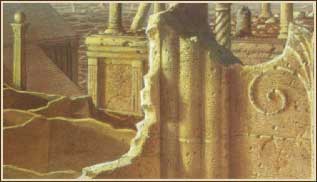
As they headed into the metaphorical heart of the ancient village, the ground beneath them began to rise into a low hill. On its slopes stood dilapidated stone buildings, on whose gables house-signs were still partially legible in places. On one of them, they saw a half-decayed symbol of a golden ear of grain; on the next, the symbol of a hammer and anvil.
No one needed another hint. They all realized they stood before a sprout of the Arkagantian civilization.
Chapter IX: Shadow of the Flame
In the middle of the elevation stood the half-fallen colonnade of a stone temple. They entered inside. Within the temple, a massive circular pit yawned in the floor. When they stopped, they saw the Shadow of the Flame. It played with delicate orange colors and danced lightly on the floor around the pit like a playful boy. He was so absorbed in his game that he probably didn’t notice at all that his parent had died long ago. Ignis smiled. He approached the edge of the pit curiously and looked at the bottom. It seemed very deep, and at its bottom, something glinted like a mirror. He was just about to fall into a strange dizziness when Omerin approached him and pulled him back by the shoulder. “Th… thanks,” Ignis murmured. “Don’t mention it. You should be more careful in places like this,” the dryad replied. “What threw you off balance?”
“Deep at the bottom of the pit is something that resembles a large mirror. It’s frightening,” Ignis spoke from a constricted throat.
“Forget about that for now; our goal recedes further and further with every delay.”
Chapter X: The Shadow of the Child and the Passage to Another World
Then Omerin immersed herself in the melody of the sacred precinct and gazed into the shadows that formed outside the temple. Some of them began to come to life and took on shapes. Suddenly she saw a strange shadow that looked like the upright figure of a person carrying something in their arms. Omerin walked out of the temple after the shadow, straining her sight in an effort to distinguish as much of the shadow as possible.
The others saw her now, almost like a sleepwalker descending the temple steps into the ruins of the lower city.
The others set off nimbly after her, but none of them saw the shadow. Omerin was so immersed in her slowly emerging vision that if she spoke, she might have jeopardized its birth. Therefore, she only continued silently on her way. Finally, she was certain: “The shadow I am following is the shadow of a person carrying a child in their arms.”
Suddenly, the shadow began to slowly disappear; it seemed it had stepped onto a path to another world. The dryad stopped and offered her hand to her companions so they could catch hold of it. And they, holding hands, followed her. They walked through the shadow path and, beyond the border of the Grand, entered another reality. It was a world different from the Grand. It was much younger, unclouded by as many events, battles, and upheavals as the Grand. Its music, which permeated the space and rang in their ears, was cheerful and morning-like. The scents that floated in the air were sweet, even intoxicating. It was easy to fall under their power. They all knew for certain: we are now very far from home and do not know the way back.
They stood in one of the rooms of a simple hut. Outside, the sun was scorching, and they heard the voices of children playing, coming through the window and half-open door. They listened to their speech, but it was not understandable. Before the dryad could hold the mage back, Súlin curiously stepped toward the door and looked out from behind it onto the street. There was a cluster of five laughing children, about six years old, playing with a ball. They had pitch-black hair and were wearing white outfits made of a single piece of cloth. As he watched them for a while, he saw an adult walk by, dressed the same as the children, but with sandals on their feet. Súlin returned to his comrades and quietly described what he saw.
When suddenly… hop…, pink…, hop… kutululu… a colored ball rolled into the room. Súlin leaned down for it to hand it to the child who ran after it, breathless. He stopped in the doorway and fixed his inquisitive little eyes on him. Then he smiled and reached out his little hands. Súlin hesitated for a moment and then passed the ball. The little boy ran back to his friends.
“So the introductory lesson in the local language is postponed until later,” Night Butterfly noted quietly.
“We should search the house before we reveal ourselves to all the local natives,” Súlin said decisively.