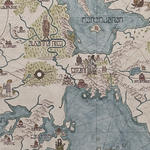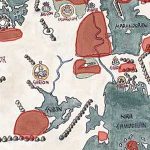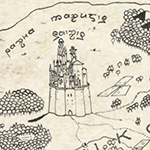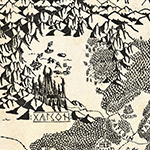
Part IV: Pillar of the South

Chapter XXV: The Inn at the Three Foxes
Anskar stepped decisively up three skillfully carved wooden steps and passed through the door, which was framed by wide beams supporting the building’s roof. The half-elf followed him first, but she hesitated on the last step, placed her hand on the door beam, and fixed her gaze on the threshold.
“There is another spatial fracture here,” she warned her friends and entered the house cautiously.
They entered a cozily warmed vestibule where a light smoke screen from several types of tobacco floated. The narrow hallway led into a vast hall, which was clearly the center of the entire tavern. From there, a noisy conversation poured out, along with multi-voiced singing accompanied by the clatter of cups and the thumping of dancing feet.
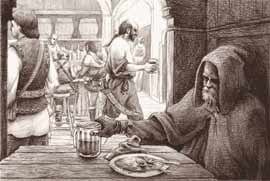
They entered the spacious hall, from which other staircases branched off to the sides leading up to numerous doors and higher floors. The ceiling of the hall, vanishing in tobacco smoke, was supported by old carved pillars. In various corners sat a wide variety of guests from distant lands—some known only from stories—at tables hardened to marble-like strength by the spilling of many barrels of beer and meaty stews, which not even a proper pub brawl could break.
The floor shook with the rhythm pounded out by the feet of drunken dancers, and the noise of the dance drowned out the singing of a bard and his companions who had come from heaven knows where. They were also struck by the fact that most of the diners were not Arkins. Behind the bar in the corner, where three decorative oil lamps hung, a slender innkeeper with a ginger head smiled at the newcomers.
“I would never have thought that such an ordinary pub could be so vast inside and accommodate such a number of travelers,” the air wizard shook his head in disbelief, standing in the middle of the entrance room, listening to the hundreds of conversations his masterfully trained ears were able to catch.
“Good afternoon, we are looking for lodging for five adults, one child, and one lion,” Súlin approached the innkeeper, who could not suppress a curious smile as everyone gathered before his eyes.
The red-haired innkeeper changed his expression in the blink of an eye and replied gravely: “There are free beds in two rooms of three.”
Súlin nodded and placed a large silver coin with a small hole in the middle on the table. The innkeeper hurriedly snatched the coin and returned three “threes” of fox gold and two worn brass keys to the wooden board.
“Now, Waymaker, we would ask you to wait for us here in the inn so that we can discuss our further plans,” the air mage turned to Anskar with a request. The young warrior, with a slight bow, withdrew into the interior of the building to listen to the music of elven harpists in a secluded room.
Meanwhile, the others climbed two spiral staircases worn down by the boots of countless lodgers of this strange inn. Through heavy oak doors, they entered one of the two modestly furnished rooms. Once convinced they were safe from the eager ears of the enemy, they cast off their dusty cloaks and gathered around the child.
The boy turned to them without preamble, his voice taking on a clairvoyant tone: “The air in the city is foul. In the center of this urban breeding ground blazes a fire that accelerates time… There is no protected place in the world. Someone plotting against me is already here.” He paused for a moment and then added simply: “You all know where we must go. In Arkagant, it is always possible to choose from two paths. One is manifest, the other hidden. The first is by the street, the second by the tunnel.”
“Did you yourself see the temple fire on the Arkian peak?” Ignis asked directly.
“As the Arch—” the child stopped mid-sentence and glanced awkwardly at the company.
A spark glinted in Súlin’s eye, and he stored the child’s involuntary slip-of-the-tongue deep in his memory, for he subconsciously suspected it was related to the name that interested him so much: Suvarna.
“I see that we likely cannot do without the help of prominent members of the local lineages. Do you happen to know of anyone we could turn to with our mission?” the air mage broke the awkward silence, turning to the boy.
“I know an old man who was once a very close friend of mine,” the child hesitated slightly and then continued, “his name was Olmar and he came from the Melissai lineage. I think he is exactly the person you are looking for, Súlin, but to even get beyond the borders of Darika, we will need the favor of the local inhabitants. As strangers, we cannot move here alone.”
“In that case, I propose that the Waymaker’s son continue to act as our guide here in the city. After all, he is also an Arkin, as he confided in us, and what’s more—I like him,” the fire mage added with a firm voice.
“On the other hand, Ignis, one can never be too cautious,” Omerin interrupted his enthusiasm, “we should not reveal the shades of our plans to everyone we meet.”
“If we trust no one, no one will trust us. In this city, we won’t get across a stranger’s threshold without an invitation,” the child replied, adding with a great deal of uncompromisingness: “And besides—his father was my faithful friend on the road.”
“I think that sounds more convincing,” the dryad noted, “so we shouldn’t keep the roadman waiting long.”
Chapter XXVI: Meeting at Mornil’s House
Before the evening shadows began to fall over the city, Anskar arrived at the sturdy gates with wide frames, so typical of the urban houses here. The Waymaker firmly gripped the ring of a wrought-iron knocker with a sun emblem. Shortly after the gate echoed with a metallic sound, a narrow window slid open in its upper part. The distrustful look of dark eyes in the window cleared.
The gate suddenly swung wide open, and behind it stood an older, noble woman; a deep blue tunic flowed from her shoulders, concealing light wrought armor in its folds, with a short decorative saber hanging at her waist. She measured the newcomer with a piercing gaze.
“Since when do city women wear armor under their house clothes? Why is Rúnen so restless?” Anskar, known in this city by the name Anskar, asked himself. He did not wait for an explanation and embraced the woman who had raised him after many years.
“What are you doing here, Askir?” Rúnen breathed in surprise. “I would expect death sooner than you.”
“You are not far from the truth, Rúnen,” the young Waymaker whispered as they crossed the threshold of her house together. Once the woman carefully locked the gate, Anskar said: “My father is dead.”
Rúnen stopped in surprise and, with a sympathetic look, squeezed Anskar’s shoulder. “He died in the silence of his room, a peaceful death. I buried him as is fitting: body to the fire, soul to the ancestors,” the warrior with exuberant curls added with certainty in his voice.
“Arka is not safe,” the woman caught his gaze, “children do not leave the houses. Unpleasant changes are happening in the leadership of the lineages; the Melissai are mainly affected,” she added in a sudden agitation. She led Anskar into an inner courtyard with a stone fountain in the center.
“I have learned that in the city’s underground, this lineage indulges in forbidden rituals. The violators of the Order break the ancient law and cross the thresholds of our houses without permission,” Rúnen initiated Anskar into the recent events in the city.
The door of the house suddenly opened with a quiet creak, and a large shadow appeared on the threshold in the night darkness. Rúnen drew her sword without hesitation. The young warrior quickly vanished from the newcomer’s sight and hid behind a curtain, ready for a quick intervention. In the faint light of the lamp, he could distinguish the stout silhouette of a man.
“Rúnen?!” the man called out in a deep voice veiled with concern.
“Oh, Mornil, is it you?!” the rich alto of the beloved woman reached the newcomer. Anskar exhaled in relief and stepped out from behind the curtain. “I am very glad to see you, Mornil,” he greeted the master of the house.
Mornil and Rúnen embraced. “What brings you here at this restless time, son?”
“My blood father died with yesterday’s sunset.”
Mornil silently took the warrior by the hand and moved with him to the inner courtyard. In its center, he stopped, whispering the words of a ritual prayer, sprinkling the hall in the eight cardinal directions.
“Turvilon has set out on the last of his expeditions,” the warrior said. “Simultaneously with his passing, a very strange company came to the threshold of my house—five travelers and a lioness carrying a child. They are led by a mage named Súlin.”
“That is a sign, Askir.”
“They demand an audience with a noble man of the Melissai lineage; his name is Olmar. I will need your advice on how to introduce a group of strangers to a high-ranking Arkin,” Anskar continued.
“Strangers? Two years ago, Súlin—this famous archmage—prevented massive floods in the Siranian Empire. It amazes me that you haven’t heard of him yet,” Mornil replied with a raised eyebrow.
“I have heard of the deeds of Súlin and his company many times, but what of it is reality and what is legend has remained hidden from me,” the young warrior added.

“But let us return to the current situation in the city,” the master of the house continued. “Two powers rule our city at this time. One is the supporters of the old order and established ways; the other is demonic. The entire Melissai family falls into that. But not without exception, for the sides do not correspond directly to the lineages, though it appears so at first glance. It is Olmar who is living proof of that. He did not submit to the decay of his lineage; he lost his mind and went into seclusion. In recent weeks, he can be seen sitting on the high cliffs of the Rock of Vision, his gaze fixed on the abyss, over which he carelessly dangles his legs. He speaks prophetic words that perhaps only he himself understands.”
“I have heard of it, but I have never been there. What kind of place is it?” Anskar asked.
“It is a sharp rock that is part of the Arkian peak. In that place, things show themselves to people as they truly are. However, it is accessible only to those who are announced. The Rock of Vision is guarded by a strange old man whom no one remembers as young. His name is Eifrun Vinori.”
“Thank you for the valuable advice, Mornil,” the young roadman interrupted. “Time is short, and I must now return to my friends staying in the Darikan inn, The Three Foxes.”
“Askir, surely you wouldn’t let such honored guests stay with strangers?!” Mornil raised his voice. “Give Master Súlin and his company my warmest invitation to lodge in my house.”
Then Anskar’s adoptive father suddenly lowered his voice: “And one last thing, Askir,” he stepped closer to the warrior, “be vigilant at night.”
After those words, Anskar bowed, crossed the threshold of the house, revealed the covered tip of his long spear, and walked out into the moist night darkness.
Chapter XXVII: Mornil Vastia Koven
With the rising moon at his back, Anskar arrived back at the inn and found his new friends at a table bending under trays of rich food and pitchers overflowing with wine. As soon as the Waymaker saw the chosen delicacies of various colors and scents, his growing appetite literally stunned him.
After a short greeting, he quickly sat at the table and, with half-full mouth, began to tell his comrades about the Rock of Vision.
“And further, I would like to give you an invitation to our house. My father—Mornil Vastia Koven—will be very happy to take care of such honored guests.”
“We thank you for the invitation,” Súlin answered for everyone. “It will be an honor.”
As they were leaving and preparing to pay, the red-haired innkeeper bowed servilely to the venerable elf: “The feast was on the house, Master.”
Súlin smiled nervously, thanked him quickly, and with a dry swallow, stepped out of the hall. Before Arsia followed the others into the darkness, she looked back at the bar one more time, and for a moment, it seemed to her she was looking into the face of a fox.
The company crossed the threshold, and the exuberant revelry of the tavern turned into the tense atmosphere of the city. They wove through known streets back to Carhain, and above their heads, the wings of nocturnal birds rustled every so often.
Night Butterfly looked up at the overcast sky and focused his mind on the source of his strength—the Moon. Its face was now faded and hidden from all sight behind an impenetrable ebony curtain of clouds. The time was approaching when it would become a perfectly black disc and its path would collide with the golden chariot. Butterfly’s strength was gradually fading.
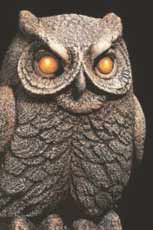
The hazy lights of the streetlamps lengthened the shadows of mature trees in ancient gardens, and on the roofs of houses along the way, they saw hundreds of pairs of prowling owl eyes. In wonder, the pilgrims looked at the roofs of the houses and into the crowns of the trees, which were literally covered with nocturnal creatures. Anskar pointed with the tip of his spear to an overhanging branch on which massive bats fluttered their wings:
“Bats and owls in Arkagant are not what they seem to your eyes. Beware of their piercing gazes. Let us lengthen our steps, so that we are in our host’s house as soon as possible.”
With a strange chill in their backs that those secretly followed feel, they arrived safely at the house with the sun knocker. Mornil was already impatiently awaiting them and led the nocturnal visitors into the safety of the courtyard of his dwelling. Only then were they introduced, and he spoke to them:
“Welcome, friends, in this restless time. How can I be of assistance to you?”
Súlin spoke in a muffled tone:
“We need to get to the Auran by the Eclipse. We bring disturbing news from Sairis. Gamol Melissai attempted a coup among the astrologers, but he was killed by a black spell at an astrologers’ ball. However, the reach of his dark plans has brought us here. We hope that with Olmar’s help, we can reach the center of the Arkian temple the day after tomorrow at the stroke of noon and thus prevent the catastrophe that the Solar Eclipse will bring.”
“Yes,” Mornil agreed, “that which you witnessed in Sairis has a connection with what is happening in this city. The active part of Gamol did not truly die, and it is evident that this reality is like a pattern woven into a carpet—where the reverse is declared the obverse. This active part of his is now fully at strength. Gamol’s lineage is a direct part of the traditional Arkian society from which Olmar Melissai comes, the one you seek, who is Gamol’s blood brother.” The man paused and after a moment added prophetically: “The side that Gamol represents has gained supporters here as well, in a new dance, in a new struggle…”
“So, brothers,” Ignis muttered as if in disbelief. “It is more serious than I thought. We must know as much as possible about the Melissai lineage, wise Mornil.”
“Olmar is six years older than Gamol,” Mornil continued. “Gamol studied the nature of the Auran flame. In the last years before his death, it even seemed to us as if he had grown younger. He was the head of his lineage, but I did not know him too intimately…” Mornil’s voice fell silent, but his eyes suddenly flashed, and he added:
“And according to what you say as well, I see that it was just as well. Order and chaos. They are like the obverse and reverse. The reverse was hidden in tunnels, vendettas, and terrifying dreams, but now it has surfaced, and the lineages fight in open clashes and new underground alliances are being formed.”
Along with the flow of Mornil’s speech, images emerged in their minds, and they once again felt they were witnesses to something much greater than they had been willing to admit until now.
After his words, a silence fell, broken only by the unceasing murmuring of the stone fountain.
“If I were you, I wouldn’t rely so much on Olmar’s help; as you probably already suspect, he is not entirely in his right mind,” the master of the house added after a short reflection.
“I see a significant fatigue of too-short nights in your faces, however, so allow me to entrust you now to the care of my wife, who will now lead you to the bedroom.” With those words, he bowed slightly and disappeared into the depths of the corridor. Rúnen led the guests to bedrooms in the public part of the house and wished everyone a good night.
“We set out for the Rock of Vision at dawn, when the gates of Arka open,” Anskar decided, even before deep sleep locked their eyelids.
Chapter XXVIII: The Rock of Vision
Even before the first gray dawn spread over Carhain, a distant temple song reached their ears from the south, gently touching their sleeping minds and gradually bringing them to wakefulness. Although most of the city was still asleep, a new sun had already been born over Arka. Its glow, however, was hidden beneath a gray wall of clouds of the penultimate day of the ending cycle. When they rose and began to prepare for the journey, Mornil entered their shared bedroom in a white robe, carrying an armful of gray cloaks:
“I wish you a good morning and a happy day! Here are the cloaks in which, according to our customs, strangers are dressed.” With words of thanks, the comrades began to put on the gifted attire. The cloaks had a simple cut, decorated only with a wrought silver clasp with which they were fastened at the neck.
Soon they were walking through the intricate alleys of Old Darika; its inhabitants were still captive to their deep dreams with which the night full of hidden deeds had gifted them.
When they reached the foot of the Carhain hill, the roadman led them further south to the goal of their journey. Again they looked with surprise at two long suspension bridges swaying in the wind above their heads. Ignis counted about a hundred paces when suddenly, from behind the houses, the massive walls of Arka began to emerge. They were higher than ten swords and encircled the steep summit, which was also the heart of the entire city, in a nearly regular circle. Their guide led them to an enormous, old gate, by whose pillars stood dávarfels—two fathoms and a foot high—but also a pair of equally tall living guards in full armor.
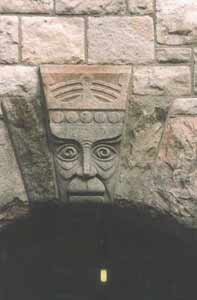
Anskar stopped in the arch of the entrance gate when he found that Arsia had stopped, and the others as well.
“It is that wall,” the sorceress spoke to her comrades, scanning along its boundary with wide-open eyes. “One of the further repetitions in smaller cycles. This gate is also a time boundary, but I will see more once we pass through it.” After those words, she passed by the guard, who indeed towered over her by more than a head, and followed Anskar on the path uphill.
Beyond the gate, many ancient and firmly built houses of the Arkian nobility, at times resembling castles, caught their eyes. Images of events experienced in these streets by noble aristocrats and generals entered their minds. To some of the adventurers—especially Ignis, accustomed to a noble architectural style—they appeared more like the houses of impoverished warriors, but he was able to appreciate their raw beauty.
Along the way, they passed a building with the bronze bee house-sign; stairs wound along magnificent orchards with beehives, and the scent of grass, pollen, and honey smelled as never before.
As they climbed along a grassy plain, a slender house with the symbol of a staff emerged at their sides. By then, they were so high on the slope that they already saw their sharp rocky goal above the battlements of distant buildings and beyond the blooming trees.
“The house with the hammer and anvil belongs to the Ganú lineage—metal-smiths and verse-smiths. The house with the sword belongs to the Akra lineage,” Anskar spoke as they passed a pair of grand stone buildings.
“And that one near the rock,” the roadman pointed with a finger, “belongs to the Onkira lineage, but it is now closed.”
“Is the lineage of smiths the most powerful of all?” Arsia turned with a question to the young warrior.
“They are very old and very powerful, the second most powerful on Arka—right after the Onkira lineage,” the Waymaker replied in a light breathlessness and, at the head of the entire company, aimed for the massive wooden doors set into an arch carved in the rock.
From a stone ledge above the door, an older bald man with a full beard arose. He carried no weapon, but he measured the newcomers with a piercing gaze.
“I welcome you, Mornil of the Koven clan. What strangers do you bring to the Rock?”
“They are pilgrims from the far north, Warden Eifrun, my friends. We are seeking Olmar Melissai; I learned that he has been staying right here recently,” Mornil answered with respect in his voice.
“So you aren’t going to the Rock, but after that old fool?” the old man sneered. He kept his further thoughts to himself, however, rang a bunch of keys, and unlocked the door lock.
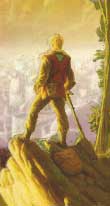
As they stepped after the old man, they felt the breath of a dark stone corridor leading upward along carved steps. The tunnel corridor led constantly diagonally upward, aiming for a protruding promontory of the magical rock that emerged on the opposite side of the Arkian hill as its natural continuation. They saw the distant exit from the darkness during their entire ascent—initially as a bright star in the deep night, which grew over time and gave more and more light to their steps. The tunnel opening at which they stood opened directly onto the sharp slope of the hill. When Anskar stepped into the light, he saw the staggering size of the space and the airy emptiness surrounding the summit. He stood stunned. They stood on a beautiful promontory protruding exactly northward from the peak of the Arkian hill. There was no one among them who did not approach the edge of the promontory with eagerness and look out into the landscape. The city and the landscape below appeared far differently than anyone remembered it. New turns of old roads had appeared, and to their surprise, they saw black smoke coming from roofs they had not seen before. The space around them seemed more tangible, and the image in the distance joined into repeating patterns, as if everything they saw was an enlargement of a simple pattern which, however, they had not yet been able to name.
They climbed further toward the end of the protrusion, and the air around them seemed to thin, and the gusts of wind grew in strength. The summit of Carhain now lay directly before them, and the hills of Diruvran were drowning in mists to the west on their left.
Súlin was the first to see a ragged man sitting sideways to them on the very edge. He wore the remains of a wretched garment, and his feet in torn boots dangled over the depths of the abyss. Mornil and the elf approached him first. The elder Koven nodded his head sadly. He recognized Olmar. The air wizard signaled to the lioness with the child to come closer.
“Greetings, Olmar,” the elf addressed the sitting man. “My name is Súlin, and I come with my friends to ask for advice in a matter of the highest importance.”
Only now did Súlin see what the man was focusing all his attention on. A small bee was crawling on his raised palm.
“What would a man see with as many eyes as you have…” Olmar spoke to the bee, “…collecting, collecting… blood! Fly and collect!” and after those words, he released the bee into the air and watched as it distanced itself from his eyes in flight.
“I do not understand you, friend…”
“Because windows are like bee eyes. I want to see the whole before it turns… For the last time I look at the city, the beautiful city. Do you see?!” and he showed Súlin the smoke of distant burning houses and fighting crowds in the streets.
The wizard froze for a moment: “Is that the work of your brother?”
Olmar shook his head: “No, I did that,” after those words, he turned to Súlin and the lioness with the child standing behind him.
“Olmar Melissai, you are one of the highest-ranking Arkins, and you surely know the answer to the question of how to get into the Arkian temple in the shortest possible time,” the air mage spoke and signaled toward the child.
“Do you see? A procession of people beneath you and in their center a black leopard carrying a child. They are already breaking through the guards into the heart of the temple,” the highest of the Melissai lineage again pointed with a finger at the city, and everyone was terrified because his words described what they saw.
“And there in front, do you see—always a step ahead—that is my brother. It is already too late, too late. The beings called Dividers have torn Arka apart, and my brother arranged it so that both halves would be white. On your side there is only luck—on theirs, eternal repetition. This is the last place where the true essence of events can be seen. Everywhere below, the Dividers are stealing the land…”
Anskar, listening to the conversation of the mage with Olmar, suddenly realized what that simple pattern that repeats in everything around them reminds him of… it was like tiny shells or flowers. A flower whose center was the Auran Temple, and its petals were the streets of the city. The strong concentric order, however, was crumbling in many places, and its structure was taking on simpler, more diverse, and more colorful forms. He observed everything in mute wonder.
“Give me your little boy!” Olmar said suddenly.
Súlin hesitated for a moment, then took the child gently into his arms and handed him over.
Olmar pressed the boy to his chest:
“Behold the god in the face of the child; he is and will be helpless,” and with those words, he laughed loudly until tears sprang from his eyes. Then his expression turned serious again and his voice strengthened: “Your journey is futile.” And he returned the child back to the elf’s arms.
Arsia, as if sensing the hidden meaning of his words, approached the man sitting in close proximity to the bottomless depths with slow steps.
“We hoped you would want a different end than the one you have now resigned yourself to,” the elf noted tiredly.
At that moment, Olmar lunged over the abyss at lightning speed, and his body slid into the empty space. The agile, strong arms of the ready Arsia caught him at the last moment.
“My dear friend, you have a tendency to complicate things,” the boy noted dryly. “I thought more of you.”
“There must surely be hidden paths leading into the heart of the temple!” Night Butterfly cried out.
The half-elf shook Olmar: “We have no time, we are looking for hidden paths, you must speak!”
“An hour before noon,” Olmar Melissai spoke into the ensuing silence, “no one is present in the Auran Temple. The bell-ringer rings the eleventh hour, and then the priests leave the temple. However, all its stairs will remain guarded. And if I were you—I wouldn’t kill the guards. Once I was on guard with my brother Gamol, and precisely an hour before noon, a young thief broke into the temple. His name was Ivaren. He was apprehended and condemned to death. From prison, however, he escaped. That is all I know; do not ask more of me and go your foolish way.”
When the last words of Melissai’s answer faded, no one could prevent him from taking his final decisive step…
Wind gusts return the rocks’ embrace
Steps falter, breath fades from the face
Silently he gazes into the deep
The only one with the answer to keep
Gazing into the abyss, his eyes do not blink
A bee on his palm, of blood it shall drink
The peak of Carhain in sight.
Time fills the cup of fate today
One last time the temple bell shall sway
Only one deceived the guard in the hall
The thief knows the path to Auran’s call
Night enters the streets with a silent sound
Yet the dark night is like day on the ground
The Order crumbles, Arka is lost in the fight
He who divides shall rule with his might.
The final step and the will to let go
Frees from the bonds and the peace he shall know
Above the dark gorge, the birds circle and fly
Guides for those who return not from the sky
They went to fight for other worlds on high.
Chapter XXIX: Further Search
A turbulent sea of floating blackish clouds covered the face of the noon sun. Together, they felt the relentless flow of time—they had hoped for so much from Olmar’s testimony. Instead of a clear path, they were left with a single uncertain trace, and that led them to a man of whom they only knew that he was the uncrowned King of Thieves. Ignis looked down one last time at the stony slope of the Rock of Vision, where Olmar’s body had shattered. Clearly, he was not the first to notice, for the birds of prey circling over the rock began to descend lower and lower in slow circles.
Arsia turned her gaze away from the dead man and looked at the Arkian Temple carved in the rock above them. This heart of the entire city, surpassing all other buildings in its position, was meant to be the strongest source of the present orderly structure. Spatial perception, however, told the sorceress otherwise.
“The site of the temple is, paradoxically, the weakest place in the city in the reverse view,” Arsia spoke in a low voice.
No one from the company paid proper attention to Arsia’s remark, except for Ignis, who stood nearby, while Súlin and the others were already descending the stony steps back to the tunnel. They were driven by an insistent thought—to return to the city and find out any detail about the fate of the King of Thieves.
Only two of them seemingly were not in a hurry; they were the ones who joined the company last. With the air mage’s permission, they remained absorbed in intimate conversation in the stone corridor for a while longer, while the others had already left the Rock of Vision.
“What do you think about the fulfillment of the company’s mission, Master Mornil? Do you believe it is truly so fateful?” Anskar asked.
“I believe in the company and its pure intentions,” the elder of the Koven lineage did not hesitate with his answer. “Gamol managed to set both sides of a split Arkagant against them; they will have a hard time. Find that thief; I will try to negotiate access to the temple at least for the child.”
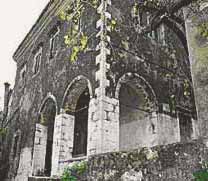
When they finished talking, they exited through the entrance doors, which snapped shut behind them, and Warden Eifrun turned the key in the lock.
“Time is relentless,” Mornil addressed the company. “So that the mission can be fulfilled in time, we must separate for a certain period to arrange the inevitable. I will negotiate with the high priests so that the child can enter the Arkian Temple.”
“I know of certain places in Younger Darika where people of a similar disposition to Ivaren could be found,” Anskar added with a slight smile.
“Despite your abilities, which I do not wish to underestimate in any way, I think a stay in the narrower and more secluded alleys of that district, which you might be heading for, young warrior, could cost you more than just a mere pouch of gold,” Súlin said and approached the roadman, who nodded silently instead of an answer.
“And to you others,” the elder of the Kovens turned to the rest of the group, “I offer the safety of my house until we return.”
“It will be an honor,” Ignis replied and nodded his head toward the lioness to follow him.
After those words, they all began to descend back toward the Arkian gates, except for Mornil, who headed for the home of the priests. After just a few steps, Mornil saw in a turn of the road the massive wall of the house belonging to the Onkira lineage. The dwelling was built in a sober architectural style; much more striking than the building itself was the ingeniously constructed garden. It was formed by several terraced overhangs that closely adjoined the steep rock. They were planted only with low woody plants and diverse bushes. Branches hung over the edges of the terraces and created the impression of a dense green waterfall. The house of roughly hewn stone was encircled by walkways of heavy oak wood along its perimeter. The only decoration of this massive structure, whose gable was lost in the clouds to the observer, were wooden pillars arranged in a circle on the walkways. Local carvers had decorated them with striking curves that resembled the flames of a fire.
The elder of the Koven lineage rang the bell above the gate and was immediately admitted inside by the doorkeeper.