[written down by Johana Passerin]
“Destruction is not change itself, but the fear of it.”
~ Faden
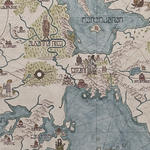
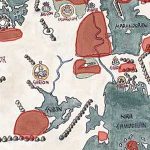
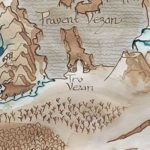
The Free Land is a countryside of peaceful settlements and dense forests lying west of Sirania and east of Garion. It is a strange land, for its protection has been overseen for ages by the knights of the Paladin Order. According to their own words, this is so that there might exist at least one land on all of Qurand that is entirely free, has no king, and simply lives in peace. And indeed, the Free Land has dwelt in tranquility for centuries. The reality, however, is somewhat more complicated, and the reason for the Paladin Order’s presence is likely something rather different from what they publicly claim.
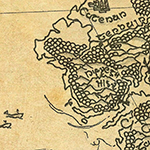
In the heart of the Free Land lies the Forbidden Forest, to which no one except the highest-ranking members of the Paladin Order has access. Within it lies a circle of fortresses. What hides at the center of this circle is a great mystery, and anyone who has tried to pry this secret from the Paladins has failed. On maps, this place was left blank or even cut out to clearly indicate that it was forbidden.
A few brave souls who, despite the explicit ban, approached close enough to see at least the sky above the Forbidden Forest, beheld a great black vortex of clouds spinning over the site. Among the few who know of it—among hunters who inquisitively penetrated the Forbidden Forest and slipped past the patrols, and among sensitives and seers who beheld the circle in dreams and visions—conjectures about what the heart of the Free Land hides are passed in whispers. It is said that a great, dark power is held captive there, or that another age, wild and terrible, dwells locked away within.

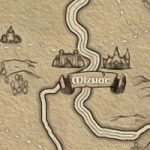
On the eve of the autumn equinox, three peculiar travelers appeared one by one in Maghon, at the Lion and Otter Inn. Each of them was a messenger from their own land, carrying an inconspicuous package entrusted to them by the esteemed and powerful representatives of their country: the first by the University in the name of science, the second by a seer for unknown motives, and the third by the Merchant Guild in the interest of wealth and prosperity. They knew only that they were to lodge at the Lion and Otter Inn in Maghon, where they might meet other messengers. They did not even know the name of the client who had ordered the rare ingredients; they were told that the innkeeper would arrange their meeting with the mysterious buyer. They also knew very little about the contents of their packages, having been strictly forbidden from unwrapping them or speaking about them with strangers.
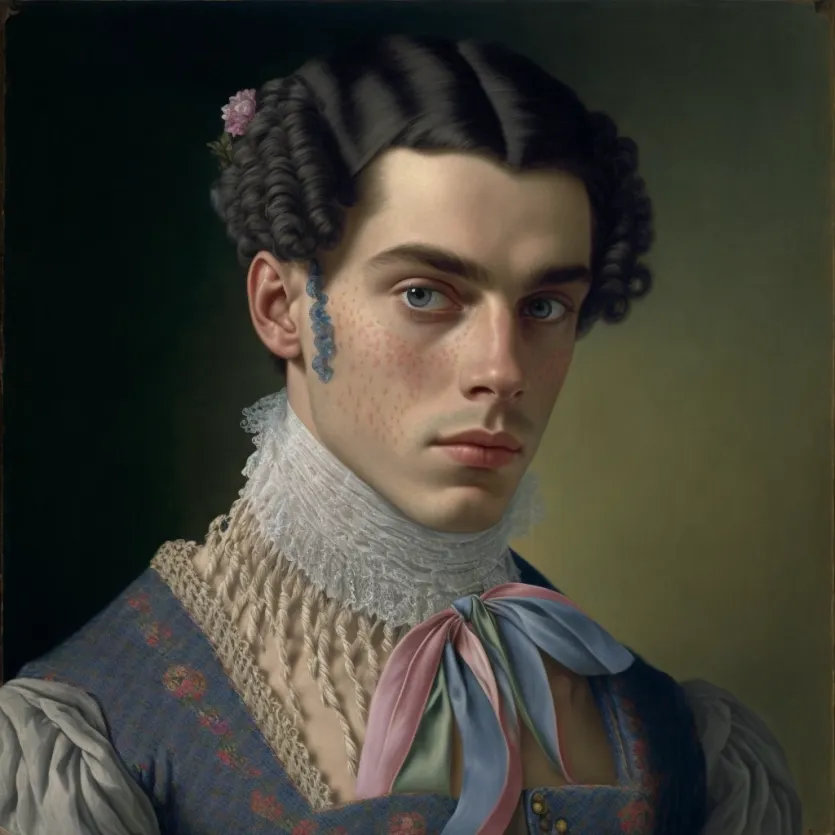
The first to arrive in Maghon was Jarn of Mulberry, from the region of Lorino. It was well known of the Lorinians that both men and women were very delicate, slender, and beautiful. It was said to be difficult to tell a woman from a man, and such was the case here. The newcomer wore a corset and a ruffled skirt with many laces, silk stockings and garters underneath, an embroidered, fitted jacket of many colors, and knitting needles in his hair holding up an intricate hairstyle. On his feet were high-heeled boots that clicked pleasantly, and he drifted in a sweet peach perfume. This, however, was merely his traveling attire. In his pack, he carried gala clothes, knitting and embroidery supplies, and a stock of silk scarves. Upon entering the inn, he looked around and, in a resonant, high voice, declared:
I wish you all good health and cheer,
I’d like a little coffee here,
In a pretty porcelain cup,
Since from afar I’ve journeyed up.
The innkeeper immediately sidled up to him and said in a half-whisper: “Coffee will be ready in a jiffy, but don’t make such a racket in here.”
He led Jarn to a small table by the window.
“Is your esteemed name Jarn?” the innkeeper asked.
“Jarn, yes, Jarn of Morušnice, and here is my right hand!” Jarn introduced himself in a ringing voice and shook the innkeeper’s hand. Several guests looked their way.
“In that case, I have a room reserved for you here. Here is the key. The room is paid for, as is the dinner.”
“Really? And who paid for it?” Jarn inquired in surprise.
“I cannot tell you that right now, but you will find out in due time. And try to be less conspicuous.”
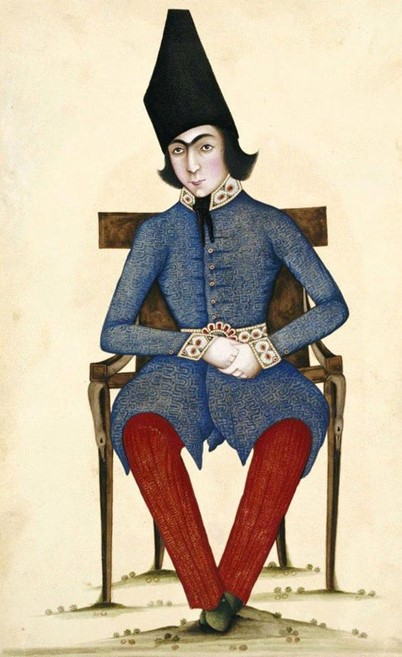
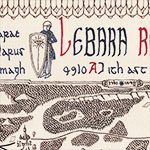
Shortly thereafter, Al-Raqím of Garion arrived at the inn (see portrait). At first glance, he looked like a mere youth who had set out on his first journey into the world to gain experience. The opposite, however, was true. Despite his youth, Al-Raqím already had several journeys behind him; besides his native Garionite, he also spoke Lebarian, mastered the basics of Vezanian and Arkinite, knew his way around arithmetic and algebra, and lacked neither courage nor guile. He knew how to make two coins out of one (at the very least two), which was a highly valued virtue in Garion. He was slender and agile. Dark hair peeked out from under his tall hat, under his nose he had peach fuzz that, with a bit of goodwill, could be called a mustache, and his almost black eyes in his swarthy face were restless and piercing. They could make themselves look sleepy and dreamy, like the eyes of opium eaters, whom Al-Raqím knew intimately, for he was born and raised in just such an opium den. Tucked in his belt in ornate sheaths were throwing daggers, and there was no doubt he knew how to handle them well.
As soon as he walked through the door, he inspected everyone and everything. It was as if he could see right into people’s pockets. He picked out—who else but Jarn—and decided that over the course of the evening, he would try his luck and rob him. He had a compulsive need to steal, perhaps just to keep in practice. He did not need the money. His travel expenses had been paid in advance by his guild, which had commissioned him to deliver a certain package to Maghon. Al-Raqím had been chosen because he possessed an unprecedented audacity and pride for his age, experience and street smarts, and above all, he knew languages.
He just walked up to the bar and greeted the innkeeper. The innkeeper sized him up from head to toe, and then asked politely: “The gentleman is from Garion?”
“I won’t deny it,” Al-Raqím smiled. Where he came from was, after all, betrayed by his clothes. Over a blue coat embroidered with silver, he had a cloak thrown over his shoulders with many pockets and a hood. His trousers were of red velvet. His green leather boots had their toes curled upwards.
“And does your esteemed name end in -qím?”
“It does, if you like. Al-Raqím. Some distort it and write Al-Rakín,” the youth replied, smoothing the fuzz under his nose as if it were already a venerable mustache.
“If you are Al-Raqím of Garion,” the innkeeper whispered, “then I have a room reserved for you here for three nights,” the innkeeper said, “but don’t play any foolish tricks here. Peddling is forbidden here, and buying things with a five-finger discount is just the same.”
Al-Raqím ignored his rude comment. He acted as if he hadn’t even understood him. Instead, he immediately asked: “A room for three nights? And who is going to pay for it? Certainly not me. I’m bringing something for someone here, and as soon as I hand it over, I’ll be on my way again.”
“The lodgings are paid for. Just like the dinners. You don’t have to worry about a thing, just wait until the one who summoned you seeks you out.”
“And who is that?” “I cannot tell you yet. But you will find out in due time,” the innkeeper shrugged, poured Al-Raqím a beer, and went back to his work.
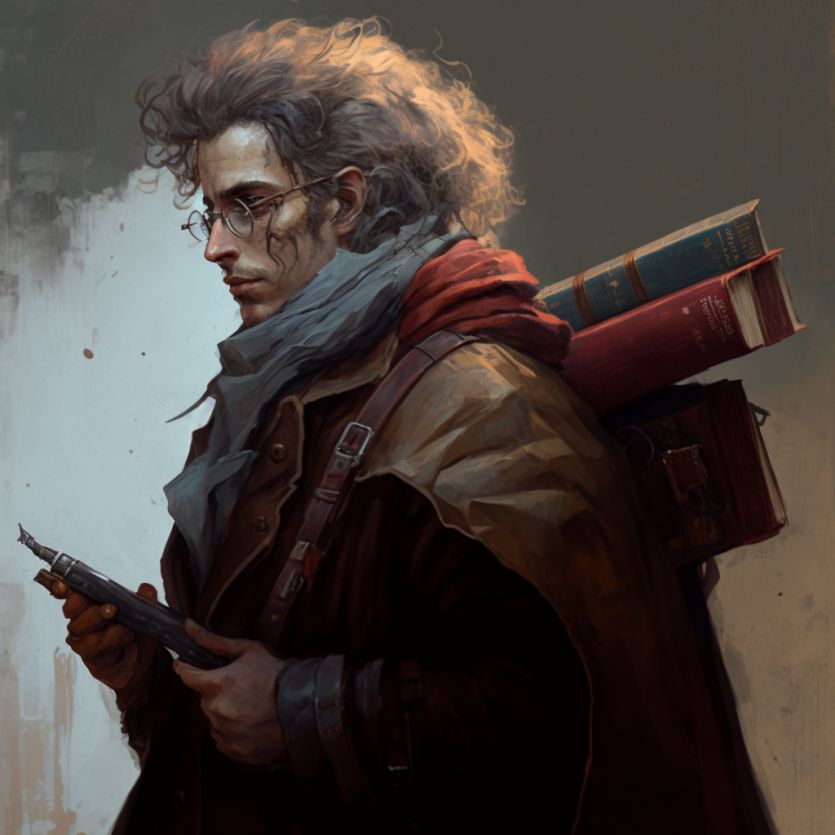
The last to arrive toward evening was Klaes of Yller. He was a scientist and a scholar. Just a few weeks ago, he had been sitting in his study at Yller University when a letter was delivered to him from the new Matriarch of his laboratory. It read roughly as follows: “Our esteemed client is calling in his old debt and requests the delivery of an ingredient available only here in Yller. For this noble and important task, you have been specifically chosen. We trust that your abilities will be of use to you on the journey to Maghon and that you will discharge your task with honor.“
Klaes rubbed his eyes, still weary with grief. Nothing mattered to him anymore. Ever since Zeilet, his dear and esteemed teacher, the head of his laboratory, had died of a mysterious poisoning, life had lost its meaning for him. Deaths during experiments (especially as a result of various explosions) were nothing unusual at the university. But Zeilet was experienced, wise, and cautious. Moreover, Klaes knew that lately she hadn’t been working on any project related to poisons. Instead, in her spare time, she had been researching something that somewhat opposed the doctrine: onda`at, the boundary of the unknowable. And perhaps that had displeased someone.
Perhaps the journey will help me forget my grief. And perhaps I will avoid the fate that befell Zeilet, which could also befall me if I followed in her footsteps, Klaes thought at the time and wrote a brief affirmative reply. Before long, the pneumatic tube mail spat out travel instructions and a mysterious small package, sealed in waxed canvas. He had three days to prepare for the journey, but he didn’t actually need that much time. He packed his instruments, especially his spectacles, with the help of which he could look into the material essence of things and stars, as well as various chemical agents, a sufficient supply of gunpowder, and his bombard, or pipe, which was his favorite tool. He did not assume that a journey through the northern kingdoms would be safe or comfortable.
Then, for several weeks, he trudged along the dusty roads of the kingdoms of Nisell, Meltika, and Tagaris. Then he sailed down the river, passed through the disgusting Kaelotsian marshes full of frogs and frog-men, and continued along the edge of the elven forest all the way to Iacana. Now he sat in the inn in Maghon, sipping hot tea. He watched the people and tried to recognize among them someone who was a stranger like himself. He himself was conspicuous at first glance by his strange lack of a hairstyle. His disheveled, unruly hair looked as though some explosion or electrical discharge had shaped it into a geyser. In reality, it was shaped this way using a special pomade with a more or less permanent effect. Thanks to this, the innkeeper recognized him immediately. He greeted him respectfully.
“Are you traveling from afar?”
Klaes nodded.
“Surely not from the northwest?”
“That is so, from Yller.”
“And are you from the University?” Yller was famous for its high learning.
“Klaes,” the scholar nodded wearily.
“I have a room for you here,” the innkeeper said, sliding a key toward Klaes. “It is paid for, including food, but don’t ask me who paid for it. I can’t tell you that yet. But you will find out in due time, you can take poison on that.”
Klaes shuddered. The mention of poison painfully reopened the memory of his teacher. He turned away and closed his eyes for a moment. When he opened them, his gaze fell upon the dressed-up Lorinian, and that reminded him that he would likely meet an envoy or envoys here who had a similar task to his own.
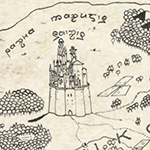
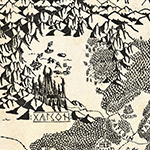
“Thank you,” he said and thoughtfully reached for the key with the number V. He climbed the stairs and settled into a room with a view of a strange tower. It towered high, several stories above the tallest buildings surrounding the main square. The town was wrapping itself in darkness, and suddenly, one by one, round lanterns began to light up everywhere, suspended from cords leading from that tower. Their light was soft, glowing in pastel colors. Klaes marveled. That light was the work of the Art. Until now, he had somewhat thought that the rest of inhabited Qurand outside Yller was a barbarian wilderness. After all, his journey had confirmed this belief. The sight of the lanterns pleased him.
When he later went back downstairs into the inn, he saw that the lamps had lit up here as well. Some had the shape of paper lanterns, others looked like animals floating freely near the ceiling. The motif of the lion and the otter prevailed among them, naturally. The taproom was cozy and had already quite filled with local people and other characters. Then his gaze fell upon the Lorinian, decked out in unbelievable clothes. This might be an envoy too, Klaes thought, reminding himself that he was supposed to meet other messengers like himself here. They would surely be travelers too. Strangers. He carefully inspected the people around him, guessing who else wasn’t from here. He watched the Lorinian pour peach brandy from a small flask into his coffee, drink, and wipe his red lips with an artfully embroidered handkerchief. Then the Lorinian made himself comfortable and looked around. His eyes also examined the surroundings, and finally, they rested unerringly on Klaes. They measured his tall geyser of hair, and then the Lorinian’s red mouth smiled. He stood up, walked over to Klaes’s table, bowed, and said in a low voice:
It seems that you too are a pilgrim grand,
Who traveled from afar to this land
To honor it with a visit true.
Unknown people invite me too.
My name is Jarn of Mulberry,
And here is my right hand of peace.
He offered Klaes his right hand, but in the manner courtly ladies offer it, as if inviting the Yllerian to kiss the tips of his fingers, whose nails bore traces of polish. Klaes, however, shook his right hand as was the custom in Yller and asked in a whisper:
“Why do you think the two of us have something in common?”
The Lorinian raised his eyebrows in surprise, but looked around and replied in a half-whisper:
Our King received a call from afar
From a man well-versed in magic’s star.
The seer Munath nodded to my quest,
That Lorino’s gift would do its best
To stop the doom and evil fate
Of Qurand, so I came through the gate.
I also know of envoys more,
Hastening here from the border’s shore.
I hope for friends to join the fight!
For company brings me great delight.
Klaes did not have such detailed information, or he had read the invitation letter, as the heads of his college called it, too carelessly. Or perhaps he hadn’t thought about it enough because he was absorbed in mourning.
“Why did you come here?” Klaes asked cautiously.
“Why? I am bringing an ingredient, you see, From our sacred orchard’s sanctuary,” the Lorinian answered in a whisper.
Klaes nodded. “I’m carrying something too,” he said mysteriously and offered the Lorinian a seat at his table. An ingredient from a sacred orchard! Oh Stone of Transformation, what kind of nation are they, these Lorinians?
For a while they conversed about how their journeys had been. Both tried not to reveal too much about themselves, while carefully trying to find out as much as possible about their counterpart. In the meantime, the inn filled to the last seat with locals and foreigners. The autumn equinox festival traditionally included a large fair and the Maghon exhibition of produce and livestock.
Here Klaes noticed a wealthy-looking man, dressed in a cloak with many folds and pockets, weaving his way through the people, spilling beer on the floor, and paying attention to something completely different than everyone else in the inn—the pockets of the other guests. Klaes couldn’t care less; they weren’t his pockets. But the man intrigued him because he too was a foreigner. Then he lost sight of him again, or stopped paying attention to him. He was talking with Jarn, as his new companion had introduced himself.
He noticed him again only when he flashed past Jarn’s back. He just walked by, light as a breeze, but bent down for a moment, and something clinked metallically.
“Excuse me, sir,” Klaes addressed him. The Garionite turned sharply, and several expressions crossed his face, from surprised to annoyed to nonchalantly detached.
“Do you need something?”
“No, it just occurred to me that you probably aren’t from around here either, and judging by the key in your hand, I assume you are staying here.”
“Hmm, you have good observation skills!” the stranger replied. “But to tell you the truth, this little key isn’t actually mine; I just found it lying here on the floor, and I wanted to take it to the innkeeper.”
Jarn turned sharply and squeaked: “The key was in the pocket of my blouse, and now—it’s in the hands of the local louse!”
“I beg your pardon!?” the Garionite protested. “I am neither a local nor a louse! My father was a nobleman!”
“Then return the key to him, if it’s his,” Klaes said deliberately and pointed to the key. “And actually—sit with us for a moment, perhaps we are going the same way.”
Al-Raqím hesitantly placed the key in front of Jarn. Then he borrowed a chair from the next table (and from the pocket of a coat that happened to be nearby, a few small coins, which vanished in the blink of an eye into the inner pocket of his sleeve), and sat down with them.
“We probably aren’t going the same way, because as soon as I handle a certain business matter, I will hastily return to Garion.”
“And what is this business matter of yours, if I may ask? Do you deal in making things around you vanish now and then?” Klaes asked.
“My name is Al-Raqím and I deal in the import and export of jewelry, clasps and pins, buttons, baubles, dyes, and precious fabrics,” the swarthy man said proudly.
“I see. And what are you bringing to Maghon? Or do you intend to buy something here instead?”
“Here? I’m only bringing a small trifle, something ordered by an apparently wealthy customer. And then I might buy something so I don’t go home empty-handed.”
“A trifle,” Jarn smiled.
“Then we are quite similar. We are also carrying a trifle,” Jarn whispered.
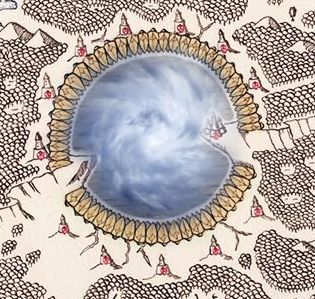
Exactly at the moment when these three travelers sat down together at one table in The Lion and the Otter inn, a hoop snapped in the very heart of the Paladin domain. It was not the work of chance, but the result of very dramatic events that are, however, part of another story. In Maghon, nothing was noticeable yet, and no one suspected a thing.
The evening progressed. Jarn and Al-Raqím had already drunk several tankards of the excellent local ale. Klaes, unlike them, did not drink as much. He knew from experience that alcohol did not go well with his mourning, so he held back somewhat. They talked. They already knew each other’s names, knew where each came from and what guild, faculty, or orchard they belonged to. They discovered that they had an appointment with their customers on the exact same day—the autumn equinox. However, none of them revealed who they actually came to Maghon to see. This was partly due to the fact that they did not actually know the name of the mysterious customer (but they did not want to admit it).
When they were having the best time (Al-Raqím had just launched into telling jokes from the Garion brothels), their socializing was interrupted by the arrival of two men. Although they wore no uniform, they were incredibly similar in some way. In their posture, height, movements, facial expressions, hair color, and cut. They approached the bar, ordered spring water, and asked the innkeeper something. They looked around. Klaes noticed them before they noticed him and pointed them out to his friends.
“Who could that be? So orderly, handsome, pleasant…” Jarn said. The others did not miss the somewhat sarcastic tone in his voice.
“I think we will find out soon,” Klaes shrugged. “They’re coming this way. I’d watch out for them.”
The two men put on a pleasant expression and approached the table of the three travelers.
“Good day,” one boomed. “I see you aren’t from around here. Do you need help with anything? Perhaps where to go for entertainment, safe and in all decency, of course…”
“We aren’t tourists,” Al-Raqím protested.
“Ah, you aren’t tourists? So here on business, on business?”
“Hm,” Al-Raqím agreed.
“Thank you, I don’t think we need anything,” Klaes said, trying to ignore the men. But they continued to stand over their table and showed no signs of leaving.
“You see, we keep an eye on the safety of our little village a bit, so we know how and are able to give good advice to those who aren’t from here, so they don’t get swindled, for instance.”
“Swindled!” Al-Raqím burst out laughing. Klaes cast a reproachful glance at him.
“You wouldn’t believe it! Fake tax collectors, for example. We had an attempt like that here. If you are carrying any goods, you should pay a duty, and the problem is that there are those who only pretend to be customs officers.”
“Oh, the horror,” Klaes sneered.
“Do you happen to have anything to declare?”
“No,” all three answered as one man.
“Are you sure you have absolutely nothing? If you showed it to us, we could tell you right away if it happens to need declaring.”
“No!” they all repeated emphatically.
“But this gentleman here said he came for business.” They turned to Al-Raqím.
“I said no such thing,” Al-Raqím protested and waved at the innkeeper. He ordered another ale.
“Then why are you here? Three such diverse travelers at one table?” the second man spoke up. He tried to ingratiate himself with a honeyed voice, but it didn’t help. Klaes found them unpleasant from the first moment, even though (or precisely because) he was used to academic formalities. They are so stiff, exemplary, polite—it makes you just want to punch them.
One of the men tried to change the subject. “Has anyone met with you recently who handed you something to bring here?” it sounded concerned.
“And why is that of such weight? And do you have the right to ask this straight?” Jarn asked.
“Yes, it is important. Treacherous enemies of the peace in our Free Land sometimes slip a package to unsuspecting travelers, and it might contain something dangerous! We are concerned with the general welfare and safety of all inhabitants. And then individual freedom must sometimes step aside.”
“Really?” said Al-Raqím, to whom the innkeeper had just brought another beer. “These gentlemen here are saying that our personal freedom should step aside for a bit. I have no idea what to think of that. Could you translate it for me? I thought I was in a free land…”
The innkeeper looked at the two men and muttered: “Is something going on?” They shook their heads.
“Then either sit down at a table and order something, or go away,” the innkeeper said, grabbed the empty glasses, and hurried off. The two pushy men tried for a while longer—through flattery and moralizing—to extract some information from the travelers about what they were carrying, who they were going to see, and who sent them, but without success. Finally, they left.
The trio waited for the promised dinner, which had been paid for by their mysterious customer. They enjoyed the appetizer—local cheeses, sausages, and other delicacies. Klaes and Al-Raqím nibbled and waited for Jarn, who had gone to his room to change. Firstly, it was the custom in his region; no decent Lorinian would sit down to dinner in traveling clothes. But he also wanted to put on some perfume, because he felt he had sweated somewhat.
When he came downstairs, his face was pale and terrified.
“The door to my room was open! Someone unlocked it—most likely with a lockpick!” he said as he sat down at the table. He looked somewhat suspiciously at Al-Raqím. Lace and silk rustled, and a waft of peach scent blew over everyone.
“I’ve been sitting here with you the whole time, you can’t deny that,” Al-Raqím protested.
“And didn’t you just forget to close it?” Klaes asked calmly, who preferred to believe that everything on Qurand had a logical and, above all, simple explanation.
“No! Someone broke into the room and turned everything upside down! They were looking for something!”
“And did you lose anything?”
Jarn shook his head. “Fortunately no. But they rummaged through my things!” The rare ingredient, of course, he preferred to keep on his person, right against his body, in a small pocket under his corset.
Klaes looked around nervously. Who could it have been? Those two guys who were trying to drag some information out of us a moment ago? Or were they trying to keep us busy with nonsense questions, and someone else did it?
The innkeeper brought them the first course of dinner.
“Enjoy your meal!” he wished them.
They started eating. Jarn did not stop watching the door, the people in the inn, and the stairs leading to the rooms. He couldn’t shake the feeling that his innocent-looking trip was turning into a dangerous adventure.
Just as they were finishing the third course, venison rolls in aspic, the door burst open and several men dressed in white and silver walked in. Paladins! Soldiers in Paladin armor! Klaes jumped from his chair, hastily swallowed his bite, and reached behind him, where his excellent bombard rested. Al-Raqím nonchalantly finished his tankard, but his hand under the table was already playing with a throwing dagger. Jarn froze. Even though the arriving men wore helmets with cheek guards, he recognized two acquaintances among the knights who had harassed them before dinner.
“Here we have them. Paladins, the virtuous guardians of order and peace,” Klaes whispered.
“They’ve shown their true colors nicely,” Al-Raqím muttered, wiped his mouth, and threw the napkin under the table.
The Paladins headed straight for them. They looked determined. There were four of them, but they gave the impression of being at least twenty.
“In the name of the Grandmaster of the Paladin Order, hand over what you are bringing!” bellowed their commander.
“What are we supposed to be bringing?” Klaes asked slowly and shifted his weight from foot to foot. He thought that his subconscious wish to punch the Paladin in question in the nose would probably come true much sooner than he expected.
“Things that can poison the air in our land, disrupt stability, peace, unity, and safety! You want to drag a disease into our clean and peaceful society. Someone called you here to bring him something. And you will give that to us now. By fair means or foul,” the knight said and laid his hand on the hilt of his short sword. His companions made the same movement.
“And if we don’t?” Al-Raqím said cheekily.
“Then we will take it by force!”
“So this is what they call helping and protecting around here!” Klaes muttered. Then he grabbed his staff and jumped exactly to the opposite side than the Paladin expected. Klaes was no brawler. His field was physics. Mechanics, optics, astronomy, mathematics. The moment the drawn sword cut the air where Klaes had stood a fraction of a second ago, Klaes’s pipe landed on the Paladin’s face. Blood spurted and stained the Paladin’s white robe.
A brawl broke out, the likes of which The Lion and the Otter inn hadn’t seen for several decades. Jarn surprised himself when a bowl he threw with the remains of the venison hit the head of a soldier lunging at him. Then he beat a hasty retreat upstairs. Al-Raqím disappeared under the table, and in the next moment emerged somewhere else, stabbing an opponent in the buttocks with a knife. People shrieked, the innkeeper shouted “Help! Murder! Fire!” Tables crashed, dishes shattered, chairs flew through the air. A soldier caught up with Jarn on the stairs as he was trying to run to his room. He grabbed him by the collar, the silk tore. This enraged Jarn and gave him strength. An indignity! A scandal! An insult! They grappled and rolled over each other, and finally, Jarn headbutted his opponent and pushed him down the stairs. The soldier, however, immediately jumped to his feet and ran at Jarn with a drawn sword. Jarn looked around and saw a window. It led directly to the main street. It is at least four swords high! thought Klaes. His heart was beating in his throat. But the Paladin with the raised sword was almost upon him. Jarn hoisted himself onto the window and jumped. His evening gown saved him—the skirt caught the air and slowed the jump, so Jarn landed on all fours like a cat, rolled like a bear, and was completely unharmed.
He looked around. Down in the street, he saw a fast-marching squad of knights of the Paladin Order. Reinforcements! That’s not good. He looked the other way—toward the tower. The path there was clear for now. He started running, his skirt billowing behind him.
Meanwhile, in the inn, the uproar died down. Klaes and Al-Raqím were surrounded.
“If they hadn’t brought reinforcements…” Klaes muttered in a whisper to Al-Raqím and looked at the three knights of the Paladin Order who lay scattered on the floor. Nine more, however, were pointing their swords at them.
“If only, if only,” Al-Raqím sneered.
“Silence! In the name of the Grandmaster of the Paladin Order, hand over what you are bringing!” Žarion said solemnly.
Klaes didn’t move a muscle. Al-Raqím was thinking about how he could make money out of this situation and was just about to make an offer when the Paladin exclaimed: “Bind them. We will interrogate and search them in our fortress.”
The soldiers rushed at them and carried out his order.
Klaes and Al-Raqím were bound and lay face down, so they didn’t see anyone walk in. But they felt that something in the room had changed. Voices murmured. The cold air of the autumn night rushed inside. They felt stillness and silence. They heard footsteps and then a rough, yet very beautiful woman’s voice. It was mumbling something. Their muscles stiffened in an unpleasant cramp. The footsteps stopped right next to them.
“Sssssssolvo!”
They felt their bonds slip off their hands by themselves, as if they were snakes, and that they could move again.
“Get up! Take your things, and the things of your friend who wears silk, and come with me. Quickly, we have no time to lose!”
Klaes got up. He looked into the face of a very beautiful woman—or girl—for age was something he couldn’t even think about in connection with her. Her pitch-black, thick hair reached her waist. She was dressed in a simple robe and a cloak with a hood. Aside from gold bracelets on her wrists and on the ankles of her bare feet, she wore no jewelry. Al-Raqím jumped to his feet and looked at her admiringly.
“To whom do we owe our rescue? What is your name, lady, so that I may praise it wherever I go?”
“You will find out later. Now we must go. Take what you need and come with me.”
Only then did they realize that the Paladin soldiers were still standing around them. But they were motionless, as if turned to stone. The other guests and the innkeeper had apparently slipped out of the inn quietly during the brawl. Klaes and Al-Raqím hurried to get their and Jarn’s belongings. The woman examined the paladins as if they were real statues. Occasionally she flicked one on the nose or pulled his ear.
Night fell on the town of Maghon, and people stood somewhat nervously under the lit lanterns. The fleeing guests from the inn and the marching Paladins had disrupted the peace in the town. Something was in the air. And they had no idea what was approaching their picturesque settlement from the very heart of the Free Land. The dark-haired woman walked quickly down the main street. She didn’t look back. Klaes and Al-Raqím had a hard time keeping up with her.
“Where is Jarn?” Al-Raqím called out breathlessly.
“Did something happen to him?”
“And where exactly are we going?” The woman did not answer their questions.
“Why did those Paladins attack us?”
At that, the woman stopped, turned to them, and hissed in a barely audible voice: “Not another word about that out here! Why? They wanted what you are carrying. And you apparently weren’t careful enough. Let’s go!”
Finally, the tower appeared before them. The paved plaza around it was made of magnificent mosaics. It was empty and softly illuminated. An inconspicuous low wall with several gates separated it from the town. The woman opened one of them, waited for them to pass, and closed it behind them again. They reached the foot of the tower. Now they saw that it was truly enormous. Near the ground, it gleamed like copper, and steam rose from numerous vents along its perimeter. The woman reached out her hand, and the richly decorated wrought doors opened soundlessly.
They walked inside. They were swallowed by a darkness full of iridescent flashes—as if someone were reflecting sunlight spots in the middle of the night. Al-Raqím gasped in amazement. Klaes racked his brain over what could possibly cause the phenomenon, when the woman beside him said:
“What you see, and mainly what you do not see and what supports the seen, is the work of the powerful mage Talantius. My name is Lyra and I am his apprentice. He is the one who summoned you and asked your communities for three gifts, things seemingly insignificant, and yet absolutely essential ingredients.”
“Three gifts?” Al-Raqím stammered.
“Is Jarn here?” Klaes asked.
“Yes, he is already upstairs. You will be reunited soon.”
Lyra led them down a corridor to a staircase, which they climbed all the way to the top. Klaes marveled that walking up the stairs hadn’t tired him at all. On the contrary, he felt as if something was lifting him the whole way. But what he saw next multiplied his amazement even more. They were led into a hall illuminated by a soft green light that came from somewhere above, from behind the pillars supporting the vault of the tower’s peak. Something was fluttering and whistling up there. Down below, on a floor as smooth and shiny as spilled milk, stood an old man.
“It is good that you came,” he said in a trembling voice. “I suspected this would happen! The scales are tipped, and what spilled from them will come here before long. The jug is empty, the shepherd’s crook is broken, the lambs and bullocks must be sacrificed, but not to the gods, but to the worms; the lion is caught in a cage, the archer’s bowstring is snapped… We have lived to see the inglorious end of an age: the eternal battle has overflowed its banks and I cannot stop it, I am too small a master for that. Hopefully, I will be able to stop at least the fear!”
“Fear?” Klaes wondered.
“Yes, whoever conquers fear can face what is coming.”