[written down by Johana Passerin]
“Ages do not change, ages overflow.” — The Host
In the preceding part of the story, titled Escape to the Silver Hills, the Vezanian Al-Raqím, the Lorinian Jarn, and the Yllerian Klaes set out to flee from Maghon to Iacana, to the Inn at the Three Foxes, where they hoped to find advice and help. They carried the Elixir, which helps to see the true essence of the New Age, the Age of Barbarism. Talantius had gifted them a talisman with the image of three foxes and also gave them a guide for the journey—the Huntress. When they escaped Maghon, which vanished into the heavens in dust and smoke, they raced with barbarian hordes at their heels to the entrance of the old silver mines. The underground was linked to the fate of Timot and Saguin, ancient apprentices of Master Talantius. The path over the mountains was dangerous, but trying to escape the hordes through the forest was entirely hopeless. And so they plunged into the depths.
In the labyrinth of underground passages, they came across a closed door and a strange room with a cabinet full of voices, with a chair upon which something with two heads both sat and didn’t sit. Locked doors stood in their way, and the key lay in a bowl full of hot water. They tried to pull it out, but without success. Finally, Jarn sacrificed his hand and retrieved the key. His hand turned black. They unlocked the door and set off further down the corridors. Little did they know that an infinitely long black hand was silently creeping behind them, black in the black darkness.
The Turnoff to the North
The heroes discovered Saguin’s tombstone and the turnoff to the north, exactly as Lyra had described. The sarcophagus was cracked and empty, and there were prints of a black hand on it. No one intended to linger by it; their hearts were heavy. Away from here! They began to feel the pain of their injuries and exhaustion. The rough adit, hewn into the rock, oppressed them. How long had it been since they ate or slept? But it is necessary to go on—not straight, however, but to the north.
Jarn leaned against the wall. His burned hand ached. He placed its palm on the left wall of the corridor, and it seemed to him that with his left ear, he heard whispering and murmuring like in a sea shell, and a wordless voice.
“Wait! The adit resounds with a whisper, someone calls me to assist her.”
The friends looked at each other. Jarn was probably delirious.
“What voices! Snap out of it!” Al-Raqím slapped his face. “I’ll go first, let’s go!”
And so they went, the Huntress at the rear with an arrow nocked on her bowstring. They had barely walked fifty swords from the crossroads when they saw a wooden door on the right side of the corridor. They felt a draft of air beneath it.
“What’s going on, Miser?” called the Huntress, who did not know why they had stopped.
“There’s a door here,” said Al-Raqím.
Klaes slumped to the ground. “Not that I mind us standing still. I’m so tired!”
Al-Raqím inspected the door, pondering how to get inside. And whether to even try.
“Unlock it with a picklock? I could bash it in with my pipe. But personally, I would rather continue down the corridor to the north,” Klaes said doubtfully.
Meanwhile, Al-Raqím was already poking around in the lock. With his long fingers, he inserted various wires one by one until finally there was a click, and the door opened. It led into a room roughly 4 x 4 swords in size. Klaes seemed to perk up at the metallic sound. He jumped up and followed Al-Raqím into the room. When they shone a lantern, a plank floor was revealed; on the left side, there were some barrels and clutter. On the right side stood a table with scattered alchemical glassware, as if someone had abandoned it here in a hurry. Al-Raqím began to examine the room, his heart pounding at the splendor. What all could be found here?
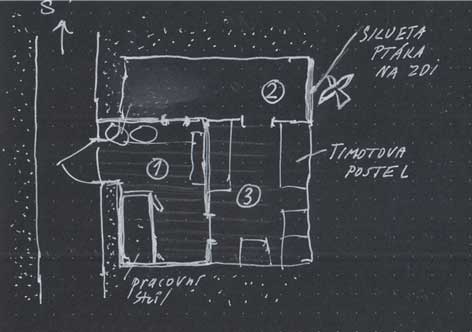
Figure 2. Alchemical workshop.
The Huntress and Jarn remained outside. Jarn was dejected and kept looking back.
“Missy, what’s troubling you?” the Huntress leaned down to him.
“Don’t you hear it? That calling, someone needs to be saved,” Jarn replied.
The Huntress answered firmly, “No, I definitely don’t hear that. Show me that hand of yours.” Jarn revealed the burned hand, and the Huntress shuddered. The hand was black and numb. She had never seen anything like it and was at a loss. She examined and treated at least his other injuries. They could hear Al-Raqím enthusiastically rummaging through the items on the alchemical table. Klaes was looking over his shoulder.
“Be careful! These powders and crystals here, that’s sulfur, and this could be arsenic, these are dangerous substances. And what do you have there?” Al-Raqím reluctantly showed him his catch. It was a small gold flacon with a chain attached to the stopper. On the body of the bottle was a winged inscription in Old Vezanian.
“Interesting, interesting. This is how various essences of offerings, for example from newborns, were preserved in ancient Vezan,” said Klaes. Al-Raqím snatched the flacon back from him and, along with three other similar bottles with their contents intact, stuffed them into the inner pocket of his coat. Then they looked around and noticed another door to the left of the entrance. They were about to open it when the Huntress’s voice came from the corridor: “Come here! Missy doesn’t look well here.” They rushed over to him.
“Are you all right?” Al-Raqím addressed him.
“I hear a strange song’s flow, coming to me through the shadows. A wordless voice calls to me and invites: come join the hunt’s delights!” Jarn whispered.
“Uh oh,” Al-Raqím sighed. He felt sorry for his friend, but apparently, he was even more annoyed that he had to abandon his exploration of the alchemical laboratory. Klaes took his spectacles from his pack and examined Jarn’s hand with their help.
“Strange. That hand is more alive!”
“Why are you looking at me like that!?” Jarn pulled away from him. “My hand was injured, but its strength has endured. There’s nothing wrong with me!”
The Huntress looked at them with concern. “More alive? I don’t like that. We should move on and get out of these dark places.”
“I am not so sure about that,” Jarn countered quietly and looked back again. The friends gathered around him and conferred. In the end, they decided to continue forward on the path to the north, as Lyra had advised them. But they didn’t get far; they soon began to stumble over rocks, and finally, they could go no further. The corridor was blocked by a cave-in, not a single crevice anywhere.
“We must turn back, and so shorten our track,” said Jarn, finding it hard to hide his pleasure that they were turning back.
“We’ll see about that,” Al-Raqím muttered.
They found themselves back in the alchemical study. The wall opposite the door was wooden, and judging by the sound, there was another space behind it. The door on the left led into a strange room, and from it, another door led to a room behind the wooden partition. The wooden walls, ceiling, and floor were densely covered with inscriptions in Vezanian. Some places had been scraped away, and in those spots, there were traces of dried blood. Most peculiar was the back wall. Against a black background, the white outline of a black bird in flight was silhouetted. It was lifelike, but it lacked eyes. On one leg it had only three talons, and on the other, four.
Without anyone noticing, Jarn’s hand began to tremble. Like one enchanted, Jarn approached the painting and touched it.
“I drew this, it is my creation!
A memory like a shadow. When was this manifestation?”
Fingers touched the avian frame,
As if the hand itself claimed the aim.
“I just recalled the scene,
How I painted this, serene!”
He whispered to himself, but his friends didn’t hear him, for they had just opened another door leading into a small chamber that was separated from the study by the wooden wall. That chamber turned out to be a bedroom with two beds and a small writing desk. On it lay scattered sheets of paper written in Lebarian. Klaes sifted through them for a while and then exclaimed in amazement:
“Why, this is Timot’s diary!”
“Really?”
“What is written there?”
“I’ll read you some of it. Shine a light for me,” he said and began to read aloud:
“We should take this with us and hand it over to the Host, provided, of course, that we get out of here alive!” Klaes remarked when they finished reading. He looked up from the crumbling pages, and it seemed to him that a figure with white hair stood behind Jarn in the dark. Just for a moment, then it vanished.
“The underground is full of phantoms,” he shuddered and passed a hand over his eyes. “I had the feeling I saw Saguin back there.”
Meanwhile, Jarn’s left hand was feeling the objects in the room, stroking them, touching them. Jarn, with his eyes closed, wandered around the room and only half-listened to what the others were talking about as they read from Timot’s diary.
“Of course! It is so ordinary, yet known, and the hand guides my arm alone,” he muttered to himself. Then he returned to the room and stood before the painting of the bird again. He suddenly felt good. It was as if he knew all this, and that comforted him.
“It is like a breeze,
Foreign and yet familiar with ease.
As if a little were all it required.
To finish the work desired.
To finish the work!”
Jarn raised his hand to his eyes and smeared his eye shadow. With that finger, which had traced his own eye, he painted the bird’s eye.
There—and this is enough, Jarn thought and stepped back from the painting with a dreamy smile.
A bird’s cry pierced the oppressive silence of the tunnels.
Everyone lunged back and saw, That in the wall where the white bird had its draw, Where the avian silhouette had been, Which had no eye in its black head unseen, There is an opening the size of the bird’s body, And beyond it, the corridor turns ready.
Inside sat a bird, staring at them with a single eye. A bird as large as a pony or a calf. Jarn stepped toward it and offered it his black hand, as if inviting it to hop onto it, but the bird snapped and croaked.
What is it? Where did it come from? Everyone’s eyes looked at Jarn, who stood there with smeared eye shadow and smudges on his face. His hand was still extended toward the bird.
The Huntress caught a scent. “A fresh breeze blows from the corridor. Perhaps there is a path on the other side.”
“But the bird is blocking us from passing through,” Klaes noted.
“If the only path leads through the bird, we go after it,” said the Huntress and drew her bow.
Jarn stepped into their path. “Leave it! Perhaps we should give it food to eat, and thus its hunger deplete!” He turned to the bird again and tried to stroke its head. The bird shrieked and snapped at him with its beak.
“You see! It will hardly let us pass peacefully!” Klaes exclaimed and unexpectedly attacked the bird with his pipe. But the raptor was faster and pecked Klaes on the hand. The Huntress fired. A white-feathered arrow struck the bird in its black chest. At that, Jarn, not the bird, roared in pain that gripped his black hand. The bird recoiled, beat its wings around itself, and tried to attack the Huntress, but she had already loosed another arrow from her bowstring. Jarn cried out again, as if the bird’s pain were his own. With its last bit of strength, the bird threw itself at the Huntress. It sank its beak into her shoulder like two curved knives. Al-Raqím hurled a knife at it and dealt it a mortal blow. A cloud of black feathers rose and swirled in all directions. When the vortex settled, they saw black feathers as if painted on the walls and floor. The path was clear. The bird had vanished, and two arrows and a knife lay on the corridor floor.
Tears of sorrow and pain streamed down Jarn’s cheeks. His hand hurt unbearably, and his mental torment was even greater. “I created it. I created it,” he repeated in a whisper.
But no one paid him any attention. It was necessary to treat the bleeding wounds, and Jarn’s pain was invisible. Then they explored the space behind the gaping bird-shaped opening. The adit soon opened perpendicularly into a sort of grand corridor. It was wide, meticulously crafted, decorated with repeating motifs resembling snakes and tendrils, among which smiling faces could also be discerned.
“This corridor also leads north!” Klaes rejoiced.
“But we are tired, we must gather our strength, eat, and rest, or we won’t get anywhere,” the Huntress said. The others agreed with her. They were exhausted, and their wounds ached. They went back to Timot’s bedroom and shared their supplies. They put the wounded in the beds, and for the others on the floor, they created at least somewhat comfortable beds out of blankets. They lay down, and in a moment, dreams spread over their heads.
In his dream, Klaes listened to rumbling and puffing, hissing and pounding. He felt as if he were home in Yller, hurtling through a tunnel in some machination, a machine powered by steam and Yllerian ingenuity, something akin to the train under the Telpan Mountains. Whether it was sleep itself, or the dream about machines, he felt far better in any case.
Al-Raqím slept a fitful, restless sleep. He too dreamt that he heard the whispering of voices in beautiful and opulent tunnels. There was life and wealth there that he longed to explore.
Jarn kept falling asleep and waking up as if in a fever. He dreamt that he was Saguin, who was dreaming that he was Jarn. In his dream, he found himself in the deep temple, in the time of the Age of Heroes. He descended deeper and deeper, ever closer to the ages and places where the answers to all the questions he yearned to reach lay hidden.
“Me too,” said Saguin, who was Jarn in the dream. And then he descended into the temple, and lingered in the place where Timot lay on a bier, preserved in immutability.
Jarn – Saguin was repairing a sort of terrestrial machine in the dream, a huge wagon, onto which he would one day load Timot’s bier and depart to the north. “They are already waiting for us there.”
Then Jarn woke up.
“I know the way to the underground temple,” he said into the darkness.
“To what temple?” replied Al-Raqím, who apparently had also just woken up.
“The underground temple is where we are building that metal wagon, towing other wagons, a tow, or rather a train!” Jarn replied.
This woke Klaes in turn, who exclaimed: “A tow? You mean that machination?”
“Yes! We must repair it so we can ride north!”
The Huntress chimed in: “Hey! Did you wake up? Then wake up!” She turned up the flame of the lamp and shone it into their faces. “You’re delirious!”
“Delirious? Maybe it was a dream, but how does he—a Lorinian—know about tows?!” He pointed a finger at Jarn.
“It doesn’t matter. We must set out. I don’t want to listen to your delirium here and lose my own mind from it. This place is full of phantoms, and I want to be gone,” the Huntress said resolutely, got up, and began packing her things. She told no one what she had dreamt about.
Then they set out. They took, of course, the path to the north. The corridor was richly decorated with beautiful ornaments. The motif was regular, but it still subtly transformed. Turnoffs occurred at regular intervals. The Huntress noticed a strange echo; at times it seemed to her as if she heard more than four pairs of feet walking. Here and there she also caught glimpses of reflections, but she attributed it to the reflections of the lantern light on excessively polished stone. Or?
The Huntress cried out. What’s going on? – What’s going on? “It’s getting to me too now!” the Huntress gasped, “I saw a phantom, a pale figure of a man with white hair, over there. But he’s not there anymore.”
The party closed ranks and walked quickly, keeping within arm’s reach of one another. They didn’t speak. The Huntress, with an arrow nocked on her bowstring, walked at the rear as usual and often looked back. After a while, they came across a corridor turning to the left. The way the turnoff was punched into the wall of the corridor resembled the adit through which they had entered this grand corridor from Timot’s alchemical laboratory.
“This way, this is the right path!” the Huntress pointed into the corridor.
Jarn, however, dreamily took a few steps straight ahead and listened intently to the silence of the depths.
“This is the path of the Temple. And down there is Timot.”
Klaes grabbed his shoulder. “Stop! That is an illusion!”
“Timot sleeps there in the deep, why does this make you weep?” Jarn muttered.
“Why? Because you’re delirious! If we don’t leave, you’ll soon be sleeping in the depths too. Perhaps your injured hand is to blame.”
Jarn looked at his hand. “There is nothing awry with my hand, I have had it this way since the land.”
Klaes rolled his eyes. Then an idea struck him. He pulled out the Elixir of True Vision, which had been entrusted to his care, and rubbed a single drop under Jarn’s eyes.
“Look at your hand now! That happened to you when you pulled the key from the hot water, remember? Only thanks to you did we get out of the trap, and your hand is like this because of it…” Klaes didn’t finish what he wanted to say. He stared at Jarn’s hand. Under the black skin, it was as if something was swarming and moving. Jarn saw it too, yelped, and quickly backed into the corridor where the Huntress was already waiting impatiently. The others rushed after him. Then they all saw a white figure coming down the corridor of the Temple. Saguin. His white hair billowed like a veil, and his eyes glowed red.
Despite their exhaustion and pain, they broke into a run. Terror and horror awakened the strength in them to run.

The stars shone in the sky. The moon had not yet risen. They lay on the ground for a while, wheezing, groaning, and coughing, but the fresh, cold air brought them back to themselves. They were in a forest. They smelled the scent of trees, moss, leaves, pine needles, and mushrooms. “It is the scent of the old age, the Age of Heroes!” someone said. They drew the night air into their nostrils again and nodded their heads. It truly was the air of the old age. They still have hope of reaching Iacana in time.
Klaes stood up and carefully inspected the surroundings. The stars were bright, but the forest was dark. Nevertheless, he soon discovered a stone path. He remembered Lyra telling them about it. The Paladin road. He returned for the rest of the party.
“We should set out immediately.”
“We outran the flood, may it not track our blood,” Jarn hummed. The night air had done him good. Hopefully, it will last him a while and he won’t start being delirious again, thought Klaes, who was keeping an eye on his black hand.
They set out on the path. The trail was broken, but the longer they walked, the better maintained it was. When the moon later rose, they saw around them in its silver light a well-kept rural landscape. Finally, they approached some settlement. Before they even saw the first houses, the dogs smelled them and started barking. Windows began to light up, and sleepy faces peeked out of half-open doors.
Jarn, without warning the others beforehand, roared at the top of his lungs—so loud the echo woke in the woods all around: “Good people, arise, your hearts fortify!” The echo repeated: “Tify, ify, fy!”
“What are you doing?!” Al-Raqím nudged him.
“We have to warn them, after all!”
“He’s right,” said Klaes. “We must warn them.”
“Hopefully they won’t stick us with pitchforks because of it,” the Huntress muttered.
Here came two men with torches and weapons (what pitchforks!), nightshirts hastily stuffed into trousers, faces creased with sleep, hair disheveled. They examined the arriving strangers with great suspicion: the Huntress, well all right, but the others? All ragged, bloody, bruised. One looks like a woman, the second carries some sort of tube on his back, and the third is definitely a thief, he has greed written on his face.
Klaes took a few steps forward, greeted them, and tried to explain what had happened in Maghon. The villagers looked at each other suspiciously and frowned at the strangers.
“What is he saying? Do you understand him?”
“Like there’s a war again?”
“Yeah.”
“Hm.”
Klaes tried again: “Something worse than war. Hordes of undead soldiers are running after us. Flee from here, don’t wait for morning!”
“But the Paladins protect us,” one of the villagers objected.
“The Paladins couldn’t handle it. Something snapped over there! Boom!” Klaes, like a proper Yllerian, pictured a burst steam pipe and a nice explosion, and threw his arms wide as he did so, which startled the villagers a bit, and they thrust their long knives out in front of them.
“Let me put it to you differently,” said Al-Raqím, “it’s like a really big storm, hail, and a gale, and floods, and ball lightning all together. Everyone run to Iacana!”
“A storm?”
“Yeah, a great big storm. A great wind that breaks everything it comes across. Run as fast as you can.”
The men nodded and went to wake the elder. The elder listened to Klaes’s warning again and then returned to the settlement, where chaos soon ensued. People tried to grab the bare essentials of their belongings and load them onto wagons. Goats bleated, children cried, hens clucked.
“Looks like they didn’t really believe us,” Al-Raqím muttered as they set out on the next leg of their journey.
“It was perhaps beyond their might, they think we did not see it right,” Jarn retorted. Klaes and the Huntress said nothing. They quickened their pace. They felt the wind of change at their backs. In the east, the sky began to color with the dawn.
They tirelessly continued their journey. The sun rose, and all the shadows crawled under rocks and into holes in the ground. For a moment, it seemed to them that it had all just been a bad dream. The summons to the journey, Maghon, the flight from the berserkers, the underground, the black hand…
The black hand! Jarn wrapped it in a strip of silk that resembled a glove and tried to hide it under his cloak, already quite torn. But everyone saw it. It didn’t fade even in the bright sunlight; on the contrary, the swarming beneath the skin was visible more clearly. The sight of Jarn hiding his injured arm in his cloak reminded them that it wasn’t a dream.
After several hours of walking, they reached the beautiful, wide, sand-strewn Paladin road, leading between even more comforting small fields and gardens, pastures with fat cattle, and ponds full of fish. Beauty. They tried to warn everyone they met, but eventually they gave it up. It was a futile endeavor; the people thought them fools. Now not even the darkness cloaked their wretched appearances, and so no one believed them.
Around three o’clock in the afternoon, they finally reached Iacana, a gentle town inhabited by both humans and elves. The houses were mostly half-timbered, single-story, with large gardens. In the middle of the town stood a three-story inn. As they got closer, they saw three foxes painted on a large signboard: one held a quill, the second a key, and the third a tankard. They looked exactly like the ones on the beer coaster they had received from Master Talantius. Three wide steps led to the door, from which laughter and clamor emanated. They went inside. The central hall had a circular shape, and at the height of the first, second, and third floors, there was a gallery with a small railing.
“So where is this host who taps the beer here?!” Al-Raqím muttered. Suddenly, a person appeared beside them, out of nowhere, neither old nor young, neither big nor small. At first glance, it wasn’t even clear whether that clean, clear face belonged to a man or a woman, but what was immediately clear was a natural authority and unprecedented dignity. He stood there beside them, and an ancient and self-evident power radiated from him, which he didn’t need at all, and exactly because of that, he possessed it.
Jarn, without really realizing what he was doing, pulled out the beer coaster.
“I was wondering where you were,” smiled the one who was undoubtedly the Host. “Talantius sends you, yes?”
“That is so,” said Klaes.
“And we bear ill news to show,” added Jarn.
The Host nodded as if he had known everything for a long time, and then he inspected the rest of the expedition.
“Ah—the Huntress! Welcome, Sunva!” They smiled at each other.
“All right then, and now beer. You must surely be thirsty after that journey.” In the blink of an eye, everyone had their beer, and the Host also brought a tankard for himself. They drank to a happy return. Return? Of course, when arriving at the Three Foxes Inn, it is necessary to drink to a return, even if we are only in the Free Land. He who has an amulet with the image of three foxes will ultimately return to the Inn. And he who carries the coaster with him while wandering through Urulóka will arrive at the Three Foxes Inn every evening.1
Al-Raqím, as soon as he emptied his first glass, became curious.
“How was the inn founded? And what about the name—The Three Foxes?”
“Simply. Three foxes founded it! The Free Land has such a tradition that foxes bid good night here. So why couldn’t they also tap beer? And I am the administrator here; it doesn’t actually belong to me.”
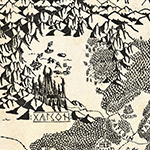
Klaes, after drinking two beers, leaned toward the Hostand detailed everything about the events in Maghon, about the Elixir, and how Master Talantius had sent them north, and that they should head to either Sairis or Xalgon. “Perhaps you will recommend which direction we should take. The barbarians are approaching fast, and our task is to deliver the Elixir somewhere they will know how to make more,” Klaes concluded his tale.
“So an age ends. I didn’t like that web anyway. As it usually happens, the result of an effort is often the exact opposite. Hm. An age of barbarism and chaos. Hm. To be honest, the inn is not in danger. But I would feel sorry for the inhabitants of Iacana. Hm, hm. So I will summon them inside; they will take shelter here. And you will still have to tell me in detail what happened along the way.” The Host winked at Jarn.
He had no choice but to take the floor. He recounted everything truthfully and without embellishment, though in verse. The Host listened and nodded. When they reached the part of the story about the bird painted on the wall, Jarn unwrapped the strip of silk he was hiding his hand in. For the first time since they had been sitting together (meanwhile it had grown dark outside), a shadow of concern washed over the Host’s face.
“May I look at it up close?”
Jarn nodded, and the Host examined his hand in detail for a while.
“That is an ancient technique,” he said then. “Two souls in one body.”
“Saguin!” Jarn burst out. “I dreamt about him, that he dreamt he was me. We descended into the depths of the Temple. Timot lies there on a bier, as if merely asleep.”
“We found Timot’s diary, here it is,” Klaes tapped the breast pocket of his coat. “And the Temple really is there.”
“Yes, yes, there is an ancient Temple under the Silver Mountains. Even the Three Foxes Inn has not stood as long as the Vezanian temples.”
“Does that mean a Vezanian spirit walks with me?” said Jarn, who was only just recovering from what he had realized. “Is he bound to me? Treading on my heels? Can it be cured?”
“Vezanians, that doesn’t necessarily mean outright evil. They just have a somewhat depressive aesthetic. And as for healing, certainly something could be done. But to tell the truth, I do not much favor this kind of magic.” The Host stood up. “And now excuse me. I must go warn the inhabitants of Iacana. I will hide them here.”
“How will they fit in here?” Al-Raqím wondered.
“Let us say that the foxes endowed us with as many rooms as there are guests,” the Host smiled. “And I am the Host because I have a sense of moderation. If the boundaries were breached, the foxes would be angered. Will you have another beer?”
With another blink of an eye, full tankards were placed before the pilgrims, and the Host departed. The Huntress also slipped away somewhere. Klaes, Jarn, and Al-Raqím sipped and, with their heads together, quietly discussed where they should go. It is closer to Sairis. The journey to Xalgon is longer, and they know how to heal such injuries as Jarn suffered there. Perhaps.
- “Whoever carries the coaster in his hands while wandering through Urulóka will arrive at the Three Foxes Inn every twilight, regardless of where his path led him. For the Inn has no fixed place in Urulóka, but appears at twilight to those invited.” ↩︎