In the following essay, we will summarize the basic mistakes a Narrator can make while leading a game—mistakes that, according to experience, many Narrators indeed commit. If you find that your dear Narrator is full of flaws and yet you haven’t found their caricature here, do not hesitate to write to us; we will be delighted to sketch your “god” for you.
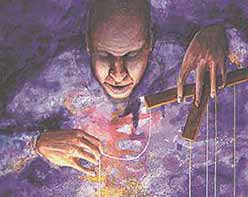
The Narrator-Manipulator
The Narrator of this kind falls into a mistake that is almost the most common and, above all, so widespread that even most high-quality Narrators succumb to it to some degree. Yet, it takes very little to rectify it. This type of Narrator has a linear story in their head, full of interesting encounters and tense situations, and during the game, they desperately try to keep the characters on the thin rope of this linear plot. Outside of this line, the world exists only very hazily or statically.
If the characters turn off the path into the forest and decide to go a different way than the Narrator intended, suddenly enraged beasts start running into their path to block them, or druids emerge from the bushes subtly trying to “advise” the party that it’s really best to get back on the road. The comedy takes on various levels depending on the intelligence and camouflaging skills of the Narrator.
The characters are not only limited by the Narrator in that they cannot go “sideways” or “elsewhere,” but they are also limited within the one-dimensional line of the game itself—in the sense that they MUST encounter what the Narrator has prepared for them, in the exact order and under the conditions the Narrator dreamed up. The ultimate crisis occurs when the Narrator places a “terrifyingly fatal” problem before the players, expecting a dramatic escalation of atmosphere, only for the characters to come up with a quick and simple way to overcome the obstacle that the Narrator forgot. At that moment, the linearist Narrator-Manipulator will likely start sweating and inventing reasons why “it just won’t work”—suddenly, a stone wall appears where there was once a door, or the obstacle cannot be levitated “because, um, there is unknown magic, um, preventing it, um.”
Difficulties of this kind can be found with many beginning Narrators; they primarily concern the technical resolution of situations, where rules and numbers play a major role. However, even more sophisticated Narrators with a broad imagination can be “Linearists,” even if they can hide it well by not arguing over technical trifles. I would call these advanced Linearists the Narrator-Novelist.
The Novelist is usually an educated person with a great imagination who dreams up the whole story—characters and all—as a grand novel with plenty of betrayals, loves, unexpected revelations, and dramatic moments calculated down to the second. The problem is that even if they wanted to write it as a novel and no one had a say in it, the plot probably wouldn’t end up the way they dreamed it one summer afternoon; in a living novel, characters come to life and sometimes act according to a logic that only emerges after writing 100 pages.
Setting the novel aside—this Narrator has attempted the total impossible: to cram several other people with their own motives and concepts into their romantic vision. Much like in meteorology, the “butterfly effect” ensures that after just five minutes, the game no longer looks exactly as the Narrator imagined, and after two hours, their whole plan is in ruins because the living reality of the game has overpowered it with its own concepts and intentions. Nevertheless, many a desperate Novelist refuses to back down and continues to fight for their now-meaningless dramatic fragments, forcing the characters—through various “accidents” and manipulations (which can even take the form of emotional blackmail)—to live out their romantic story.
It is obvious that not all games are only about the personal activity of the players and that even high-quality games can have a strong story. How, then, can one avoid the flaw that even the most experienced Narrator can commit from time to time? First, it is important to realize the very foundations from which the problem arose. Why does the Narrator force the characters? Because they want them to enjoy their dramatic plot. Why do they want them to enjoy it? Because they want them to have fun, to experience the emotions of their characters, etc. That is the basis. Unfortunately, this path leads to the exact opposite of the original intent—instead of fun, annoyance; instead of freedom of action, slavery in a universe where the Matrix reloads every 5 minutes to prevent the characters from going where they want.
The solution: The Narrator must realize that their true fun is the fun of the characters. If they want to lead them to a Great Story, they should not construct it as a linear structure, but as a system of “nodal points” between which there is completely free movement.
The Narrator – Deus Otiosus

This kind of Narrator is, in many ways, the opposite of the aforementioned Manipulator. Deus Otiosus is a term from religious studies meaning an “idle god”—a god who created the world, is omniscient, and theoretically omnipotent, but now just lets the world “run” according to the laws they designed and no longer intervenes.
In the role of the Narrator, this principle manifests as running the game where the Narrator is passive and only reacts to the activity of the characters. It is a seemingly perfectly fair approach—the Narrator only simulates the cosmos and doesn’t push their story anywhere. The problem is that such an approach is fallacious if taken to the point of ad absurdum. An RPG is not a simulation of reality, and its purpose is not to be an impartially non-participatory and perfectly objective bore, but primarily to entertain and inform. The Narrator is called the Narrator because they are something of a “wizard of words,” not a computer that only reacts to environmental changes.
The “Bank Key” Example
It might seem that despite what I state here, this approach is quite good and its practical flaws are not visible. Let me try to give a few examples. A typical Deus Otiosus, for instance, has it decided that the secret doors to a bank can only be accessed with a secret key. One key is held by the bank manager. The second is held by a certain Mr. D. The third has been lying for two days in a decorative flowerpot in the square because Thief A left it there for Thief B. Only an old herbalist saw the key being placed in the flowerpot.
The characters need to get into the bank. They walk around the town. They try the underworld. Unfortunately, at one point when it was obvious, they don’t ask at the spice shop and therefore don’t meet the old woman. They also, unfortunately, don’t bump into the flowerpot and the key doesn’t fall out. The banker, of course, won’t give them the key, and they don’t find out that Mr. D. has a key because they can’t ask the right way, and the Deus Otiosus won’t spontaneously tell them anything because it’s “against the rules.” Two days pass and the second thief picks up the key in the flowerpot. Quest failed.
If the Narrator were not a Deus Otiosus, they would simply throw the herbalist woman in their path in an alley in the evening as she is being mugged by drunks. The characters, of course, help her, and she mentions the key as a reward. Or, if the characters don’t bump directly into the flowerpot, a cart could knock it over and the key would roll with a loud clink right to the feet of one of the characters before heading for the sewer. Hooray, adventure! Sure, it’s manipulation, but an RPG cannot do without manipulation. (Here, I’m gaining credit for all the manipulators.) If the world of an RPG were as “lawfully correct” as that city in the hands of the Narrator called Deus Otiosus, the characters would encounter nothing; when they did encounter something, they wouldn’t understand it; and when they did understand it, it would be too late anyway. Which isn’t a very pleasant game.
© 2004 Jan Kozák Jr.