In the center of the visible world stands the city of Arka, and in its midst burns the Great Auran—the fiery frontier protected and maintained by all the Hwarnij. Through its power, the Great Auran creates the entire surrounding world, which could not endure without it. In the evening, the stars are lit with the aid of the Auran, and in the morning, a new sun is formed from its combustible vapors. In the past, all fires were lit from the Auran; even the fire that burns within living beings, causing their thermal radiation, originates from the Auran.
THE LINEAGES OF ARKA and Their Families
Vinair
Angiras – Priests
Atharvan – Magoi
Chaktra – Warriors
Archinau – Horses
Melittar – Bees
Aidar – Builders
Karian – Hunters
Vina – Fowlers and poultry breeders
Kanva – “Verse-smiths” (Poets)
Kvanari
Angiras – Priests
Atharvan – Magoi
Karian – Hunters
Kanva – “Metal-smiths” and ceremonial musicians
Pharain – Fruit, orchardry
Símiar – Grain, classical agriculture
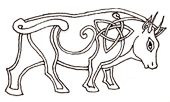
Gavain
Chanur – Cattle breeding
Avis – Sheep breeding
Aigan – Goat breeding
Narka – Pig breeding
Kartha – Craftsmen / woodworking
Vastira – Craftsmen / clothing
Utuni – Plants with edible parts underground (Tubers)
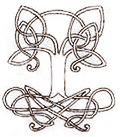
Santra
Ruvan – Those who provide wood
Druvida – Forest sages
Angiras – Priests of the Tree
Atharvan
Makartha – Collectors and growers of forest-type fruit

Argialdar
Cúir – Archers, protectors
Ailinan – Healers
Vanatari – Rangers
Lantarvida – Plant experts
Askravida – Star experts, priests
Alphi – Fairies, elves
Arguvain – Silver-shapers
Five kinds of fire are recognized according to their importance:
The Invisible Flame burning before the throne of Machuznatar.
The Great Auran, whose life in the heart of the Arkian Citadel is maintained by the Hwarnij; it is one of the primary manifestations of the Invisible Flame.
The Fire of the Sun and Stars, which rise daily from the sparks and vapors of the Auran.
The Fire within Living Beings, whose souls are made of a substance similar to the stars.
Fire created by burning wood is the lowest of the fires, so distant from its origin that even dark powers may use it.
Old legends tell that long ago a terrible storm arose, and the radiant world of men was seized by destruction. Then the nation of the Hwarnij walked through the storm, seeking a place of salvation. They carried the sacred fire of their homeland in a staff, and from it, the fire was rekindled at the site of the current Citadel.
The Great Song was chanted, and from the staff, along with a spark of the Auran, came Machuznatar, who, strengthened by song and fire, defeated the serpent and wolf demons. They grew fearful of the Sun, which only then, after long centuries of darkness, rose over Arka and drove away the Moon. Though the demons lost, they kept the night as their time. Some of the subjects of these demons chose light instead of darkness and joined the Hwarnij—these became the Darins.
Fire sustains the world so it does not grow cold and die. Just as simple fire lives on wood, the Great Auran lives on devotion, loyalty, reverence, and above all, the Sacrificial Song. In short, on humanity. Serpents, wolves, and the Moon are abhorrent to it, for they are cold, calculating, and heartless. Therefore, people must constantly strive to ensure the fire does not go out. In the morning, the Sun is lit by the Song, and in the evening, the fire is scattered; from its sparks, properly set upon the sky, arise the stars that protect the night from total darkness. The center of every human dwelling is a hearth or fireplace, just as the Auran is the center of the whole world and the warm heart is the center of every person.
Whoever travels outside Arka as night approaches must master such powers that the fire they settle by in the evening has power similar to the Auran to protect them against the night. For as soon as the Sun sets, all places not under the protective power of the Auran or one of its descendants sink into utter darkness and chaos, ruled by fiends.
IMPORTANT CONCEPTS:
Hwarnij (or Arkins): A nation of brave fire-worshippers. They are short in stature, typically with fair skin, dark hair, sharp noses, and thin lips. Their nature is cheerful and social, yet stubborn and strong-willed. Their kin-based society is highly collectivist, prioritizing the whole over the individual. Skills in which they excel: singing, storytelling, memory, self-denial, sacrifice, and a strong sense of duty (following the “spirit of the law”).
Hwarnil: Sun, radiance, light.
Machuznatar: The mythical first ruler and founder, victor over demons, and guardian of the Invisible Flame.
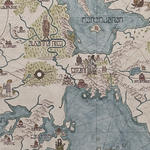
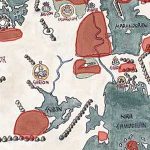
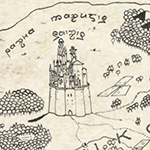
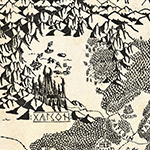
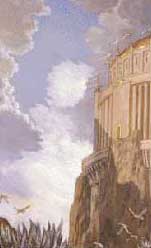
Arka: The stone city of Arka sits atop a mountain in the middle of an island, in the middle of Lake Erdogdu, in the middle of forests, in the middle of a ring of mountain peaks. In its center is the temple where the Auran burns. Arka is protected by massive walls built, according to ancient legends, by giants of the Old World. In the walls are four gates to the four cardinal directions.
Lake Erdogdu: A clear and beautiful lake surrounding the island of Arka like a great ring. It mirrors the stars and hides many secrets in its depths.
Citadel: The roofless temple in the middle of Arka where the Great Auran burns eternally.
Darika: The lower wooden city that three-quarters surrounds Arka. It is inhabited by non-privileged residents—the original islanders and various outcasts. Their lesser rights are balanced by fewer duties; they may drink alcohol, eat as they please, and engage in primitive theater. Consequently, the Darins are often seen as superficial, hedonistic, and wealthy.
Lerna: A colony village of Arkian Hwarnij. In its center burns one of the Sons of Auran—a fire capable of holding back night and chaos.
During the game, characters discovered that Arka was attacked by shape-shifting demons (human/wolf form) who are resistant to the power of the Auran. They successfully penetrated Arka, but their attack was repelled with the help of our heroes.