- When I visit Sirania, what will it look like? Will there be “Mediterranean” forests and plants in the south and mixed/coniferous ones in the north?
- Are there fields? What is usually grown on them? Is it similar to Europe?
- How populated is the territory of Sirania?
- Is the country divided into administrative units, or is it centrally managed from Sirgon?
- How does the Siranian economy work?
- Do technical inventions exist?
- How do people commonly make a living?
- What metals are commonly mined?
- How dense is the network of roads and paths?
- What kind of transport is used? Horses, wagons, or something else?
- What about banks? Do they exist?
- Are Siranians racially segregated?
- What is the system of government? We know that two Empresses rule now, but who do they rule over? The Ministers?
- Does every city have its own mayor? Is there anyone like a regional governor? Are taxes paid to the treasury?
- What kind of food is eaten in a normal family?
- Are there taverns (any difference compared to our world)?
- Does theater exist?
- Is music played?
- What about folk customs? Are there holidays celebrated throughout the Empire?
When I visit Sirania, what will it look like? Will there be “Mediterranean” forests and plants in the south and mixed/coniferous ones in the north?
Indeed, something like that. Furthermore, Siranian forests are true forests—meaning primeval woodlands, not “tree fields” cultivated for timber. Naturally, forests differ in character just as human communities do. Individual forest cultures can be recognized by their scent from afar. Any Elf or Dryad can tell without difficulty which Siranian forest they are currently standing in. These forest “states” have various names in the languages of Elves, Dryads, and Siranian hunters. The common man, however, only superficially notices that the northeast is typically birch, the north is oak-spruce, the northwest has a strong pine element, and so on.
As for the trees, species other than “earthly” ones occur in Sirania—essentially, even what we might call a “beech” is not a European beech, but the closest relative to it; it has silver bark, leaves shaped like a Siranian eye, and it is slender and tall. Biologists should not fixate too much on exact properties—the names are merely working titles; the true names of the trees can be found in the Siranian dictionary.
Just as there are the Unborn or the Firstborn among the Elves, there are Patriarchs among the trees—ancient ancestors of current arboreal races, or older generations of trees, like “giant horsetails” of past ages that have survived on the face of the earth to this day. These obscurities are mostly hidden in the depths of the wildwoods, in remote valleys where the current age has not yet managed to seep in.
Are there fields? What is usually grown on them? Is it similar to Europe?
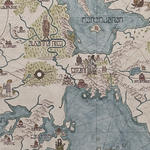
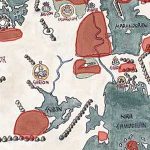
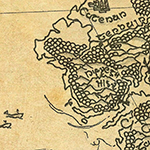
The map is very schematic, but it approximately corresponds to the truth. Where you see depicted fields, there truly are extensive fields—though, of course, interspersed with forests, orchards, and groves. Sirania, naturally, lives primarily off agriculture, as bread is the main side dish and flour is the basis of most meals. Various cereals, root vegetables, hops, etc., are grown in the fields. In the south, famous vineyards and tobacco plantations stretch across the land. Sirania knows nothing like our corn or potatoes.
Orchardry plays a very significant role in Sirania. This is a legacy of the Elven upbringing the Siranians received during their “Middle Ages.” Elven states subsist entirely on trees and can utilize them without harming them in the slightest. Elves loathe the plow and the turning of topsoil, but most of all, they detest the scythe and the harvest. The disadvantage of an arboreal economy is that if a plundering army destroys a field, it can be replanted next year; if they destroy an orchard, people are without food for years. Sirania stands halfway here. Fruit is an essential component of the diet; moreover, they learned from the Elves to eat chestnuts, beechnuts, and other fruits unknown to us.
How populated is the territory of Sirania?
There are regions where the density of villages and towns is higher (on the map, this roughly coincides with the areas marked with fields); one can imagine a network similar to Czech villages in the Bohemian-Moravian Highlands during, say, the Baroque era. There is no sharp legal boundary between a hamlet, a village, and a small town; they differ only in size. The Great Cities—Sirgon, Sir, Sairis, Asvittara, etc.—on the other hand, differ significantly. They have their own privileged rights and self-governance, answering only directly to the Empress, not to any ministers or sub-administrators.
Cities outside these “Great” ones can, of course, be found, usually located in the centers of agricultural regions or at major trade route intersections. Some are simply overgrown villages, while others were created as organized projects of the Crown—these cities are built according to the designs of famous Imperial architects; their appearance is noble, though not as rich as Sirgon. At their center, they usually have a well-laid-out square, a town hall in the governmental style, a school, a library, baths, and a central temple of the Eternal Emperor (Eternal Brothers). Both types—the overgrown village and the architect’s masterpiece—can be distinguished very quickly.
Is the country divided into administrative units, or is it centrally managed from Sirgon?
The regions belonging to city-states such as Arkagas, Adamas, Asvittara, Sairis, etc., are administered from those cities. The Archaics govern themselves, as do the Dryads—the only thing they have in common with the Empire is their commitment to uphold the Siranian Constitution and to provide a certain number of warriors when a “Just War” (i.e., one approved by the entire Empire) is waged.
Centrally managed from Sirgon are the areas of the so-called Western and Eastern Siranian Plateaus. This includes, firstly, the vast area north of Sirgon, east of the Ma Sarit, west of Barazgiri, and south of Sairis and Asvittara; and secondly, the equally extensive lowland area west of the Simanas Mountains, the coastal lands toward the island of Vaktar, the plains around Sir, and the northern coast under the Adamas Mountains up to the borders of the city-state of Adamas. The administration of these regions is a matter of a noble-bureaucratic hierarchy. However, there is no independent nobility that owns “their” estates. All territory under the Crown’s administration is sheltered by the power of the Empress. The only independent territories are the aforementioned city-states, which are joined in an Imperial Federation and, of their own free will, submit to a common government.
How does the Siranian economy work?
Sirania could be loosely compared to a feudal state. Most land and real property in the country traditionally belong to the Crown (the Emperor), which grants it in fief to noble houses. In many cases, these fiefs have long been permanently assigned to certain families. However, ownership never fully transferred to them, and although no one can imagine the Parha Marutis being ruled by anyone other than the powerful Sun Alogar house, their hereditary fief does not actually belong to them, and the Empress could strip them of it at any time.
Due to the unique nature of Siranian governance, however, “landowners” are not recruited solely from the courtly retinue and commanders, but are chosen for their office through a complex method involving divination and consultation with the Gods. Thus, many owners are not noble in the bloodline sense, and many nobles are not owners. Within the “tree structure,” there may be vassals subordinate to first-level vassals, and so on. There are also a few who were granted land by Imperial decree until the “Sinking of the Earth”; while they are subordinate to the Crown and pay dues or provide troops, their land cannot be taken even if they break the law. These are usually not large tracts, and the figures whose houses earned such privileges are exceptional.
The foundation of the economy is therefore agriculture. The country also lives significantly through trade. The Siranian government encourages the commercial activities of its inhabitants, so one can encounter many Siranian merchants on the road even abroad.
While life in the countryside is still fully feudal, the cities seem to exist in a different age—famous architects build temples, museums, baths, and shopping centers; famous composers present their symphonies; mages study in vast parks around their towers; financiers speculate on exchanges; and renowned courtesans dedicate themselves to ethnic minorities at benefit concerts.
Do technical inventions exist?
Siranian society is actually very “advanced,” but its inventiveness took a different direction than that of modern Europe. Consequently, many things central to us remain on the periphery of interest, even if they are available.
Some examples:
Printing: Functional printing presses exist in Sirania—their products include public provincial proclamations, school textbooks, etc. However, printed books hold very low social value. There is even a different word for them, similar to “copy” or “fake.” In contrast, a hand-written book is of true value, the center of fetishistic interest for both scholars and commoners. All essential materials intended to appear authentic or permanent are therefore written by hand. Magic also contributes to this; over generations of development, it has been successfully bound to the psychological process of writing with a quill, such that handwriting is protected against fire and water. Most scribes also master the psionic technique of speed-writing.
Paper Money: The currencies used in Sirania are “full-valued”—meaning their price derives from the value of the coin’s metal and not from the immediate state of international trade or the exchange situation. This, of course, limits the dynamics of finance, but it brings stability that the government is unwilling to give up. Promissory notes and vouchers exist, but paper money did not evolve from them.
Electricity: Electrical phenomena are theoretically known, but there is no combination of social conditions for electricity to be widely used. The needs of scholars and the wealthy are fully covered by a plethora of magical techniques, which are usually more efficient than working with electricity, and ordinary people make do with candles.
Architecture: Knowledge of architecture combined with spatial magic and other esoteric doctrines has created a very advanced architectural culture. Custom-built houses from a member of the Architects’ Guild are aesthetic and technical gems that withstand many disasters, including fires and earthquakes.
How do people commonly make a living?
People live by labor, just like everywhere else. Farmers work in the fields or orchards. Masons, carpenters, and blacksmiths by their professions. Is there anything specific? Probably not. There are more orchardists than we might expect, given the amount of orchards in the Empire. There is also a larger number of various maintenance jobs organized directly by the government, aimed at keeping cities, roads, and castles clean and functional—which they succeed at, making Sirania appear as an extremely clean and tidy country. Many people also live by trade and, especially in the cities, by services.
What metals are commonly mined?
Both precious and utility metals are mined—practically everything that can be mined. There are large silver deposits in Sirania and plenty of iron, copper, and other utility metals. Besides that, extremely rare metals such as platinum or magical metals can be obtained through magical means.
How dense is the network of roads and paths?
Broad and perfectly maintained roads run between all major cities (of which there are approximately thirty). The main backbone of the roads, however, consists of two Great Ways—one from north to south, the other from west to east—which intersect in Sairis. On these two roads, every 40 miles, there are so-called milestones or indicators of distance to Sairis. Besides this great arterial backbone and those major roads, there is, of course, a large web of paths and trails, though these are not necessarily paved. A white paved road overgrown with moss or short grass is one of the most classic images of the Siranian countryside.
What kind of transport is used? Horses, wagons, or something else?
Horses are normally used for transport. Wagons and ships are used for cargo. Horses are specially bred, each race for its purpose. Regarding animals cooperating with humans, in mountain areas, various animals are used depending on the cultural region—mountain horses, mountain bulls, mules, Targs (large goats), and others. Among the very rare are giant eagles and griffins, though they never carry cargo, only people.
What about banks? Do they exist?
Yes, they do. Private banks deal with money exchange, lending at interest, and safekeeping. There is no “state bank”—only the State Treasury, which has a different function. Banks of foreign origin do not have it easy in Sirania, though established brands from Garion and Havdaur are inevitably present.
Are Siranians racially segregated?
Toward the south, the concentration of Black Siranians gradually increases, but the divide is not sharp. The two Siranian lineages are not “races” in the common sense, but arose from a magical, fateful polarization. Therefore, they have different talents and different “essences.” Each lineage naturally gravitates toward different things—for example, the Black Siranians toward seafaring, physical labor with materials (blacksmithing, carpentry, pottery), they love the touch of material and the touch of the body, they breed animals, care for the sick, dance, and drink alcohol, among hundreds of other specifics. The White Siranians, on the contrary, would ideally levitate above the earth and avoid contact with it; they favor firm ground, order, organization, numbers, systems, thoughts, offices, paper, writing, task fulfillment, trees, paintings, noble music, and a thousand other things.
All of this naturally separates the communities both geographically and within each region according to practice. Yet, nothing like ghettos arises; in cities, Whites and Blacks live side by side and build no walls between themselves. Mostly, Blacks and Whites need each other; they are complementary. One cannot truly exist without the other. People of both lineages firmly identify with their identity and are proud of it.
What is the system of government? We know that two Empresses rule now, but who do they rule over? The Ministers?
Yes, the Empress(es) have advisors and assistants who concretely realize their will. These are called Ministers. Ministers, in turn, have human and material resources to carry out their work. However, everything is more complex due to the presence of liege lords, who are another link in the descending tree of organization.
Does every city have its own mayor? Is there anyone like a regional governor? Are taxes paid to the treasury?
Yes, cities have their “mayors.” However, how much power such a city administrator has is determined by tradition and the cultural situation. In some places, cities are despotically managed by a single lord; elsewhere, the leading element is a city council that elects only a statutory chairman with the function of a mayor, who nonetheless follows the council. As for taxes, the law mandates the payment of a tithe—no more, no less. However, in places out of sight where questionable lords or mafia-like associations rule, it is quite possible that people pay taxes in percentages as outrageous as those paid by today’s working person.
What kind of food is eaten in a normal family?
Food depends on the location. Families by the sea have a preponderance of fish; families in the middle of fields live on grain products, vegetables, and fruit. Hunters bring home venison, and shepherds eat mutton. Families with Elven blood or Elven traditions eat light Elven meals. Families near the borders of Gandhara sometimes adopt the strict vegetarian diet of the Gandharans.
Are there taverns (any difference compared to our world)?
Taverns exist and hold a somewhat different status than in our world. Famous taverns (called Inns) have centuries-old histories; their innkeepers are remembered even with the dates of their “reign,” much like kings. Inns are, in a way, temples—a “Peace Oath” is respected in them, so enemies can feast at one table and yet not raise a hand against each other. The most famous Inn of this kind is the Inn at the Three Foxes, of which enough has been said elsewhere.
Besides these famous Inns, there are ordinary taverns. Their quality varies greatly, and an experienced traveler can usually tell from the outside what kind of company they have stumbled upon. Taverns of unknown names can hide many unexpected things—they may be dens of thieves, kitchens of human flesh, or gateways to dark realms. Every innkeeper thus tries to create an environment as welcoming as possible to resemble the safety of the famous Inns, because even a small skirmish can grow in people’s mouths into a legend that causes interest in his establishment to turn away.
Does theater exist?
Theater is known in Sirania, but it is an import from Garion and Havdaur, and except for Sirgon, it has practically not taken root. Garion theater has several sub-types, depending on whether it is played with masks or ritual makeup, whether it is spoken, recited, or sung, and so on.
Is music played?
Music plays a significant role in the lives of Siranians, though not as fundamental as among the Arkagantians, Archaics, or Gandharans, whose cultures are built directly upon music. Most Siranians enjoy singing and playing instruments, and village festivals are never complete without proper musical accompaniment or a concert. In the cities, of course, a sophisticated musical culture flourishes.
What about folk customs? Are there holidays celebrated throughout the Empire?
Holidays are, of course, celebrated. There are state holidays and local holidays. State holidays concern the great nodes of the year—solstices and equinoxes, full moons, and new moons. They are also linked to the reign in the sense that the Opening of the Scepter is a holiday, along with many others. Local holidays are either folk festivals for the purpose of increasing the fertility of women and the land, or holidays linked to sacred places and specific beings inhabiting the surroundings. Besides that, there are holidays celebrated by various deities, attended by those who honor them. Some of these holidays have become generally popular, such as the winter cleansing festival of Pallas.
Most people (especially in the countryside) also live through their daily rituals—if they see bad omens, they ward them off; if they see something good, they bless it; they greet the rising sun and the morning star three times, a returning friend, a spring of water, the moonlight, the priest, etc. These folk superstitious customs also vary considerably from region to region.