A report for the Sirgon Archive by the researcher and adventurer Dartev sun Gaih concerning the culture, land, and state of Argolin.
The Dark Elves constitute the youngest group of Elven migration waves. Genetically related populations (though now possessing distinct traits) can be found on the mainland in the continent’s mountain ranges or scattered across coastal regions. Their largest racially relatively pure state is the island kingdom of Argolin.
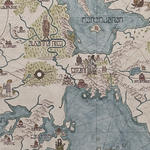
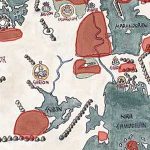
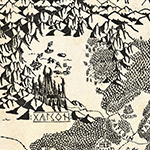
Argolin lies 1,000 miles north of the parallel upon which Divine Garion rests, and approximately 6,000 miles west of the Garion meridian. It is the westernmost outpost of the civilized world. Further west lie only the terrible and tempestuous Seas of Ruin, inhabited by sea serpents, fearsome whales, and spiny lobsters larger than royal ships. Argolin rightfully reigns over the world’s western coast, for its fleet is unmatched in those regions. The state maintains warm relations with Garion and the larger Northern Kingdoms, has a peace treaty with Xalgon, and in recent years has been at peace with Havdaur—though past centuries were woven with their mutual struggles for hegemony over the western coast. The coastal peoples do not love the Argolin Elves, as they were often victims of their plundering and wars. The King of Argolin is the mighty Tanith, father of the Dark Elves of the Firstborn lineage.
History
For long centuries, the Dark Elves struggled for bare survival on the slopes of the Argolin islands, squeezed between a dangerous sea and mountain forests held by fierce Druids who refused to yield an inch. The Dark Elves gradually acclimated to the harsh conditions and permanent threat; they discovered fish-rich currents and learned to navigate the immensely rugged coastline of Argolin, full of capes, fjords, reefs, and caves. In this way, they developed resilience and a keen sense of orientation. They weathered several attacks (from Sea Peoples, the Xalgon Empire, and Havdaur), driving some enemies into dangerous straits and whirlpools and demolishing others with catapults from the slopes, though they could not defend the coastal villages and towns. After each attack, they started anew. But this, too, steeled them—they learned to observe the sea from afar and to move their forces rapidly across the impassable island slopes. They transformed from a forgotten small folk into a naval and commercial superpower almost overnight.
Two significant events, occurring barely a year apart, enabled this sudden metamorphosis. After the last sea invasion, their towns lay once again in ruins, and there was neither shelter nor food to survive the approaching harsh winter. A leader of one of the clans dared to venture into the Druidic forests to plead for food and shelter, as the situation was desperate. After long negotiations, all clans that agreed to the harsh conditions of their former enemies were taken under their protection. They swore that they would not fell a tree without the Druids’ permission, that they would recognize Druidic magic and religion as their own, and that henceforth they would follow their counsel in matters related to magic, the forest, and all of nature. In return, the Masters of the Forest helped them in many ways—initiating many into their doctrines, employing others in their expanding orchards, and allowing them access to the higher parts of the islands.
The clans that did not accept Druidic power met a miserable death. A year after the Reconciliation, a second major event occurred. During a famed adventure, a clan chief discovered extensive gold deposits in the south of the archipelago. A few years later, deposits of rare platinum-group metals were found further north. (This entire find is shrouded in mystery, as platinum metals do not otherwise occur in such concentrations). Furthermore, most of the now-accessible rivers proved to be gold-bearing. The settlers were threatened by gold fever, which was immediately cooled by the stern gazes of the formidable, bearded Druids. They allowed mining only from the riverbeds. “Mother Earth must not be exploited,” they claimed, but what the rivers wash away would only roll into the sea—toward which the Druids held no warm feelings. From this moment begins an unhindered cultural ascent that continues to this day. A small limitation for the warlike nation of Dark Elves remains the fact that iron ore deposits are very small, practically limited to the southernmost steep islet of Eimon. The demand for raw iron is thus met through trade with the mainland and other islands.
Today’s State of Society
From the outside, it appears stable and strong, but inside it hides subtle controversies that place it on a knife’s edge. Society has somewhat “cracked” due to the rapid expansion of its possibilities, which has affected the psyche of some wealthier citizens who suffer from various forms of madness, megalomania, and morbid pride. The individual clans balance each other’s power, and any shift in force would shove the system from equilibrium into chaos. Except perhaps for some of the Arduinns, the Dark Elves are mostly blinded by a desire for greater power, and a weakened clan would be torn to pieces by the other two.
Furthermore, preparations are underway to open larger mines for precious stones to the north and gold to the south. The Druidic power group has gently weakened over the centuries, lulled by its superior position, and has partially merged with the Elves. Meanwhile, the Cathadans grew rich, the Amairgens built impregnable fortresses and mighty fleets, the Arduinns learned magic, and the Druids were suddenly no longer needed.
Their former subjects were allowed such growth that they have outgrown their masters. The only thing restraining the Dark Elves from an open breach of ancient laws is the lingering power of a given word (they dare not break an oath) and a silent fear that the Druids know something more, or that their power is greater than it appears. Druids are not the type to show their cards… It is possible that in areas where even the Arduinns have no access, something is hidden that makes the Druids so powerful and certain of their position—some legacy from the days of the Fanesgic Empire or perhaps even older…
Physical Appearance of the Archipelago
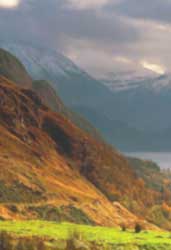
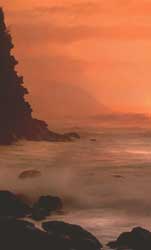
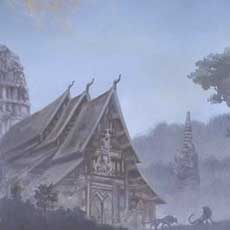
Simply monumental—fantastically shaped cliffs rise from the foaming sea to immense heights. Coastal and inland slopes transition seamlessly into complex mountain ranges that expose their snowy peaks to the sun at an altitude of 2,000 meters above sea level. But even that is not enough; above them rise peaks that exceed them by another 1,500 meters. Upon the snowless tower-rocks nest the Argolin Gryphons, the largest birds of the known world.
Below the region of ice and inhospitable rocks are pastures for mountain cattle, scrub, and the first small groves. Below these, a wide strip is occupied by a very dense mixed forest, the domain of the Druids. This forest often reaches the sea shores, and many secrets are hidden in its misty, valley interiors. In places where the coastal area is more gently sloped, there are extensive fertile pastures, many of which have been converted into fields by human (Elven) activity. The archipelago is surrounded on almost all sides by the open ocean, which is very dangerous in this area due to its confused currents, supported by the tidal pull in the inter-island gorges. Sharp gales often blow from the west, demolishing the results of civilizational efforts and uprooting even mature trees near the coast. Waves triggered by these gales sometimes reach ten meters in height and, along with the wind, are the bane of unprepared mariners.
Population
The original inhabitants (aborigines) of the forests are the Druids (Drvidir, Druvidir, Dryidir) and the Dryads (Drvads, Druvads, Druads), their women. In the lowlands and cliffs, the substrate Fanesgs—originally perhaps a sea people, but by the time of the Dark Elves’ arrival, merely “cave rats” defending themselves against immigrants with bronze weapons and black magic. In some areas, the Fanesgic element was not entirely displaced, leaving linguistic, anthropological, and ethnological traces. Little is known about the antagonistic relationship between the Druids and Fanesgs in the times before the Elven invasion.
There is a view that west of Argolin there once existed another larger island, the center of a mighty empire that fell into darkness and perished in ruin. The Druids claim that the Fanesgs are the last refugees of this thoroughly evil society. More objective theories suggest that both the Druids and Fanesgs are common heirs to some older, now-extinct culture. However, both groups took divergent paths from the beginning. The ancient culture might have perished precisely due to internal antagonism—a split into two distinct warring groups, the remnants of which are perhaps the Druids and Fanesgs.
Gryphons
The Druids always had contact with the Gryphons, which later became important transport and combat animals and, among other things, the heraldic symbol of Argolin. The Argolin cliffs uniquely suit Gryphons, and thus their numbers expanded here to a usable figure; elsewhere in the world, they are an exception. What is a difficulty for humans and Elves—mad winds and inaccessible rocks—combined with an ocean rich in fish of all sizes, creates an ideal combination for these giant feathered creatures. In appearance, the Gryphon resembles a bird of prey like an eagle, but besides wings, it also possesses front talons. In size, it approaches a medium-grown dragon. Its intelligence has not been sufficiently explored by other kingdoms; perhaps only those who can “brother” or tame a Gryphon and fly upon it can say something of it. In combat strength, a Gryphon cannot compare with a dragon—the reptile is superior—but in speed, the Gryphon surpasses the dragon.
Geological Past
The archipelago’s form was created by the folding of original seabed sediments at the seam of oceanic plates. In the geologically recent period, however, the area was hit by a series of volcanic events that first lifted the mountains even higher and eventually erupted onto the surface in the form of several volcanoes in the central part of the archipelago. During these events and later (as the area remains tectonically active today), some islands perished or subsided, disappearing beneath the surface. Some nearly touch the surface, creating extensive areas of sub-surface reefs. In Argolin, deposits of precious metals and stones naturally coincide with areas of igneous rocks.
Main Danger Zones Around the Islands
Currents and Winds – see above; treacherous currents with strong pull in the vicinity of the islands, and winds reaching hurricane force in gusts, blowing particularly from the west. (But also from other directions).
Mists – the meeting of warm and cold currents creates mists at sea; the mountain ranges themselves trap cloud cover, and the mainland slopes and valleys are often shrouded in steam of volcanic origin (geysers and hot springs). All this contributes to the fact that sometimes it is simply impossible to see a step ahead (or a knot’s length for ships).
Maelstroms – in areas where opposing currents meet and near island straits, giant whirlpools often form. Some are permanent, others temporary. Ignorance of these whirlpools has never served anyone well.
Shoals and Reefs – many of the high mountain ranges of the Argolin Islands continue beneath the surface; sometimes it is too late by the time one realizes this in practice. Parts of islands, and occasionally entire islands, have submerged during tectonic shifts, some not very deep. Certain sub-surface or surface formations have been hollowed out by peculiar creatures, creating “basins” whose jagged edges hide sometimes only 1–5 meters below the surface; at times, waves do not even break upon them due to their sharpness and small area.
Misty Rocks – an area southwest of Argolin, quite extensive. Perhaps due to volcanic vapors, or perhaps the activity of certain animals or plants, this group of rocks is constantly shrouded in mists that have hallucinogenic effects. No one who has ventured there has ever returned. Even gryphons refuse to fly there. Perhaps these are the ruins of the original Pelasgic Empire.
Volcanic Phenomena – occasionally, there is a spontaneous release of large volumes of gas, which creates a several-hundred-meter-wide crater in the sea surface that water quickly refills; this is quite unpleasant for those who happen to be at the bottom of this crater at that moment. The origin of these “bubbles”—whether organic or volcanic—remains a subject of ongoing debate. This category also includes earthquakes and undersea eruptions, which generate powerful swells with well-known consequences…
Appearance of the Dark Elves

In appearance and character, the Dark Elves of Argolin are very close to humans, lacking the distinctive features of Elves and their mild temperament. Yet no one mistakes them for humans, even though the differences are hard to name—compared to mainland Elves, the faces and statures of Argolinians are energetic, elemental, and sturdy. Hair is brown, russet, or black. Eyes are dark, rarely light green or light blue—more likely grey. The facial expression is often stubborn, restless, intense, mischievous, or angry. Their nature is volatile, ambitious, and relentless. Some, therefore, call them “Cruel Elves.”
They are more inclined to league themselves with wild human tribes and other “uncultured” but vital nations than with their own languid kin. They appreciate warrior skills and courage, including the courage to do “evil.” They do not distinguish much between abstract “good” and “evil”; if something is performed with grace and bravado, they admire it, whether it is a work of destruction or a great feat of construction.
Like the priests in Havdaur, they tend to observe the skeletons of old rituals and care little for speculation or mythology. They stick to the practical side—only those rituals that they have justified practically survive in full force. Otherwise, they live more or less by the laws of the prairie—the stronger wins, the more capable is better. Duels are their favorite pastime. Women are logically equal only if they can keep pace with men in a world of cultivated strength and ability. Those who cannot (the majority) are left with the fate of disenfranchised servants, as are weak and incapable men.
Lineages
Of the ancient eight clans, only three remain today, though each exceeds the numbers of all original eight combined. As each of the three clans specialized over time (due to the regions they occupied and mingling with various ethnicities), they drifted apart and began to form almost new nations. Yet we can still speak collectively of the Dark Elves, as they share more traits and abilities than they do differences.
ARDUINNS: (Heraldic sign: vertically split shield – a Gryphon on a rock and a star over a tree). Descendants of the clan that once brokered peace with the Druids. They maintain their tradition: they are peacemakers, yet they have not lost the combativeness of the Dark Elves, often preferring intellect and feeling over brute force. They arose from the mingling of Dark Elves and Druids. They mostly inhabit the Druidic forests. They are experts in magic and nature. Usually, they are the ones who “tame” Gryphons and serve as their riders.
AMAIRGENS: (Heraldic sign: a sword with the blade vertically immersed into the ocean) The lineage most similar to the original immigrants of the Dark Elven race; they are only slightly mingled with mainland humans and elves, and outside of Argolin, they are the primary inhabitants of the continental colonies. They are excellent mariners, fierce warriors, cruel, unyielding, cunning, egotistical, conceited, and difficult to control (possessing the instincts of lone wolves rather than obedient soldiers). Since time immemorial, they have sustained themselves through seafaring, whaling, and naval combat. Their ships tirelessly traverse the seas between the mainland and Argolin; the best among them are capable of navigating the archipelago itself without risk to their lives, exploiting the local chaotic currents. These elite mariners, called falassituri (falassa = sea), form their own power unit subject only to the King himself – Aurvandil. The security of the archipelago depends on them, their traditional knowledge, and their arduous training; the danger that the inhabitants themselves might lose precise awareness of the currents, winds, and whirlpools is ever-present. In truth, they are not necessarily better sailors than, for instance, the men of the Islands, for their main strength lies in knowledge (– at which phase of the tidal cycle whirlpools form and how large they are, the periodicity with which a certain current strengthens, and behind which exact rock one must turn sharply right to avoid the ship being sucked into the straits). On the mainland, they are hired as mercenaries or serve in fighting orders that rival the Paladins.
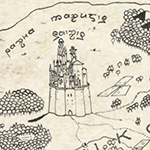
CATHADANS: (Heraldic sign: a golden tower and dome upon a mountain) Descendants of the clan involved in the discovery of the gold deposits. The darkest of the Elves—mingled with the Fanesgs, they secretly continue to practice black magic; their character is poor, and their sole interest is wealth. Some of them possess an excellent knowledge of karst regions (the limestone plateaus in the north and south of the archipelago) and caves, but above all, commerce and the bustle of city life are their second nature. The seat of the greatest Cathadan magnates and Amairgen lords is the renowned Golden City beneath Mount Artijamon.
Colony
On the mainland, in the region adjacent to the Argolin Sea and further into the territories of the scattered Elves, the Argolinians founded several port cities that quickly expanded under the influence of flowing wealth. These cities, when located within the sphere of influence of any kingdom, bring such a sum in taxes to the respective state entity that their dissolution would simply be unprofitable and nothing more.