They are an ancient people who, according to legend, derive their origin from the celestial nymphs known as Apsaras. For this reason, it is often thought they are related to the Gandharans and Archaics, as those races claim descent from Gandharvas—celestial beings of the same rank as Apsaras. These connections, however, are relationships between languages rather than peoples. By blood, Dryads belong far more to the Yggs.
Dryads constitute a world unto themselves. Their nation is divided into many groups whose differences are so vast they could be considered separate races. There are lineages of Dryads that reveal themselves to the outside world, and others of whom we know nothing. A lineage may appear significant to us, only for us to discover it is merely an unimportant splinter tribe.
JUNGLE DRYADS
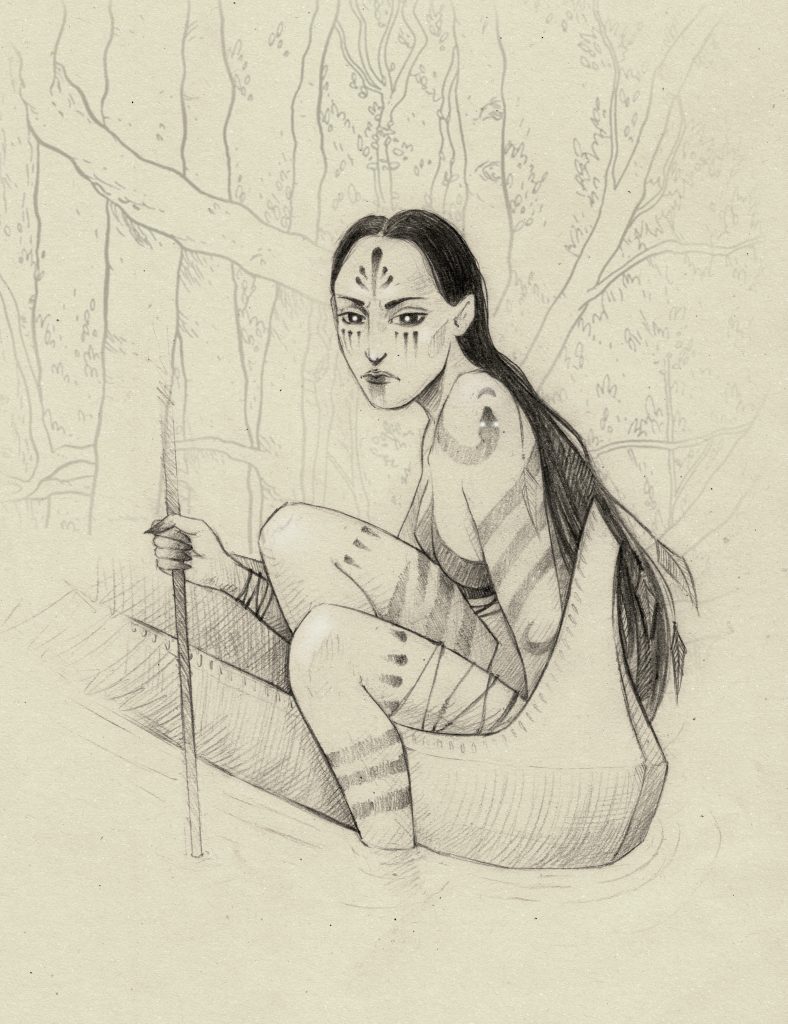
Slender, dark-skinned, dark-eyed, and black-haired, they live hidden in the depths of the southern jungles. They often set out in boats upon rivers or the sea to fish; waterways are their easiest means of travel. They usually go sparsely dressed and enjoy decorating their bodies with paintings.
Their society is divided into tribes. A tribe consists of several dozen related Dryads who all sleep within a single, massive tree. Each has a place where she merges with the trunk of the jungle tree, permeating it to spend the night or the rainy season.
Jungle Dryads are often skilled in Serpent Magic, preferring the material path over the immaterial. Among them are shamans knowledgeable in the magic of plants and animals.
Forest dryads tend to be proficient in snake magic, preferring material paths to immaterial ones. They also have shamans among them who are familiar with the magic of plants and animals.
They are ruled by a High Priestess who resides in a massive stone temple at the center of an ancient City. Of the City—as the Dryads call the place, which is the sole source of their concept of what a city actually is—only ruins and debris remain, slowly being reclaimed by the jungle. Creeping plants climb the temple walls, yet the structure has hardly decayed compared to others. The High Priestess can ask the forest to spare the temple. On the walls, there are still reliefs, on the ceilings frescoes, and on the floors mosaics depicting the Great Mother in her various forms, alongside floral ornaments and the likenesses of birds, fish, animals, spirits, and demons.
Once, the Jungle Dryads possessed a mighty empire; they were many, and the jungle was vast. The City lived. The Dryads claimed its stone houses and temples from an unknown civilization that vanished for unknown reasons, using them to store beautiful objects and for assemblies where they talked and sang. Alongside the Elves, the Dryads dedicated themselves to art, for sustenance was easy to obtain through fishing and gathering. But then, humans began to fell the trees, biting into the edges of the infinite jungle. The Elves departed, only a few remained, and the twilight began. Yet the High Priestess, with her power and will, still strives to hold back or at least slow the decline, watching over the observance of ancient traditions and leaving no room for new ideas. The world of the Jungle Dryads has stagnated. It hovers in time without change, slowly decaying like stagnant water that gradually turns turbid.
FOREST DRYADS
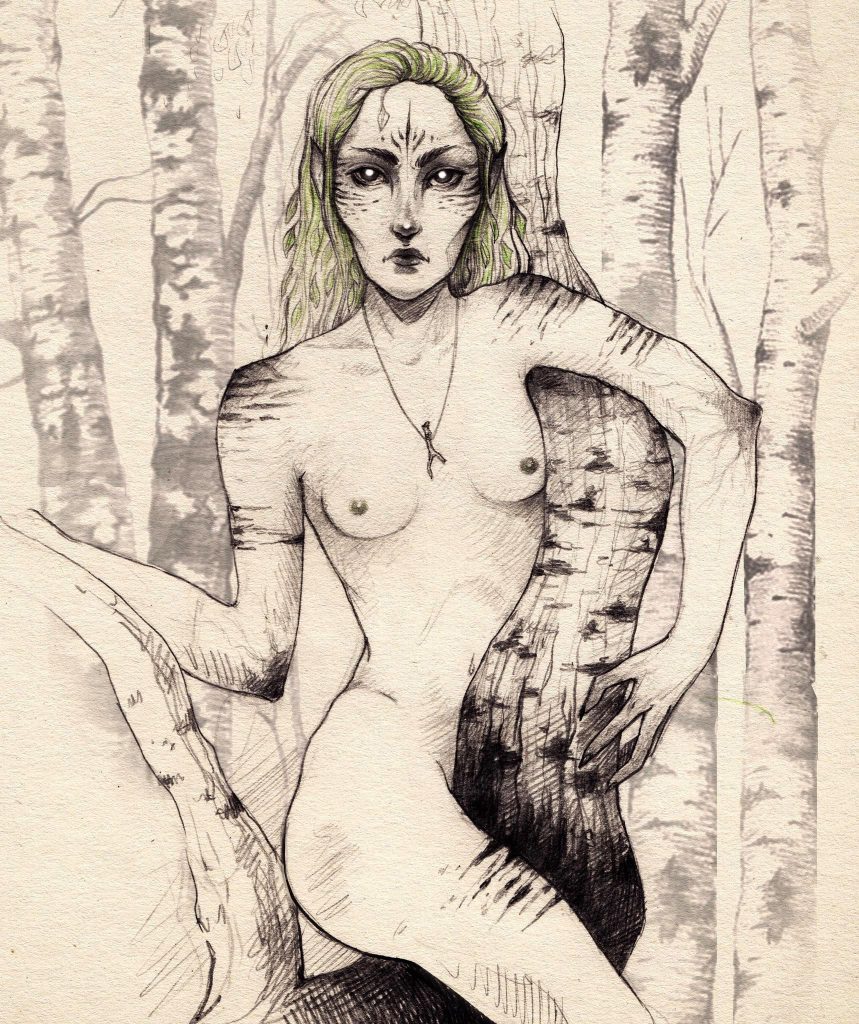
The name “Forest Dryad” is somewhat pleonastic, as the word “dryad” already implies a tree or forest. Forest Dryads are thus the “truest Dryads”—those we mean when the term is not further specified. They live in union with the trees and act as their protectors. Much like Elves, they defend the wild nature that has not known the axe or the plow of man. Unlike Elves, who can retreat after a lost battle, these Dryads are bound to their forest and die upon its destruction.
It is said they live as long as the tree from which they came. Some say these Dryads commune with trees and are impregnated by their resin, so that a newborn Dryad has the sap of trees in her blood. This may also be why these Dryads have skin that is brown like oak bark, silvery like beech bark, or white like birch bark. Their eyes and hair are green or brown. They master the spells of Druids and many others, for their connection to the forest is even more intimate.
Forest Dryads have a sympathetic connection to the energy currents in the wild and are the most sought-after experts for “forest healing.” For them, the forest is a single interconnected organism whose rhythms and bonds they can perceive. They can identify dark or weak spots that may be sources of disease or imbalance. Forests under the care of these Dryads are recognizable by several traits: they are more diverse and harmonious than normal forests, literally flourishing. Glades are colorful with flowers for most of the year, and the forest is full of insects, birds, and game. Dark places are carefully surrounded by menhirs and walls of protective holly, while power is distributed from “good places” throughout the entire forest.
The greatest challenge for Forest Dryads, however, is not dark spots, but the external danger of expanding non-forest nations, for whom forests are merely a source of timber and unused land. Forest Dryads are considered the least compromising of all Dryads and are relatively “hot-headed” regarding conflict with external enemies. The life of every tree is as dear to them as the life of their own child; conversely, the life of humans holds minimal value for them—a value further diminished by the fact that they know humans almost exclusively as insensitive outsiders and “tree-slayers.” Consequently, Forest Dryads often lead aggressive counter-strikes against human damage in the forest, which in the past has led to wars, burned villages, and burned forests. Other Dryad lineages and Elves try to keep the Forest Dryads in check, just as wise rulers restrain their woodcutters, for this type of conflict is a constant threat.
MOUNTAIN DRYADS
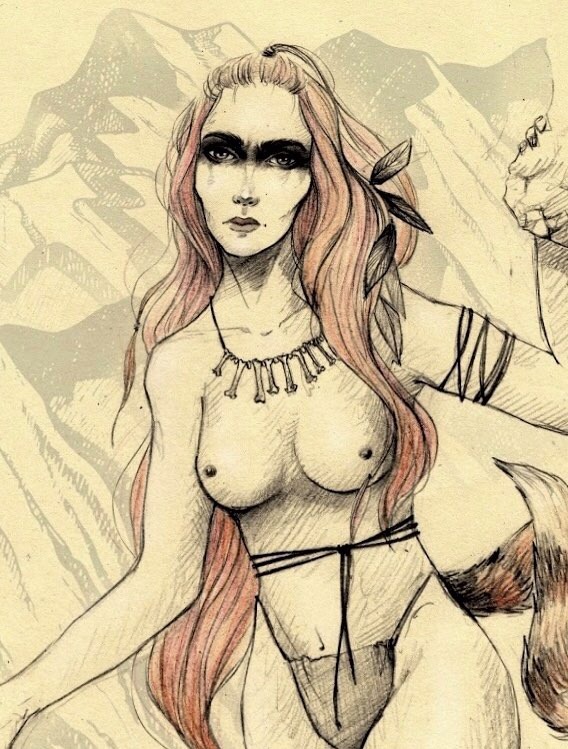
Also called Oreads. They are handsome girls with sturdy builds, famous for the strength of their legs and their endurance in running. They cross mountain distances at speeds approaching the flight of birds. they are not as slender as the Dryads of the lowlands—partly due to their physical strength and partly because a thin body would not survive long in the mountain frost. Even so, many grow a fine fur similar to a rabbit’s in winter to protect them from the cold. An uninitiated traveler might easily mistake them for an animal, especially if they see only the cautious movement of something furry in unclear terrain. From these occasional contacts, many colorful legends arise—of wild women called Yetis, or even of werewolves.
One common legend tells of a man saved from death by a mother bear in the forest. Out of love for the man, she transforms into a woman, and they live together until the man breaks a taboo and the woman turns back into a bear forever. This romantic story is likely based on a confused memory of the annual rhythm of the Dryad growing fur for winter and molting for summer. Popular imagination subsequently connected this with a heart-wrenching tale.
Even in summer, Oreads boast thick dark or russet hair that flutters behind them as they run, whether loose or braided; when standing still, it falls to their ankles. Most Mountain Dryads also have a long, bushy tail similar to a fox’s, reaching the ground. Unlike a fox’s tail, theirs is very agile and prehensile, providing great help when moving through trees, in the mountains, and during combat.
Their nature is gregarious and less mysterious than that of Forest Dryads. They usually learn magic from their own sorceresses or from friendly Elves. They do not like to enter civilization, as they would be forced to wear clothes.
DRYAD WARRIORS
Sometimes inaccurately called Amazons. Their statures are tall (as tall as the average man) and agile. They enjoy singing, and work comes easily to them. An ancient story is told of them: ages ago, they were a group of male hunters and warriors who so worshipped the Great Goddess of the Forest that they wished to shed their manhood to be closer to her. The Goddess took pity on them and, while they bathed in a magical spring, transformed them into women.
From the men they once were, they inherited a sort of efficient, practical mind, boisterous gregariousness, combativeness, and a joy in displays of strength, physical tempering, and wrestling. However, they cannot bear a child, for according to legend, even the noble Goddess who changed their bodies and souls could not grant them the feminine gift.
Warriors typically wear leather trousers, with small breasts bound by a leather strap; on their belt, alongside a sword, they carry a string with snippets from the clothing or armor of slain enemies. Those who have been successful enough wear a set of these strips around their neck as a warrior’s necklace. Before battle, they put on bracers, a leather jerkin, and a helmet; their equipment thus corresponds to that of a typical light infantryman. Among Dryads, Warriors are those closest to the mentality of outside humans, often serving as the primary negotiating force. They interpret between the voice of the forest arcana (represented mainly by sorceresses and Forest Dryads) and the voice of the city and field. This role of interpretation is reflected on a practical level, as Warriors learn human and Elven languages (which other Dryads often do not know at all) in addition to the arts of war and diplomacy.
Warriors also frequently travel outside the forest to human settlements, which brings a twofold problem. First, in the outside world, they are often considered spies for the forest (which is sometimes true, sometimes not) and are persecuted as such. Second, it occasionally happens that they simply forget the forest and join the fast, entertaining life of human society, which suits them in many ways: they do not have to listen to or obey the wise voices of the forest representatives, and their courage and “sharp elbows” often bring them success, money, and a good life.
DRYAD SORCERESSES
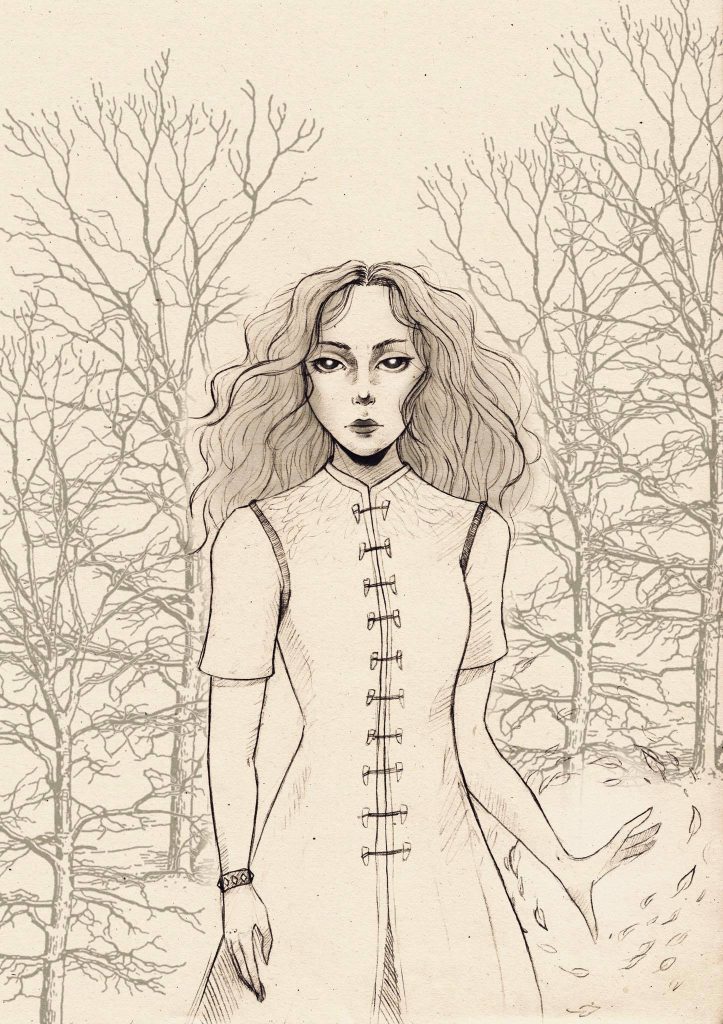
They look like thirteen-year-old girls on the verge of adolescence. However, they never mature. They are born of pure magic, but their embryo must develop within a woman’s womb; thus, they require Dryad mothers for their birth.
They have a very strong gift for magic, which they develop excellently. Given their unchanging appearance, it is difficult to estimate the power of such a sorceress, and many woodcutters have lost their lives attempting to attack a seemingly defenseless girl who came to tell them in a calm voice that they must not touch these trees.
Sorceresses are never numerous, as their birth is a rare occurrence. “The stars must be right” for a sorceress to be born, and her arrival in the world is usually accompanied by omens—from celestial phenomena to tremors of the earth or strange behavior of animals. Sorceresses can usually speak shortly after birth, and from the little that is known, it seems as if a collective of ancient souls exists within each of them, consulting and then speaking through the sorceress’s mouth. Others say her soul is born pure and connects to ancient forces in the environment, which she then allows to speak through her.
What is certain, however, is that the power of sorceress is great and grows with time. Most are many centuries old, and it is not known that a Dryad sorceress ever withered with age. Ancient sorceresses are recognized by silvery, shimmering hair and by eyes that radiate eons of memory. The Dryads themselves fear very old sorceresses, for they often act and speak as cruelly and relentlessly as wild nature or cosmic laws. Their will knows no discussion and no appeal. Yet, in the long run, their cruel decisions are for the benefit of the forest.
There were ages when the Dryads were not slaughtered to the last only because of the protective power of these sorceresses. The Dryads remember this and therefore take great care to ensure this rare species never vanishes.
DRYAD MOTHERS
A very important lineage that, following the model of certain animal or insect societies, ensures the continuation of infertile lineages, such as the Dryad Warriors or Sorceresses. Dryad Mothers look like fertile women with notably broad hips. Thanks to hips broader than those of humans, childbirth is not nearly as dangerous or painful for them; on the contrary, it is a moment of supreme ecstasy and sacred rapture, in which they connect to the source of life hidden within them and in the powerful forest places where the births occur. Dryad Mothers dedicate themselves to the earliest upbringing of young Dryads until they grow enough to begin being initiated into the specific traditions of their group—be they Warriors, Sorceresses, Mountain Dryads, or Forest Dryads. Dryad Mothers are the guardians of many stories and teachings that they pass on to the young Dryads, helping to shape their famously strong cohesion and identity.
There is some debate as to who actually impregnates the Dryad Mothers. Conjectures are many. Some claim that, like the Forest Dryads, they unite with trees and become pregnant from the nectar of tree buds. Others believe the source of seed is the Dryad Warriors, who possess a female form but still maintain a male essence. According to others, the Dryads invite or kidnap suitable men who then serve them as breeding bulls. Still others believe the key lies with the Dryad Sorceresses, who grant the Dryad Mothers the gift of parthenogenesis through magic.
SYMBIONTS
Much like Druids, Dryads enjoy uniting and identifying with trees, and not only on a spiritual level. On forest paths, it is not uncommon to encounter a Dryad covered from head to foot in climbing ivy. Such a figure looks very imposing—like someone in scale armor made of green metal. Usually, however, Dryads do not let themselves be entirely overgrown: they allow the ivy to grow through their hair, forearms, back, thighs, and calves. At night, they take root and, through the rootlets of their ivy, drink water and nutrients while connecting to the forest consciousness. A rooted Dryad is indistinguishable from an ivy-covered boulder. Some also use the clinging tendrils of their plant as weapons or climbing aids. Some have poison sacs at the ends of their tendrils; others use them to induce sleep.
SERPENT MAGIC
The birth of a serpent occurs when a Dryad becomes pregnant but, after a certain time, does not give birth to a child, but to a snake. The length of the “pregnancy”—and thus the maturation of the serpent—affects the scope of its properties. It is a question of how its conception and development occur. Some claim that a consubstantial clone is created within the Dryad (through a sort of separation of a part of the spine), while others claim that a specialized Sorceress, a Dryad Mother, or even the Dryad herself influences a normally conceived fetus and mutates it from a child into a serpent.
After birth, the Dryad is firmly bound to the serpent by an unbreakable telepathic bond; the serpent has only the rudiments of individuality. (Others claim different things: that the serpent is actually a demon tamed by the Dryad, which a Sorceress enslaved by giving birth to it. Such people then claim the serpent tries to escape the bond and destroy its mistress. They also say the Sorceress keeps it alive with her own blood, which the demon regularly drinks inside the Dryad. Others elaborate that the serpent drinks this blood every month, which smacks of a folk interpretation of the female cycle. Back to more certain information.) The serpent moves freely over the sorceress’s body, with which it is perfectly synchronized, as if it were a fifth limb. In times of rest or upon command, it returns inside the Dryad, like a kangaroo joey into a pouch. More sober interpretations claim there is something like a placenta inside the Dryad, from which the serpent feeds and regenerates.
The first of the serpent’s mutable properties is permeability or density, along with the related changes in shape. This is the strongest property and the most difficult to master. A newly born serpent remains practically in the same shape—a snake crawling over the sorceress’s body. Over the years and depending on the length of the serpent-pregnancy, it gains ever greater mutability—initially only changes in shape while maintaining volume (rods; circularity comes only at the end), later the ability to densify to the hardness of metal, or conversely, to disperse around the sorceress like a protective mist. Ultimately, the originally indisputably material serpent becomes almost a magical aura around the sorceress—her effective magical power, with which she equals even classical mages of her experience level.
The second serpent property, used more in the beginning, is its chameleonic color-changing, initially only adapting to the background—primarily the color of its Dryad’s body—and later the natural ability to make itself invisible: transparent and translucent.
The serpent’s head is the most important part of this creature—it is always expressed in any transformation. It is the part that can attack, through which the Dryad can cast spells, and most importantly, which can feed from the placenta within the sorceress and thus regrow any lost part of its body. Conversely, parts that are cut off are quickly abandoned by the aura shared by the Dryad and the serpent, and they decompose and perish.