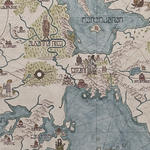

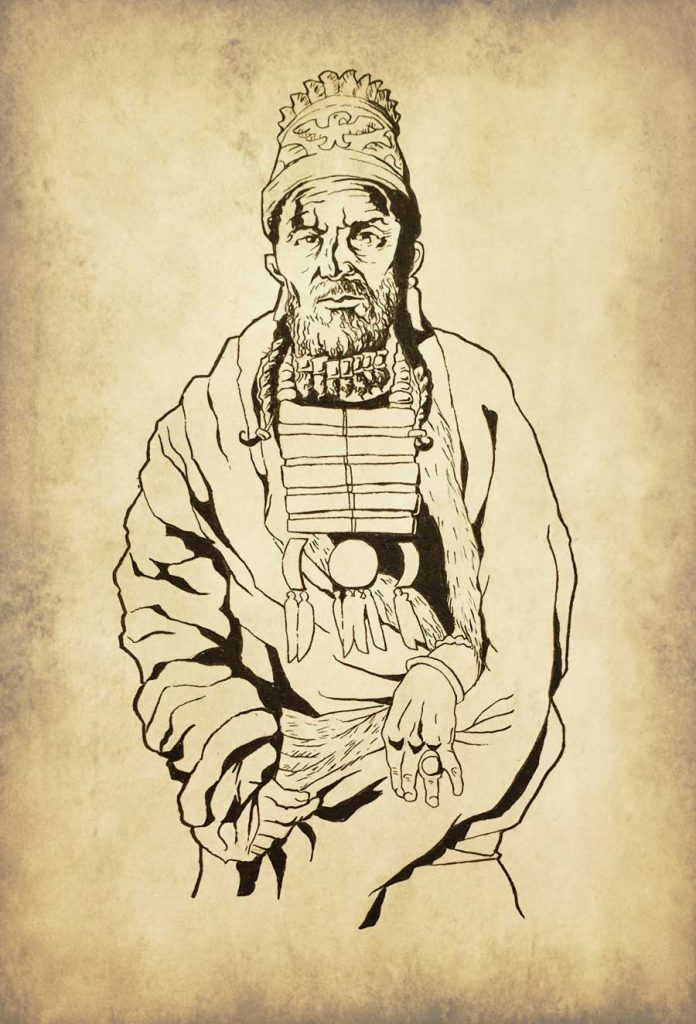
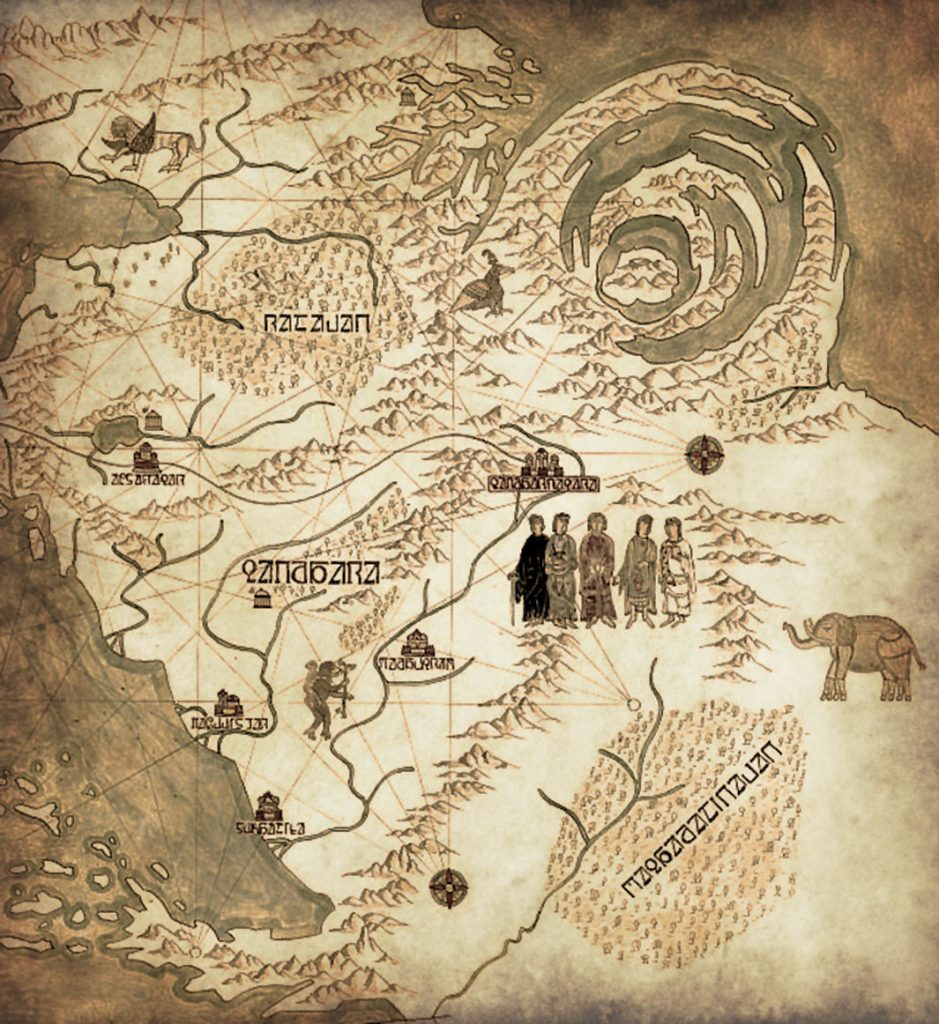
The Gandharans inhabit a vast continent to the east, connected to the western kingdoms by a narrow land bridge upon which the Siranian Empire lies. They are, in fact, a distinct race and are divided into a wide array of nations; however, as it is quite difficult for Siranians to properly distinguish between them, they tend to view them simplistically—and our description will follow this simplified approach. Siranians can relatively easily recognize Gandharans from the southern belts of the eastern continent due to their darker skin, but that is where the distinction usually ends. Furthermore, the Gandharans are highly secretive and isolationist, sending beyond the borders of the Gandharan Empire only selected representatives of their people—vetted merchants and diplomats from only specific social castes.
On average, Gandharans are half a head shorter than people from western lands; they have mahogany skin and sharp, angular features that make their faces resemble a cross between a bird of prey and a woodcarving. In their youth, both men and women can appear beautiful and attractive to westerners, but by their thirtieth year, Gandharan faces acquire traits of harshness and severity that Siranians find somewhat daunting. They live to a higher average age than most humans, usually 100, and rarely more than 120 years. Gandharans are particularly renowned for their phenomenal memory. Even without training, they possess excellent visual, episodic, and verbal memory; however, with the help of Gandharan memory techniques, this capacity is multiplied many times over. This is because Gandharans harbor a deep distrust of the written word and commit everything essential to memory, including all scholarly texts, historical records, instructions, and manuals of every kind.
Related to this memory is another peculiar characteristic of the race: a collective consciousness. Most Gandharans possess a sort of intuitive collective empathy which, through years of training, can be developed to the brink of telepathic ability. When such trained individuals die, they telepathically pass on their memories, which then live on in the younger generation. This contributes significantly to the stability and generational understanding across the time and space of the Empire.
Among the less commonly known, yet fundamental, traits of the Gandharans as a race is Will. Not only do they possess a strong “will” with a lowercase ‘w’—the ability to fixate firmly on difficult goals and persevere despite adversity—but they also possess a strong Will (uppercase), the ability to reach outside their own bodies to influence the minds of other beings or, exceptionally, to move inanimate objects. Training in the Will is one of the pillars of Gandharan combat instruction, where swordsmanship techniques are interwoven with strikes of the Will.
Gandharan culture is highly collectivist and governed by a combination of rigid traditions linked to the roles of individual castes. At its apex, however, are the Maghavans—enlightened mages who possess the authority of gods. The Maghavans engage in the constant adaptation of the culture and manage the breeding processes of selected lineages and groups. Such an arrangement functions because, for Gandharans, the highest values are order and community; the individual identifies their life goals with the goals of their community and the Empire as a whole. Order is always maintained at the cost of some degree of violence, and even the enlightened leaders at the head of the Gandharan Empire cannot avoid a series of violent measures—not only those whose logic the population understands and supports but occasionally those that must be enforced despite the feelings of the people.
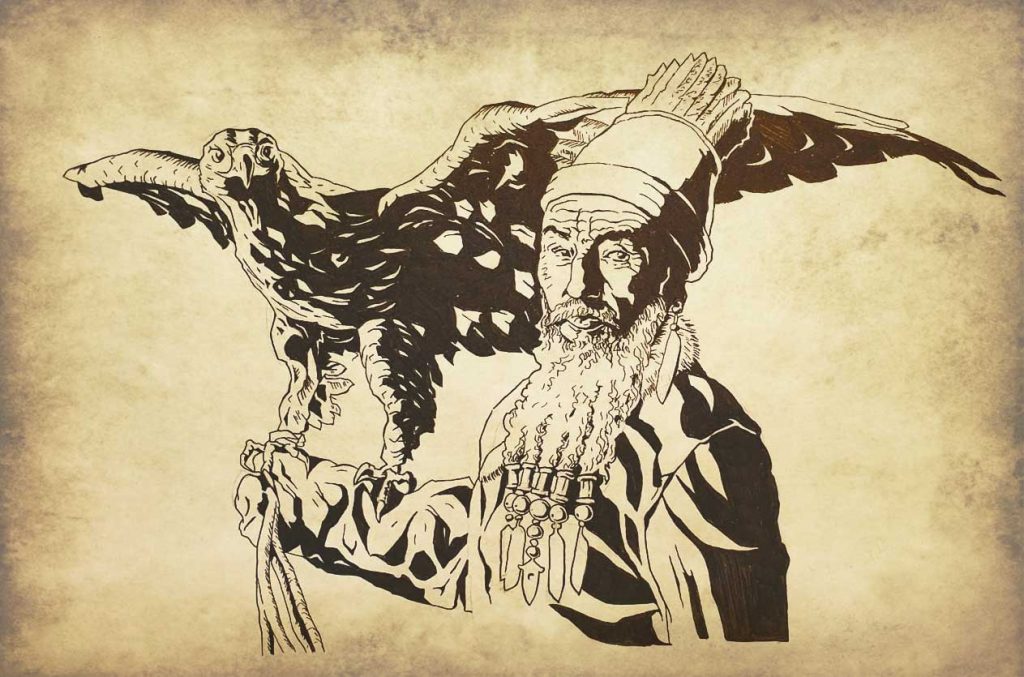
Paradoxically, alongside this strictly orderly aspect, Gandharan culture also contains a variety of irrational elements. All manner of hags, shamans, seers, diviners, and sometimes even outright fools and jugglers wander within communities or travel across the landscape, sometimes with an entourage. Renowned shamans are hosted and welcomed, while fools and jugglers are merely tolerated, but ultimately the fundamental attitude toward them all is that they are necessary exceptions to the rule—present so that the Order does not suffocate under its own regularity.
Society recognizes a total of five castes, or Colors: Killers, Executors, Callers, Knowers, and the Ascended (Maghavans). Each of the five basic Colors has its own code of honor and morality. For instance, Killers are permitted to kill (humans or animals), but only under specific conditions (within a ritual; a properly declared war is understood as a ritual). Therefore, only Killers may perform the duties of a soldier or even a butcher. Executors see their goal in the creation of material values and the maintenance of social order (this includes messengers, merchants, builders, and farmers). Callers communicate with divine forces, and Knowers investigate the world through reason and intuition (this includes scholars of all kinds, physicians, and masters of memory).
Paradoxically, the symbolic “colors” associated with the individual castes are not actually colors in the usual sense:
Killers – black
Executors – gray
Knowers – white
Caller – varied
Ascended – red
The Gandharans evoke highly mixed feelings in the inhabitants of Sirania. On one hand, Sirania feels the might of the Gandharan Empire, which, through its power superiority, could wipe Sirania from the surface of Qurand at any time—arousing fear and anxiety. These are relieved by the fact that Gandhara maintains its isolation and has not threatened Sirania for many centuries; on the contrary, in many instances, it acts as a cautious ally. However, the collectivism and obedience of the Gandharans toward authority give the somewhat individualistic Siranians the impression that their mysterious neighbors are a kind of voluntary slaves, or even bees in a giant hive of collective consciousness. Real encounters with living Gandharans dispel such notions—in human contact, Gandharans are polite and kind, despite their stern expressions and piercing eyes, and are thoroughly human in both their humor and their gravity.
What is known of the Gandharans in the west, however, is merely the tip of the iceberg. Gandhara itself is divided into numerous state entities, each with its own history and problems. Only occasionally do reports of distant conflicts or social changes drift across the border mountains into Sirania, yet these too remain clouded and unclear.