Many beings intervene in the fabric and history of Qurand whose power or age places them within the order of gods. Sometimes, the term “gods” is inaccurately used to include the Zilaths, Andals, or the Unborn. Strictly speaking, however, the designation “god” belongs only to beings of the Aetlan order—those who derive their power not from a supermundane essence, but from the trust and devotion shown to them by their believers. It is no exaggeration to say they are beings grown from the hearts, minds, and cravings of all living creatures and inanimate creations upon the face of Qurand. Thus, gods arise not only from the hearts of beings endowed with complex speech and reason but also from the hearts of the silent and the simple—beings who know only hunger and fear, satiety and rest. Yet the abyssal power of the gods reaches even deeper: to the inanimate creation, the consciousness of cliffs and valleys, and the will of the spring, the whistling wind, and the smoke. There, however, it encounters the power of the Andals, who rule the elements.
This explanation, however, is insufficient, and the priests of individual gods would rightly object to it as a sacrilegious simplification. For while gods grow from souls, souls simultaneously grow from them; the drama of life unfolds in the dizzying turns of this eternal loop. “Loop” (Loph) is, after all, one of the Siranian expressions for “god.” A god is a loop not only as an eternal cycle between a creature’s consciousness and the immortal essence of the deity but also as a hunter’s noose in which the creature is caught. A god is a tamer and a shepherd who gathers souls into his flock, into his choir, where the voices of the captured cattle sing the shepherd’s song and dance to the rhythm set by the waving of the master’s arm. In the whirl of the dance, they forget they were once washed into the divine embrace like castaways on a ten-year wandering journey home—that they used to be human before a beautiful priestess, with a wave of her wand, changed them into a woolly herd. The god then lets them graze on slopes of sweet clover and always, on a festive day, summons them to the temple, to his shepherd’s cave. He blocks the sun-drenched entrance with a dark full moon and invites his divine brothers and sisters to a feast. The banquet is the fattened castaway with a silent face, whose entrails are greedily swallowed by the grateful guests. In this way, and others, the allegorical mysteries speak of the deepest secret of divine rule.
The Pantheon is a community of gods, a sort of divine senate, where each has a seat and each is granted a hearing in measure with their power. The most powerful members of the Pantheon enjoy great reverence in heaven and on earth. On earth, numerous temples are consecrated to them; their names are known to all, and in times of need, people turn to them. For the gods hear their names clearly and distinctly wherever they are spoken, and through their name (written or said), their power and will may descend to earth. Twelve goddesses and twelve gods are considered the most powerful. Curiously, the goddesses tend to seize more influence than the gods, who sometimes lag behind their consorts in power.
The Goddesses
It must be revealed at the outset that the goddesses are not merely noble statues in temples or characters of myth; they are not only sacred symbols and the sound of their names, but are contained within every woman and maiden, every crone and little girl. They are born in women a thousand times and die, being sometimes closer, sometimes further on the journey of life, but always present. Virginal Kova is not just a stone icon in a village chapel; she is also that nameless girl who gives a thirsty wanderer a drink; she is the girl who, since the dawn of time, brings water from the well; she is the silent wife whose words are wiser than the reason of elders and as foolish as the world itself. Mendeas is not only a mysterious presence at witches’ sabbaths and a fearsome guardian of the truth of blood, but is also contained in the narrowed eye of a queen, in the experienced fingers of a gossiping herbalist, and in the withered face of a Garionian high priestess.
The reader will also soon notice how close the goddesses are to one another—how their natures and domains overlap. This is no accident. On a deeper level, some or perhaps all goddesses are firmly linked, like a single cosmic mountain appearing differently from different sides.

Madain (abbreviated as Mada) – with the epithet ‘Mother of the gods’. Madain is the lush and sensual primordial mother of all living things—not only for human generations but also for animals and plants. She is older than consciousness, older than all religion; she is the unstoppable force of life and procreation. From her womb, she brings forth all, and with her milk, she nourishes creation. It is said that the Milky Way consists of her motherly milk, which itself is but a remnant of the primordial Ocean of Milk. Parts of this ocean were drunk by the thirsty embryos of the gods, and parts were churned into the butter of Creation. Madain is by nature both cruel and kind, like life in its exuberant growth. She is the ripening grape, the budding breast, the pregnant belly, but also the cancer that, in its thirst for life, knows no mercy.
Madain is the mistress of fertility and procreation, conception and childbirth, life and health, food and nourishment, growth and blossoming, fate and success; yet she also reigns over illness and misfortune, injury, aging, and death. Her symbol is a round stone, her idol a pregnant woman, and her fruit a pear.
Kovalin (abbreviated as Kova) – is the Water-Bearer. A girl barely grown, full of dreams and hopes, both foolish and wise, with eyes and a soul of great depth. Her black eyes turn inward as often as outward; she hears the ancient voices of the soil and the sky and sings exquisitely while drawing water. She is the guardian of the well, from which she draws not only water but inspiration, lost knowledge, and the sight of things future and past. The ripples in the well are the verses of her poems. Her beauty is also her tragic fate, for the world is not ready to bear such blessing. She is loved by many, but most by Death, who comes to her in the flower of youth. The people weep for the loss, but the wise also weep tears of joy, for her beauty—frozen in the eternal memory of spring, untouched by the decay of autumn—has reached immortality.
Kova is the mistress of inspiration and poetry, of dreaming and desire, of secrets and knowledge, of the springs of waters and the springs of the mind. She is the keeper of oracular wisdom and the knowledge of things future and past; she is the mistress of magical beginnings, of the enchanted power of the soul’s spring, and of the tragic pathos found in poems, songs, theater, and life. Her symbol is an amphora, her idol a veiled girl, and her fruit a song.
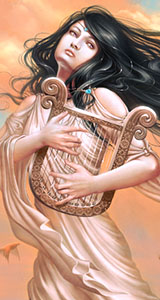
Tiranat (abbreviated Tira) – Tiranat, also known as Apiris, is the sister of Feidan. Like him, she rejoices in the wind whistling past her ears during the race and the hunt. The meadows and forest clearings are her temple; the mountains her fortress. Along with Feidan, she competes in the forests with bow and reed; the howling of wolves and the call of stags are the voices of her orchestra. It is said she needs no food, nourishing herself on morning dew—the sweetest nectar. When war horns sound and Feidan is imprisoned, Tiranat takes up the sword and axe, dons silver armor, and sows death among the combatants until their passions drain away with their blood.
Tiranat is the mistress of music and noble entertainment, of adventurous expeditions and the hunt—whether for beast or for thought. She is the mistress of races and athletic contests, of horse-racing and the chase, of wild forests, mountains, and sacred groves and preserves. She is a sisterly protector, both caring and ruthless. She speaks the languages of birds and animals, and from among them, she has her companions and friends, whom she sometimes grants human form before the eyes of strangers. Conversely, to her, man is but conceited game to be hunted in times of war. Her symbol is a bow, her idol a huntress, and her fruit an acorn.
Laki – The black hair of this gaunt maiden is matted with the blood of corpses and tied into braids with loops of vipers. Laki wades across the battlefield with a fearsome smile, clutching a red-flaming torch and an iron sickle with twenty-eight teeth. Around her waist is a belt of human skin, hung with the severed hands of kings and generals that still squirm like snakes. Aside from this belt, Laki is entirely naked, her only clothing a layer of dried blood and mud, finely cracked like the bark of a young tree.
Laki is the mistress of war and violent death; she is the ruler of all passions that exceed the measure of life and lead their victim to the grave. She is the mistress of madness and obsession, of destruction and empty laughter. She is the mistress of life without meaning and of meaning without life. She is a dancer upon the ruins of the soul, a scavenger following lost battles. Her symbol is a sickle, her idol a naked warrior, and her fruit a rodent’s tooth.
Karidíat (abbreviated as Kari) – It is said that Karidíat is closest to humans because she shares their fate of the Fall. When the gods established their order, Karidíat alone was not reconciled with it; she chose to defy their decree and stand on the side of punished humanity. She is a mistress of transformation and concealment, an eternal wanderer without a home—solitary and untiring. For long ages, she hid from the wrathful gaze of the gods and lived the lives of mortal men, illuminating their hearts and awakening them to courage, bravery, distant journeys, and great deeds. She gathered into her hands many powerful secrets of Qurand and artifacts of myth and legend, which restored to her a portion of the power lost through her apostasy. She became an expert on paths and hidden gates, ancient trails and forgotten passwords, dormant threats and sealed caves. Eventually, the gods had to recognize her power and the truth of her mission; though she still stands somewhat outside the inner circle of the mighty, she no longer wages open war against them. She became a messenger, a bearer of news, the mistress of scrolls and various scripts, of languages, the magic of translation, and the curse of misunderstanding. She is depicted as a warrior in armor, with a sword at her belt and a sorcerous traveler’s staff, accompanied by the dog Adar and the falcon Iris, who serve as her scent and her sight.
Karidíat is the mistress of paths and hidden places, of encounters and guests, of scripts and languages, of translations and news, of messages and legacies, of experience and will, of stubbornness and freedom, of wandering and solitary heroism. Her symbol is a staff, her idol an armored wayfarer, and her fruit a spark.
Rheamona (abbreviated as Rhea) – The crowned ruler of the gods, noble and venerable. She is a queen by blood, by power, by carriage, by action, by gesture, by style, by thought—by everything. Every mortal queen is but a shadow of the glory and stellar attraction of Rheamona. She possesses both shimmering youth and noble age, the pure virginity of an absolute queen, and the unquestionable fertility and motherhood that bring blessings to the land and its people. She is kind yet justly stern; however, toward her rivals and the lovers who reject her, she is cruel and merciless. She possesses the wisdom of women; she is the lady of the house, the keeper of the keys to the royal treasury and larder, a tiller of fields, and a skillful hostess. Yet her true radiance and divinity hide beneath her rich garments—in her perfect, statuesque, mature womanhood, and in her amorous passion, which she bestows only upon him who is truly destined for royal rule. For it is told that she appears to those who might gain a crown and kingly power in the guise of an ugly, lustful crone. Only the brave hero who does not recoil, but kisses her and enters her bed, discovers the next day that the crone has transformed into a breathtaking woman; and as long as he holds her, the rule shall remain firmly in his hands.
Rheamona is the mistress of the intoxicating draught of rule and power, of mature womanhood and female authority, of politics and power negotiations, of hosting and hospitality, of the culture of banquets and social events, of prestige and renown, of wealth and influence, of the household and family, of fertility and success. Her symbol is a diadem, her idol a queen, and her fruit the grapevine.
Liarfaina (abbreviated as Lia) – A seductress and a femme fatale, luring and challenging, promising untold pleasures and miracles, enticing others onto the thin ice of reckless ventures, suicidal gestures, and desperate renunciation. She beckons with a graceful hand, squints her eyes, and invites with a gaze. She is peerless, unreachable, always distant by her own will, always departing and arriving unexpectedly; at the sight of her, breath falters and words stick in the throat. She is cunning and always victorious, skilled in speech and flattery. Her hair is golden-red, like flames or the glow of sunset. She always commands admiration, whether dressed simply, richly, or not at all. Yet she is fondest of jewelry and ornaments, gems, gold, and shimmering treasures. She can never be caught unprepared; she is always playing a game, speaking not directly, but in promises. She plays an eternal game, in which she presses the honey of desire and fascination—the sweet shackles of fate—from mortal hearts between her lips and palms.
Liarfaina is the mistress of romantic love and amorous desire, of the enticement and luring of both body and soul, of cosmic attraction, of obsession and illnesses associated with longing, of songs and poems, of cosmetics and adornment, of dance and song. Her symbol is a necklace, her idol a bejeweled naked beauty, and her fruit a shell with a pearl.
Mendeas – The secretive steward of mysteries appears as a pale maiden or a wrinkled crone, a wealthy matron, a village herbalist, a legal expert, or a vizier to emperors. She is drawn to rituals—be they sorcerous, social, tea, or card ceremonies—and to incantations, whether they are magical, political, or the rhymes of children. She guards secrets that must never see the light of day, and some say this is because she would dissolve like smoke if they did. Mendeas loves barriers, locks, obstacles, prohibitions, hierarchy, discipline, and silent, indistinct violence. She delights in the loops and knots of words. She is the mistress of the rules of Orders, of laws, and of bans. From words and precise formulations, she can weave a whip, forge a gate, or set a trap. She knows when to drop a hint, when to release a rumor, and how to give a different meaning to what has been said.
Mendeas is the mistress of sorcery, spells, and legal formulas, of herbs and potions, of hexes and curses, of rituals and litanies. Her symbol is the serpent, her idol a veiled woman in a bodice with belts, knots, and clasps, and her fruit the mandrake.
Maar – Graceful is the stride of Maar, kind is the gaze of her eyes, and sweet is the touch of her hand. In many languages, Maar means Death, and those who have beheld her always remember her beautiful eyes and the gentleness with which she took them into her arms—not unlike a mother taking her newborn. Maar is therefore the goddess of both death and life. Death is birth; the force that bites away at life is simultaneously the force that drives it forward, just as the waxing of the moon is the same as its waning, merely seen from a different perspective. The crescent moon—a symbol of hope and growth, but also of depletion and death—is thus the sign of Maar, and along with it, the crescent clipping of a human fingernail, which, like the moon, measures the ebbing time of our lives. The nail is a spike marking the passing months and years, a sickle that cuts down the ripened harvest so that it may be sown once more and sprout again next spring from its grave in the furrow.
Maar is the mistress of death and time, of counting and tree rings, of nails and horns, of shells and hooves, of spikes and notches, of engravings and chisels, of the moon, of tides, of the seasons of rut and mating and infertility, of sleep and waking, of departures and returns. Her symbol is the sickle or crescent, her idol a hooded woman, and her fruit a horn or fingernail.
Vakriel – The starry sky is the eye and consciousness of the goddess Vakriel. Her soul is as clear as crystal, her voice the sound of celestial organs, and her language the mysterious laws of heavenly movements. She is the guardian of order and fate—omniscient, silent, unknown to mortals, and hidden. Yet she hides nothing; it is simply that her depth is greater than human sight can reach. Vakriel constantly sings a quiet yet immensely vast song, and those who occasionally sense her presence say she bestows a kind smile upon the world—one that does not fade even when witnessing war and destruction.
Vakriel is the mistress of stars and astral fate, of thought and its laws, of the depths of the universe and the soul, of awakened consciousness, wise insight, genius, and the clarity of mind. Her symbol is the ring, her idol a woman in the lotus position, and her fruit a star.
Skionara (abbreviated as Skiona) – The goddess Skiona is at home in cities, in schools, and wherever there is a need to learn, to refine both mind and body, to investigate, to research, to verify, and to argue logically. Though she is a virginal goddess, she is by no means lonely; her companions are the sciences and crafts, and her children are thoughts, inventions, books, and all the creativity of human hands and the human mind. As the patroness of crafts, skills, and all manner of study, she receives offerings and invocations from all students and apprentices; as the patroness of science and all lore, libations are poured to her in libraries, and dedications are inscribed to her on the opening pages of scientific works.
Skionara is the goddess of science and crafts, of study and research, of exact knowledge, history, and systematic magic. She is also the mistress of all records, dictionaries, and literature. Her symbol is a measuring tool, her idol a woman in scholarly robes, and her fruit a book.
Charpó – Charpó is the Crone. She is hunched and withered, wrinkled and bearded—so ancient that it is no longer possible to discern whether she is an old man or an old woman. Her voice is usually a low croak, but when she wishes, she can speak clearly and loudly, with a voice that is pure and striking, capable of binding and commanding the will of any mortal. Charpó remembers the eons; she knows both the simple-minded and the scholars; she has hosted lost kings and minstrels, demons and gods in her little cottage. She is so old that she stands at the very threshold of life and death. She is neither living nor dead, neither eternal nor immortal; she is simply and immensely old, age itself personified. She is so old that she has transcended not only all desire but even indifference. No spell, no will, no power can move her; she fears neither death, nor pain, nor loss. For the world, for mortals and immortals alike, she may have both understanding and contempt, but no one truly knows what hides within her, what her insinuations are meant to signify—whether she mocks or affirms, whether she doubts or merely pretends to do so. Many say she is utterly mad, others honor her for her wisdom, while still others claim she is but a foolish old woman whose words carry no meaning.
Charpó is the goddess of old age and the ultimate boundaries of the meaning of life for mortal beings. Her symbol is a knotted staff, her idol an old woman, and her fruit an oak boletus.