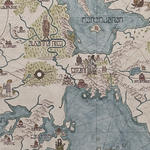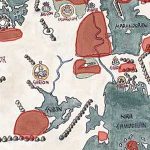
Readers of these pages may have noticed the ornamental border encircling the map of the Siranian Empire. This framework is not accidental; its simple form hides several symbolic connections. The border, shaped like a rope woven of eyes, is a symbol of Time and the succession of individual Ages. These include the “tiny ages”—ten thousand of which fit into a single second, through which the universe repeatedly emerges and vanishes in every fraction of time—as well as the “great ages”: the turning of day and night, the great summer and winter lasting centuries, and the Ages of the World. These follow one another in a chain, for if they were to occur all at once, the beauty of all forms would be exhausted in a single moment-eternity, merging into a boundless radiance that is also the quietest darkness, where there is no room for change or distinction.
If one looks closely at the map’s border, they will see that the “eyes” are actually formed by a pair of serpents. They entwine in a double helix around a common center made of the bubbles of worlds and spaces. These serpents themselves are composed of another pair of serpents, and should we look closer still, we would find that those too are composite, and so on unto infinity.
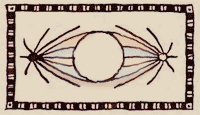
The Eye is the symbol for Qurand, the World. Its boundary points are two opposites—light and darkness, dryness and moisture, heat and cold—and all the revealed world expands between them. They are the two poles of a magnet, and between them stretch lines of force which, rippled by the movement of time, separate into several distinct strands. The greatest five strands are the Five Elements from which the world is woven. Upon these five strands, Qurand rests like a child in a net-bag, a spider upon its web, or a butterfly enwrapped in a cocoon. It is precisely in the perfect center between these two opposites that the most fertile and spacious place arises, where Qurand has settled. Moving toward either extreme, the worlds grow smaller, cramped by a narrowing space that, at the very edge, collapses into a single point.
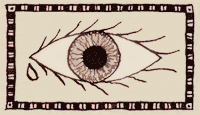
The mystery of the world is revealed by the Eye itself. The world is a “world” (svět) because it is a visible order, a “light” (svit); the world is the world of the eye. What is not in the eye, is not. Therefore, the eye is the Light of the World. We do not experience the world, but the reflection of the world within the eye. Does the world mirror itself in the eye, or does the eye mirror itself in the world? What is certain is that when the gods fashioned the world from the body of a slain giant, they created the boundaries of the visible world from his eyelashes. That slain giant is the First Man, buried within every living being, and those mythical boundaries of the world can still be seen today when looking into the face of another—their lashes are the very lashes used by the gods. These lashes form the limits of visibility, beyond which lies nothing but the world of dreams, mists, and darkness. The image of the sky is the iris, and the image of Garion, the Pillar of the Earth, is the pupil—the Lady of the Earth, beautiful and dancing.
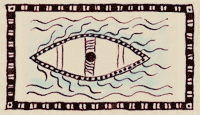
Ages ago, a flood of destruction inundated the Amber Citadel, and only the Great Sage escaped upon his ship. His ship was named the Ark. Its shape, seen from above, is strangely similar to an eye. Instead of lashes, there are ripples created as the Ship of Consciousness furrows the Ocean of Dreams. Its mast is a tree to which the Great Sage is bound by a pair of living ropes. It is said that the tree has a crown of flames and that the Sage burns within it eternally. He sacrificed himself willingly, feeding the sacred fire Aurán with his suffering to save all others from the deluge.
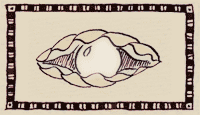
An ancient song tells of a pearl hidden at the bottom of the sea and guarded by a dragon. Few know that this story requires clarification. The pearl is often depicted resting inside a pearl oyster. The truth, however, is that it is not a shell, but the head of a dragon. The dragon holds the pearl upon its tongue, gripping it from both sides within its jaws. These are no longer the “charming lashes” that form the world’s border, but a curtain of dragon teeth—cruel and impenetrable. Only a true hero can defeat the dragon and cross the threshold of teeth.
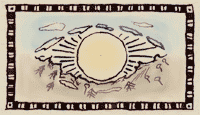
Finally, alongside the Eye, the Flame-Mast, the Pearl, and Qurand, we have the Sun, born in the east like a pearl between heaven and earth. Heaven and earth are the hammer and anvil, forging a new sun every morning—the Fire of the World. It is the eye of the world, the fire of the world, the light of the world.
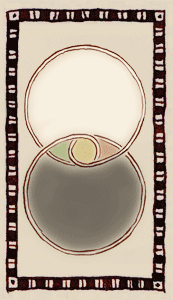
But let us speak plainly. The wise say that the shape of the eye is formed by the intersection of two perfect shapes—perfect darkness and perfect light. Both, on their own, are blinding and rob the sight of its power. Anyone who has ever seen true light will testify that what we call light is merely twilight. In twilight we walk, read, and tell stories; in twilight we live. Our world is a world of twilight (šero). The Light is too great for us; it would sear our vision away.
The eye is a space of twilight and moist sea breezes, where life and forms arise. Too far from the twilight in either direction, the eye becomes blind—just as we suffocate too high above the earth or when buried beneath it. Yet, we have our roots in the earth and perpetually strain toward the heavens, though if we ever reach them, we die like the moth that finally reaches its long-desired flame.

These symbols will not speak to everyone at all times. They are merely inspiration and refreshment for wanderings through this world or another, should the mood strike.