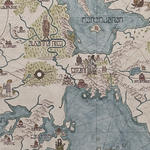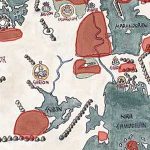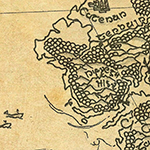
The archipelago of Vaktar and Mantrin has a convoluted history with roots reaching deep into the ancient past. The islands, though very different in form and settlement, have weathered historical storms together; thus, it is fitting to tell their stories as one.
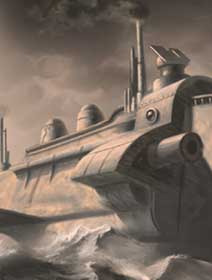
Little is known about the earliest history of Vaktar and Mantrin, save for legends claiming that the Grey Tower on Vaktar stood there long before the first humans arrived. It is said that the island of Vaktar is the peak of a mountain whose roots reach beneath the sea to the very bottom of the world, and that in ancient ages, Mantrin sailed around it, for it had no roots at all. Mantrin reportedly had the form of a great ship, circling its brother island like the earth around the sun. Another legend tells that both islands are ancient living beings bound by love, and that Tinwil, the small green islet between them, is their child. Tinwil—and this is no legend, but fact—grows larger year by year.
The age of legends eventually ended, and human beings arrived. These were the ancient Azharians during the Times of Fires. Noble men and women of this lineage settled on the shores and mountain slopes. They dedicated themselves to fishing and orcharding, yet the core of their culture was knowledge and magic.
Like their relatives, the Gandharans or Archaics, they took different paths in their quest and eventually drifted far from the others. The Gandharans preserved the most of ancient Azharnant because they had the maghavans and their culture never fell to anyone. The sages of the Archaics kept the knowledge as well, but secretly and silently, only for their own people. Among the inhabitants of Vaktar and Mantrin, the Mages became the bearers of the Azharnant heritage, and from here, this name and knowledge spread across the land.
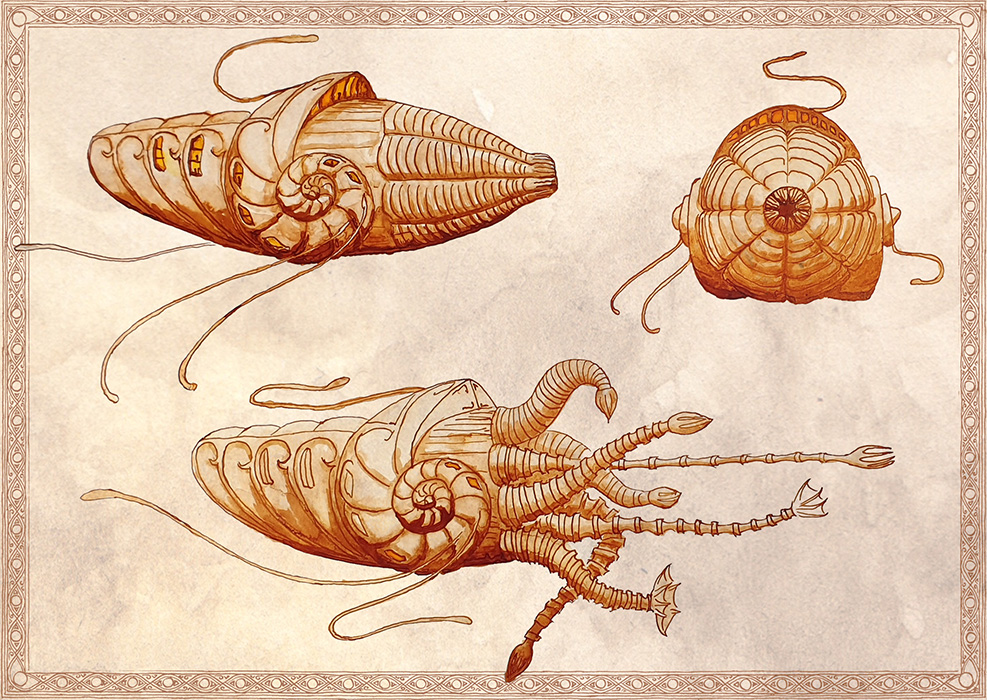
Top: During calm sailing, side and front view
Bottom: In combat readiness
The Mantrin Mages, however, delved into the secrets of matter, uncovering much for the purposes of building houses, fortresses, and ships. They created new weapons and dominated their maritime neighbors. There was a time when the steel fleet of Mantrin ruled the entire south of Qurand—the vast seas stretching thousands of miles southeast and southwest of Sirania.
In their pride and power, they imposed high tributes on conquered nations, and great wealth flowed to these two tiny islands. Cities of stone, concrete, and steel arose, alongside towers of glass and roads made of synthetic opals. Eventually, however, the patience of Gandhara, Sirania, and the Southern Kingdoms ran out. In a naval war lasting ten years, they finally defeated Mantrin. Yet, even during the war, the fundamental secrets of Mantrin technology never fell into their hands. Thus, the Kira Samudran (the Great Ocean) remained dangerous for a long time due to scattered remnants of the Mantrin fleets, which turned to piracy and transformed their secret bases into raiders’ dens. It is said they remained in hidden contact with Mantrin, sending part of their “profits” to restore the ruined archipelago.
Today, after a century as a Gandharan protectorate, the archipelago is free once again. Mages are once more researching the nature of matter, rediscovering doctrines lost during the war years. Cities flourish in peace and ships sail the Ocean. Only the legendary steel ships are no longer seen; Gandhara and Sirania mandated a ban on their construction.
VAKTAR
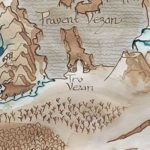
The center of the northern island is a hilly upland, partly covered in tall grass and solitary Antarassian birches, and partly revealing grey-white rocks that jut toward the sky in strangely wind-swept shapes.
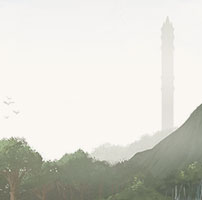
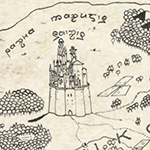
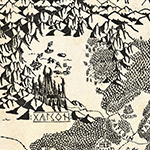
In the middle of these uplands has stood the Grey Tower since time immemorial, unbuilt by human hands. The area around the tower is considered sacred, and no one resides there permanently. However, beyond a certain boundary, small, squat grey turrets suddenly sprout like mushrooms from the spores of the central tower—the work of the old mages from the time of the Azharians’ arrival.
Vaktar is a far calmer and more contemplative island than Mantrin, which bustles with worldly activity and the work of many manufactories and laboratories. Here, on the northern island, has been the center of the Order of Mantrin Mages and the largest libraries and study halls since the very beginning. During the peak of island magic, the local university town of Zangena successfully rivaled even Sairis in prestige.
It is said that from time to time, a mage feels strangely drawn to the Grey Tower, wandering closer and closer across the uplands until one day they stand before the stone doors at its base, and the doors open. Few who have entered have ever returned to the people of this world.
MANTRIN
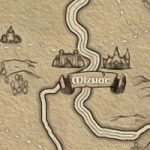
The larger of the islands also has a higher population density. Its many port cities live with bustling activity and constant development. The central mountain ridge is not very high, but the slopes are very steep. Most of the island sits only slightly above the level of the warm southern sea. While the windy highlands of Vaktar can be quite cold, the climate on Mantrin is very warm and humid.
Before the development of civilization, the island was overgrown with dense forests and rich flora, but today most of its usable surface is covered by cities, villages, and fields. Thanks to the inventions of the mages, fields are used very intensively, and their yields support more people than is possible in other lands.
The culture of Mantrin is truly unique, primarily due to the inventions that have most changed the face of the land. High apartment buildings in the cities, functional architecture, manufactories, and smoking laboratories are a foreign visitor’s first impressions. Further wonder comes upon seeing the straight, safe, and above all, beautiful roads of synthetic opal and the glass buildings of the wealthy, which shimmer with all colors in the setting sun.
Just as the mages’ teachings are oriented outward—toward examining the external world—the culture of the Mantrins is also outward-facing. Dozens of large ports serve as the starting or ending points for thousands of ships that crisscross the world’s oceans to trade, fight, discover, or serve as mobile dwellings. Thus, many novelties, both material and informational, constantly arrive in the cities.
A century ago, the island suffered a terrible defeat, but it has finally recovered and regained full control over itself. The glass towers stand once more, opal roads again encircle the land, and the chimneys of the workshops smoke. Who knows where this land is headed and whether the fate of Qurand lies, in a way, in its hands…
THE MAGES
The original Mantrin word “Mage” denoted “a person who became powerful through their knowledge.” Before the great expansion of island culture and before their steel ships dominated the Southern Ocean, this word was almost unknown. Only the more educated knew it referred to sorcerers from this archipelago. However, the mages became the primary architects of Vaktar and Mantrin’s technological superiority over neighboring nations. Their star shone brightly—they swiftly adopted the knowledge of all surrounding nations, enriching their self-conception to such an extent that it became attractive to many sorcerers and even to many gifted beings who did not care for the “scholastic” magic of the time, finding it too mystical and insufficiently exact. The Zangena school on Vaktar filled with students, and suddenly mages were everywhere, performing the roles of their sorcerous predecessors along with much that was new.
The reaction, however, was not long in coming. For decades, the mages trained in Zangena led other magical disciplines, and their popularity grew until Vaktar began to be called the “Island of Wizards,” and the term “mage” became synonymous with an expert in the hidden things and laws of the world. Ultimately, the counter-strike came. The Great Masters in Sairis and the maghavans in Gandharnagara absorbed the new elements brought by the mages and integrated them into their own doctrines. Subsequently, their countries attacked the island empire and defeated it. The mages, who by then were by no means only of Mantrin origin, publicly declared their neutrality, thereby saving their schools and most of Vaktar from the cataclysm of war; however, they never regained their leading position in the world of magic. The only testimony to their glorious times is the word “mage” itself, which has been preserved since the days of their power as a general term for a sorcerer.
What makes the island mages unique? They are oriented outward, toward examining nature and its laws—even the “miraculous” ones. They rarely focus on the psychic or spiritual parts of beings, focusing instead on how things work and the elements that compose reality. However, they approach them differently than the masters in Sairis. They are not afraid to use complex apparatuses and examine the properties of matter under extreme conditions.
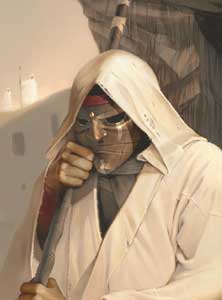
As for their appearance, its conservatism contrasts somewhat with the progressive nature of their research. Mantrin mages cling to old customs in dress, preserving much of how they looked when they arrived on the island centuries ago as descendants of the maghavans. Thus, as a mandatory part of their attire, island mages wear armor and a sword, a face mask and helmet, a cloak, and a staff—all relics of maghavan equipment. Over the ages, however, the style has changed. Many wear heavily lightened armor, almost to the point of uselessness, and the sword as well. Even those whose gear is still fully functional no longer wear the scale mail of their ancestors, but technologically advanced armor in the latest style. It is a common pastime for technically minded Mantrin mages to constantly upgrade their gear; thus, their sword is soon charged with electricity, their staff issues thunderous strikes (with a necessary dose of sulfurous smell), and so on. It is also almost a rule that the more “miraculous” a mage’s sword is, the worse they are at wielding it. Conversely, the most dangerous are, of course, the unassuming, hunched old men in faded armor.