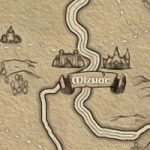
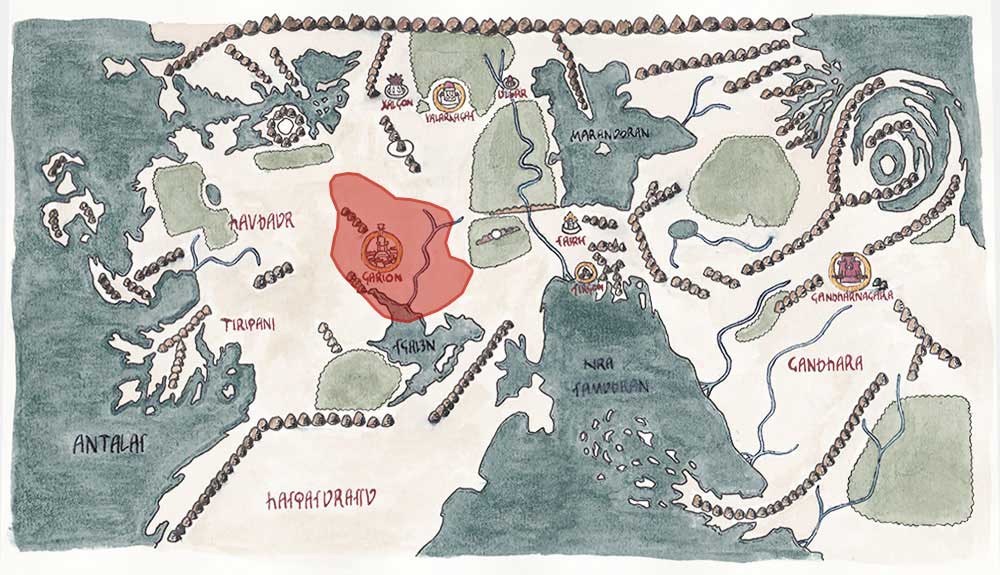
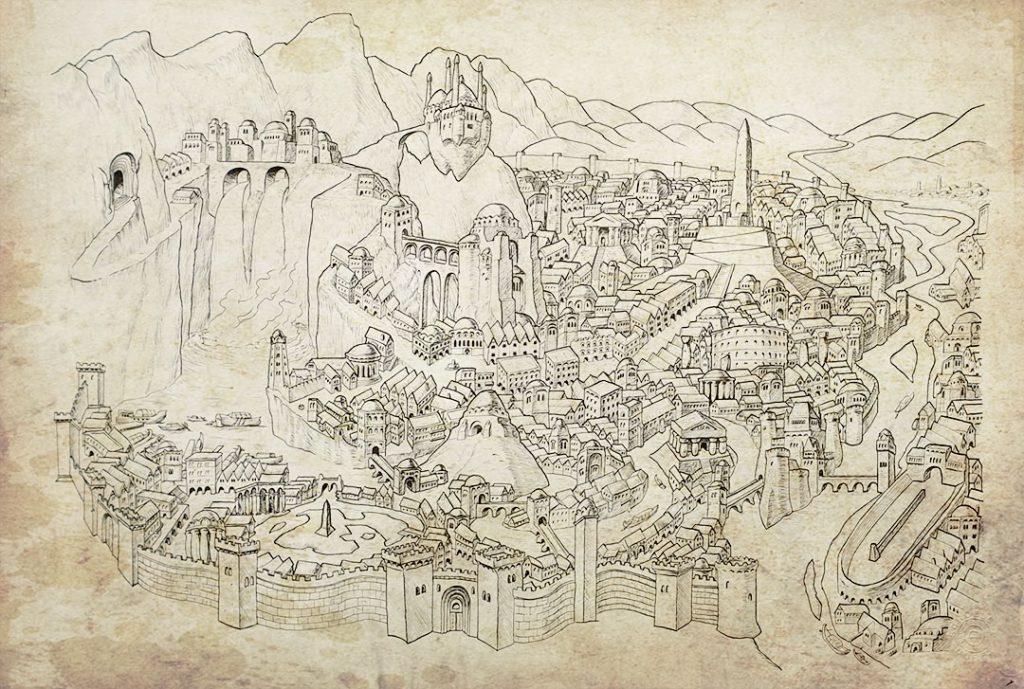
The largest and wealthiest city on the face of Qurand, the figurative center of the world, and a crossroads of paths. A city with an ancient and turbulent past. Broad avenues of multi-story houses crisscross the center, meeting in crowded squares before illustrious temples and theaters. The oldest part of the city, Bet‘even, towers high above the center on a rock bridge over a massive waterfall. Behind the waterfall, within the cliffs, an underground section of the city is carved along a long rocky tunnel.
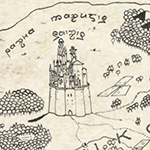
The city center is encircled by a high wall and protected by the river current and mountains; however, millennia ago, the houses and streets outgrew the boundaries of the old city, and the urban sprawl now covers hills and valleys as far as the eye can see. Yet, from every corner of the city, one can still see the symbolic heart of Garion—an immense ziggurat with a pillar at its summit: Gar Ion, the Pillar of the Heavens.
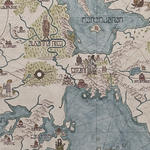
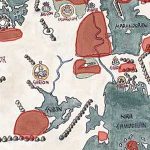
According to the last census, Garion has roughly 3 million inhabitants, crowding as many people into one place as constitute an entire large nation elsewhere. The city is a great glutton and devourer. Numerous aqueducts lead from the nearby mountains into the city, and its granaries are filled with grain from the vast fields that stretch south along the River Ranna to Essa, a city in the delta, and along the northern shores of the inland sea, Sgallen.
The Name
The name Garion is quite a puzzle. Many languages are spoken here—a variety of Vezanian and Dornish dialects, Elvish, and Siranian. Garionite itself is simply a creole in which all these languages mingle. The name Garion means different things in different tongues. It is usually interpreted as being composed of two parts: ion meaning “pillar, tower” and gar meaning “land” or “earth” in Dornish; thus, the city’s name would mean “Pillar of the Earth.” In Elvish, the name translates to “Scion of Art,” while in Vezanian, it means “Confluence.”
The City
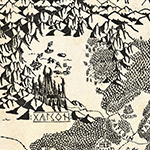
The ridge of the Zenith Mountains cuts across the broad plains north of the inland sea of Sgallen. Garion lies where a wide tunnel was bored through the ridge, eventually expanded into an entire underground city where Garionite banks are traditionally located. From its eastern gate, called Pathech, the Holy Way leads down from the mountains to the city center. The Holy Way passes through Bet’even, the hanging district built on bridges over the waterfall, and its ancient paving stones, covered in runes, end at the Old Agora. The city is renowned for its shops, marketplaces, theaters, temples, racetracks, and baths. Tradition holds that there are nine wonders of the world located within the city, and no traveler should leave without visiting all nine. They include:
- Bet’even – The city above the waterfall
- Gar Ion – The pillar at the center of the world
- Olgotheum – The largest amphitheater on Qurand
- Ertzessa – A garden fashioned as a miniature of the entire world
- Džatiraydan – The flying rock of the Genies
- Abalqasir – The palace mountain
- Duthal – The underground city
- Pantheon – The original ancient temple of all gods
- Hradby města – A double-row fortification towering high above the houses of the outer city
History
The origins of Garion are shrouded in mist. It is widely considered the oldest human city, founded by the ancient Vezanians with the help of the Elves. The traditional date for the city’s founding is 11,800 BCE, and Garionites reckon their years from this point, making the current year 12,880 SE.
Shortly after founding Garion, the people of the Vezanian race founded a second city to the south—Vezan—after which the entire race is named, located within sight of Kaal Charmat. The union of these two cities gave rise to the Vezanian Empire, in which Garion played the role of the wealthy city and “granary,” while Vezan served as the intellectual center where people quickly delved into secret doctrines. Soon, in their pride, they challenged the hegemony of the Elves and, in the Racial Wars, gradually forced them to retreat into protected realms.
Garion flourished during the era of Old Vezan, and its wealth and opulence were proverbial. It was then that the immense pillar was built in its center—an artificial mountain topped with a tower or obelisk, a portal, and a throne. It is said to have been built by the hands of young gods as a work of joy and mystery. Access to the gate and throne is forever guarded by the Unborn Tuarvalir.
Eventually, the Empire collapsed in a terrible cataclysm. Vezan sank into the mists, and Garion itself was heavily damaged by earthquakes and the plundering of hordes. A Dark Age followed for millennia, during which the city was nearly abandoned; people lived hidden only in the safe tunnels of Duthal and on the bridges of Bet’even, looking out from above at abandoned ruins as far as the eye could reach.
Following the appearance of the prophet Marggothius, who hailed from Garion, his followers began to gather in the city, and an era of restoration began. It took long for the city to reclaim its status; first as part of the Havdaur Empire, but eventually gaining independence to form the Garion Empire, which included all lands west of Sirania. However, the Thousand-Year Empire eventually weakened, and the Saifates, Havdaur, and other now-independent lands seceded.
Garion ultimately remained what it had always been—the wealthy heart of the world, a vast marketplace full of spices and luxury. Its imperial power is a thing of the past, yet it remains the most powerful city on Qurand: the center of a great state that still calls itself an Empire, but rules through diplomacy and gold rather than military might.
- Founding of Garion
- Rise of the Vezanian Empire
- The Racial Wars
- The Fall of Vezan
- The World Deluge and Transformation of the Lands
- Emergence of the prophet and reformer Marggothius
- Period of Old Havdaur
- The Ascendance of Garion as the city of “All Gods” and the birth of the Millennial Empire
- Decline of the Garion Empire; secession of Havdaur and the Saifates
- New rise of Garion
- The Present Day