The true origin of languages is largely unknown. Given that we know almost nothing of the eldest eras, most of the great language families possess a legendary origin. No one is able or willing to separate the factual core from the mythical narrative; therefore, for the earliest age, they remain fused into a single whole.
For millennia, scholars have argued over how the human (or Elven) tongue arose, yet they reach no consensus. The most popular theories are based on the mythology of the great languages themselves; thus, we shall encounter them there.
I. The Azharian Family
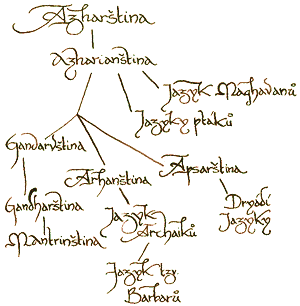
According to legend, the Azharian languages descend from the magical tongue of the Azhars, with which they gave form and meaning to the chaotic primordial matter of the Zilaths. Azharian is considered the highest form of language—full of meaning and perfect. It is said that the Azhars still speak it today, and every being spontaneously understands it, even if they are unable to speak it themselves.
The first descendants of Azharian are Azharianian—the language of the Azharianian companion spirits who descended alongside the Azhars—and the language of birds. The language of the Maghavans, itself a descendant, is in many ways similar to Azharianian. From Azharianian, three main branches evolved: Gandharvic, Arhanic, and Apsaric. It is said that Gandharvic took all the precision and hardness, Arhanic all the richness, and Apsaric all the grace of the original tongue.
From Gandharvic arose Gandharan; from Arhanic, the language of the Archaics; and from Apsaric, the Dryad tongues. From Old Gandharan, the language of the Mantrins also emerged through independent development. Related to the language of the Archaics is the tongue of the so-called Black Barbarians, who dwell scattered throughout Gandhara, Sirania, and the Free Land.
II. The Archontic Family
According to legend, the language of the Archons originates from the creative word of Zilath, through which the world became the world. Zilath’s tongue supposedly possessed the quality that every word was a thing; therefore, for one who spoke this language, it was not words that emerged, but objects. This tongue was later adapted by Zilath himself for the mouths of corporeal beings, and thus arose the Language of Power, the language of magic. The language of the Zilaths and their subordinate demons is of a similar character. Demons of the lower planes, clothing themselves in human bodies, brought this tongue to Qurand, giving rise to Old Charmatian, the language of the inhabitants of Kaal-Charmat.
Conversely, the nobles of the Dark Folk adorned their inherited tongue with many graceful forms, giving rise to the enchanting language of Old Vezan, an empire that fell ages ago. Its descendants carried the language to the far north, resulting in Xalgonian. Besides Xalgonian, the language of Garion is also a descendant of Vezanian.
III. The Arkian Family
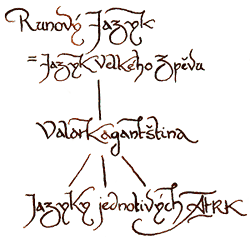
The Arkian languages are the only living yet clearly artificial tongues on the face of Qurand. It is said that Proto-Arkian was created by the Azharian Suvarna as an acoustic equivalent to a runic inscription he wrote upon the surface of the Ocean of Dreams with his own blood. The acoustic counterpart to this inscription was, and is, the Great Chant, which to this day is sung unchanged in the temples of the individual Arks.
Arkian tongues change very little; as long as the Great Chant is understood, the language tends to lean upon it and remain stable through it. Nevertheless, the language does shift, and one can tell which Ark a speaker hails from by their accent and minor variations.
IV. The Siranian Family
The nation of the Ancients, who were the common ancestors of the Siranians and the Chirbets, originates—according to legend—from the North Star. Along otherworldly paths, they once descended to the very farthest North of Qurand, where they lived in a blessed land in communion with the gods.
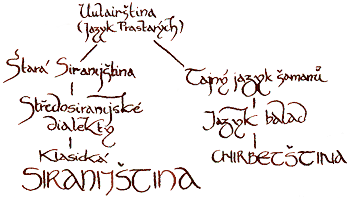
Their language was in some ways similar to Azharianian, yet it is unmistakable. It was a language as complex as a shifting crystal druse, allowing for rich poetry, and its sound was said to command human hearts.
The Ancients then set out on a great Pilgrimage to the South, for they yearned for the fellowship of the Forest and flowing water. Some, however, turned away from the Pilgrimage and looked back at the highest pass of Kaal-Charmat. These became the inhabitants of the Chirbets—brave hunters on skates, shamans, and poets. The others supposedly continued on and reached Sirania. There, their language changed, for the world was different. Then the gods attacked Sirania, and the language changed again. It lost its flexibility and became clear and simple. Because of this, it soon became the Common Tongue of Sirania and the near vicinity. In these times, it is already a necessity for every merchant venturing east of Garion to know at least a smattering of Siranian.
V. The Elven Family
The Elven languages derive from the language of the Unborn. This language was as perfect as water, smooth and interconnected like the very laws of the world by which spheres orbit their stars. It was the acoustic form of the ideal shapes of the Unborn energies. After gross matter came into being and the firpuvod-jazykust mortal beings were born, it was already evident that each of the Unborn spoke a tongue distinct from the others. Thus arose the first eight Elven languages. They were the idiosyncratic expressions of the eight Unborn, who shaped the Primordial Tone through their nature and diction.
The Firstborn mostly spoke the languages of their progenitors, but the Secondborn primarily used the tongues of Or and Wë—speaking Or’s language by day and Wë’s by night. Their descendants, however, mixed the two and joined them into a single whole, creating the language of the High Elves. The language of the Wood Elves evolved from the language of Damar, for they were of her people. The forefathers of the Dark Elves were disciples of Urwë, and thus much of his tongue is found in the language of the Dark ones; later, however, they likened their speech to that of the Grey Elves. Terrible and powerful was the language of Naes, Father of Dragons, and his worshipers—the Wild Elves—adopted many of his hissing words into their originally Wë-based Elvish.