The Unborn gained consciousness during the Second Age of the world alongside the emergence of cosmic matter; thus, besides Tho and Baoth, they are the eldest inhabitants of the Universe—older than all the gods and the Azhars themselves. They arose naturally during the Age of Silence as cosmic energy found its place and formed a structure. That primordial pattern, born of the purest self-movement of energy—toward which everything naturally strives to return, though disrupted and swirled by history and the will of individuals—had eight nodes, eight key points, eight gates. Within these, consciousness was born, and eons later, they were named the Unborn.
The Unborn participated in all subsequent ages but never permanently took a “side,” for their intentions lie outside the fundamental conflict between the Azhars and the Zilaths. They alone fully understand their path; thus, their actions often seem irrational or incomprehensible. It is said of them that they strive for beauty, but those who say so add in the same breath that the beauty of tragedy is deeper than the beauty of joy.
Mortals have always looked upon the Unborn with distrust and fear; many nations call them Titans and view their deeds as acts of destruction. Yet they reassure themselves that the Unborn belonged to the ages of the distant past and that in this age of the world, they have been tamed and bound by the gods.
The descendants of the Unborn became the Firstborn, also known among people as the Heroes of the Elven race. They stand with one part of themselves in the world of their fathers—the realm of cosmic forces—and the other in the world of the history of nations.
Thus are the great Unborn remembered by the ancients:
OR – The Sun (Also Ammor, originally Annor). Mortals behold this Unborn every morning after the dawn-dance of the Morning Star. His power, beauty, and strength are so apparent that many no longer perceive them. His gift to the world is the light of day and the clear mind of knowledge. Like the other Unborn, he forms one of the most fundamental and indispensable constants of the world; the wonder of his magic is no less because he has performed it every day for millions of years—on the contrary, it is all the greater. The joyful pathos of his eternal return from the darkness fills souls, serving as an image of happiness and a theme for hymns and songs.
He is revered not only among the Elves but also among many human nations. His temples are as diverse as the natures of these peoples, yet they share a fondness for the god’s purely symbolic form, favoring vast spaces and massive, simple structures resembling mountains whose peaks reach closest to the sun.
A mysterious legend speaks of him as the Apple upon the World Tree. It tells that he, in his radiant nobility, is the very fruit of the Tree that allowed the first humans to liberate themselves from the blindness and chaos of the Zilathic Age. It also says that at the birth of a child, Or enters the body with their first breath, and throughout their life, he touches every living being with one of his golden hairs.
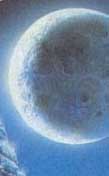
WË – The Moon (Also Irhel or Ithel). The Unborn Wë, who is androgynous like Or, is the silver king of the night and the guardian of great secrets. His face is veiled, half-dark and half-white. He is the guardian of the Boundary, not unlike Or; however, unlike him, he guards the gate to the worlds of darkness. While in cause he follows Or, in time he is older, for he is the lord and ruler of Inversion and its great teacher. He reigned over the sky during the Age of Slavery, and then his name was the Sun, for he was indeed the sun of the night. Like Or, he rose from the Waters—not as their adversary, but as their emissary.
Wë is also revered by many non-elven nations. His temples come to life at twilight and fall asleep at dawn; during the heat of the day, they lie fallow like the dead stones of ancient times. Like Or, Wë dislikes being depicted in human or animal form. He favors mysterious symbols, hidden chambers, and towering twin towers that thrust from the earth like horns, reaching for the sky like the extended hands of a mortal, seeking to touch the pair of lunar hands before they dissolve into nothingness among the stars.
Wë is the guardian of mystery and great knowledge, for which he paid with his wholeness; for none can gaze into both worlds as he does and remain whole. He lost much, most of all the full trust of his brothers, both the Azhars and the Zilaths, yet both companies of gods desire him and still join with him, as if hoping for his change. His birth is shrouded in mystery, for he is said to hail from a tree—though not the tree of the Lightbringer.
DAMAR – Mother Earth, Lady of Birth and Death. Like Or, the power of Damar is so vast and omnipresent that we no longer see it for its sheer scale. She is the mother of all the world’s matter and thus, from a certain perspective, the Mistress of the Universe, as her worshipers call her. She is mysteriously present in all that is, indifferent to whether it lives by our standards or not. She is the dark soil into which the dying remnant of a past life sinks to give birth to a new harvest, a new life, a new age. She is dark, but in darkness, all things germinate. She is cruel, yet none is more patient or tolerant than she.
Like her brothers, Or and Wë, she has two faces. She is the Maiden, the girl, the huntress in the wild forests, the Lady of Bears, ruler of beasts, a ruthless warrior of an untamed world—bare and empty in her wildness, filled with but a single desire: to hunt or be hunted. Her second face exists only when she is caught. Then she transforms into the Mother and the fearful protector of all things fragile and human. With a fleeting gaze filled with dread, she looks into the grey eyes of the wolves she once ruled and calls for her husband to drive them away. She gathers seeds and fruits, grafts the orchard, and plucks the weeds she once wore as a maiden’s crown of victory. Between the Maiden and the Mother stands Death, for in order for the maiden to become a mother, she must die and forget all she was, calling it folly (however sweet); likewise, for the mother to become the maiden, she must die and forget. Yet humans see only the second of these deaths. The first they perceive not as death, but as birth—the birth of her child.
As is the nature of gods and not men, Damar is maiden and mother at once; she is the virginal mother and the maternal virgin. Elves and men tell various myths to understand this mystery—they say that every evening Damar bathes at the roots of the Tree and that this bath restores her virginity, or that she brings forth all things without a man’s aid as an untouched virgin. But none of this is the full truth, for that is known only to those who have left the warm hearths and the lyres of storytellers for the inhospitable wasteland of the deep forests to dance with bears and wolves in a circle to honor the Lady.

AEI – The Wandering Lord of Mists (Also Ainar, Aeinabhar, Aeivatnar, Aeilhún). A Titan ruling over the mists of the world of the dead and over the forest. Few know much of the Lord of Mists, for such is his essence. Mist is a mysterious substance; people often mistakenly consider it a simple and ordinary obstacle on the path. On the contrary, mist is a gate and a way to other worlds, a sign of awakening, an icon of change, a teller of dreams, a destroyer of the frail, and a bridge for souls. By veiling the world, it paradoxically reveals reality and guides those who can truly see. The world of Mist is three times larger than the world of Earth, stretching like a plain or an ocean between the stars. But he who steps out of the mist becomes a prisoner of the Earth and may never leave it again. The misty forests of the Age of Silence are the seat of souls, dreams, and thoughts—the temple of Aei and the heaven of the dead. It is not mist; it is the continuum of the soul’s substance.
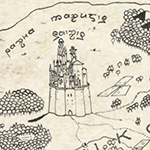
IRIN – The Guardian of the Gate (Tuarvalir) to the Celestial Tower (Gar = earth, Ion = tower, Garion = Tower of the earth), which is the center of Garion. Ancient cyclopean stairs, cracked by dozens of ancient ages and glowing with a warm white in the morning world, lead to the Celestial Tower. Its stone is even older, weathered by the storms of the Age of Elements, built by the hands of the gods themselves. Before the entrance to the Tower, before the moss- and lichen-covered but sturdy gate made from the bones of an ancient demon, stands Irin on eternal watch. To a mortal, it seems as if he is not there, for they see no human or giant figure standing before the portal, but the Tuarvalir stands there nonetheless. His strength is equal to his brother, the Sun; his power equal to his sister, the Earth; and his mystery as deep as that of his sibling (or non-sibling), the Moon. Yet it seems as though no one stands on the stairs before the Tower. Only the wind whistles there at times, as if playing an ancient flute. There, in that very place, stands the Eternal Guardian—unmoved, focused, vigilant.
During upheavals, dark ages, and evil times when the land was held by beings of Chaos, it happened that some dark hero, a god, or perhaps one of the Zilaths themselves attempted to take the gate of the Tower by storm. None of them, however, ever reached the gates. Halfway there, they clashed with the vigilant guardian and were repelled, cast away, swept aside, and crushed.
QUAH – Called Ilphani, “Star Dust.” Lady of the infinite plains of twilight. Twilight is the brother of Mist. It is larger than she, perhaps a thousand or a million times, and hides within it countless plains and worlds, yet it is more fragile and easily driven away by light. Quah is this Twilight that stretches between the stars and through which all Dusk-walkers pass. Quah visits Qurand only occasionally—sometimes in the morning or evening she appears for a moment and then immediately vanishes again.
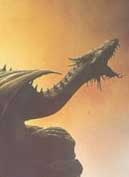
NAES – Father of Dragons (Nazrawirainagoahizar). The dragons—sons and daughters of this god and kin to the Elven race—tore their father Naes to pieces. Each dragon carries within it a part of its stolen treasure, from which divine blood eternally wells in the form of fire, searing the dragon’s entrails and torturing it with terrible ecstasy and pain, eventually driving it to madness—and that is the true nature of a dragon. Dragons are forever stained by patricide and deicide, yet they forever inherit a part of their father’s power, which is nonetheless corrupted and ruinous. As a reminder of the first bloodshed, they spill their father’s blood in the form of fire across the world, bringing destruction to all that is built and unified due to their fragmented nature. Yet even this is not the true secret of the dragons, for that is known only to those who clash with them and leave alive.
URWË – Called Avontar, “Lord of All.” Lord of Darkness. If Mist is three times larger than Earth, and if Twilight is a thousand times larger than Mist, then Darkness is ten thousand times larger than Twilight—and when we say ten thousand, we mean countless. Darkness is the primordial state of all; it is everywhere and in everything, and places filled with light are but infinitely small islands that we could “round down” to nothing. Therefore, Urwë is the lord of all. All know that light is temporary, while darkness is eternal. Light may struggle and leap above the surface of darkness for a while, but in the end, it always goes out, and Avontar comes to lie in that place. Every place of light is but a temporary concession from Avontar, and he, the ultimate general, always conquers his land back.