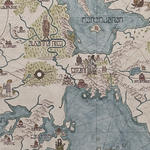

GGandhara is a vast empire that borders Sirania along its eastern frontiers. The rugged continent stretching to the east of the Siranian Empire is nearly as large as the entire Western continent, and it is governed by a single rule and a single administration—the entirety is a single empire: Gandhara.
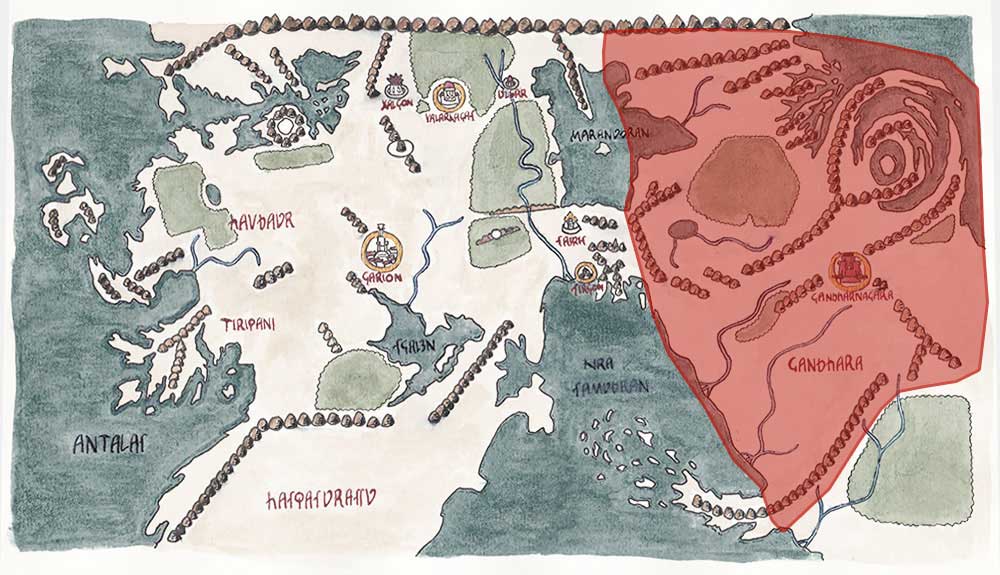
The Gandharan continent is the least explored part of Qurand for one primary reason—entry into Gandhara is forbidden to all foreigners, save for special exceptions who are bound by oath and kept under constant, vigilant supervision. Nevertheless, certain fundamental features of the continent’s geography can be stated with certainty:
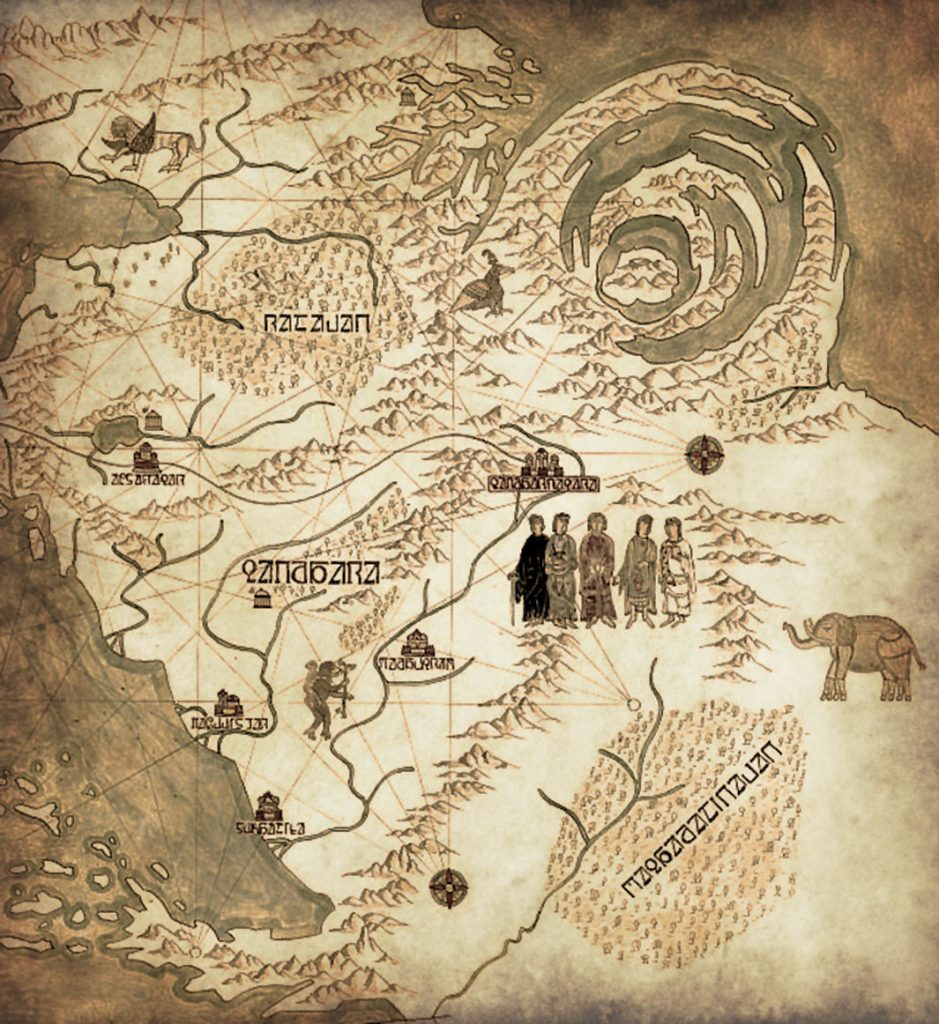
The entire land is, on average, far more mountainous than the lands of the West—where the West has plains and levels, Gandhara has hills and highlands; where the West has hills, Gandhara has mountains; and where the West has mountains, Gandhara has massive alpine ranges. All these mountain ridges converge into a great knot at the very center of the empire, where a high plateau stretches for hundreds upon hundreds of miles. From this plateau rise the highest peaks in the world: the Nazranzikhara mountains. Upon this plateau lie many mysterious places and valleys where, according to legend, the Gandharan nation was born long ago.
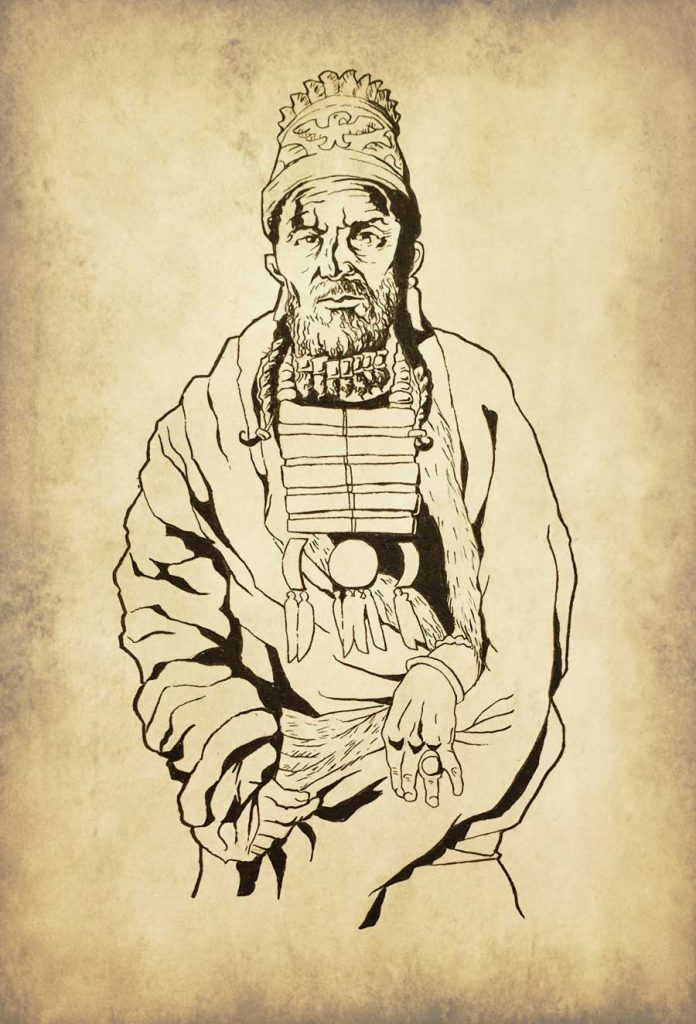
Somewhere upon this plateau, in a place called the Heart of the Mountains, or Gharahjartarok, lies an ancient monastery—the only remaining school of the Maghavans on Qurand. The abbot of this monastery is Adimaghavan Indar, the Superior of the Order. The most prominent part of the monastery is its fortified, soaring facade, which towers like one of the surrounding mountains over the valley where Gandharnagara, the capital of the empire, is situated.
The Gandharans live in a caste society governed by rigid rules. The Maghavans are the highest authority in all decision-making. Gandharan society has little sympathy for human weakness; anything deemed a failure is disposed of in Spartan fashion by being cast from the cliffs, of which there is never a shortage in Gandhara. Each social caste has a prescribed role: women are entirely under the dominion of men, the young under the dominion of the elderly, and the courts are harsh and brief, with sentences that are swift and efficient. Through the radical suppression of individuality for the sake of the collective, Gandhara has achieved immense power and capability, much like an anthill or a beehive; everyone has a clearly defined role. The Gandharan order allows individuality to manifest only at the highest rungs of the social ladder—levels reached only by those perfectly vetted by the system. The Gandharans consider their system the ultimate form of quality control and have no qualms about categorizing individuals as “high quality” or “low quality.” In their judgment, only an individuality that ascends to the summit is worthy of expression.
After tens of thousands of years of experimenting with the limits of order, the Gandharans realized that a perfectly repressive system eventually causes its own downfall—either because the population becomes too dissatisfied with a system that cannot adapt to change, or because other lands prove to be more enterprising or militarily potent. Gandhara has lost this type of struggle with its surroundings several times, but it has never truly perished; it has always risen again, capitalizing on the experience of its defeat. This is because the fundamental value of Gandhara is memory—the refusal to forget past lessons.
Over time, the strict order has gained moments of flexibility, resulting in a series of intentional exceptions and “soft spots” where the rigid social structure can bend. For instance, in exceptional cases where individuals are clearly born with talents suited for the “wrong” caste, transition is possible after grueling trials and tests. Within the hierarchies, limited mobility is possible—increasingly so the higher one ascends. However, the Gandharan hierarchy is far more self-aware than those in other lands. For tens of thousands of years, it has reflected on the problems of proper governance, performing constant self-evaluations and correcting its concepts with fine adjustments. The greatest horror and enemy for Gandhara is the idea of rapid change or revolution, where it is impossible to precisely reflect on individual steps and maintain conscious control over everything.
Gandharan architecture is not particularly aesthetic; it is primarily functional. Exceptions are found on one hand in the temples, which are the sophisticated works of the most gifted architect-seers, and on the other hand in the humble village dwellings, which folk creativity adorns with a simple but clear beauty.
There is one area where Gandhara clearly excels over surrounding cultures, and this excellence occasionally crosses the empire’s borders, allowing all to witness its indisputable quality: the military. The Gandharan army is the best-equipped, fastest, and most organized (and every other “most”) military force on Qurand. The so-called Gandharan mile, which is equivalent to 40 Siranian miles, is a day’s leisurely march for the imperial host. If the army is in a hurry, it is capable of covering 2 Gandharan miles per day on level ground and maintaining this pace for several days.
Conscious of its own strength, Gandhara interferes in Western politics only minimally. Every crossing of Gandhara’s borders by its armies is felt strongly by its neighbors and is never forgotten. The Gandharan army does not return home without victory.