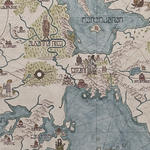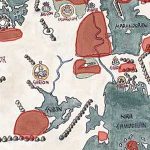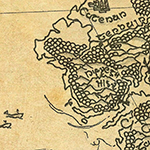
At the far south, on the very edge of the mapped world—beyond the Tiriqan steppes and the Hasqasurassu desert—lies an immense tropical jungle. In the north, it is known only through echoes and tales, as if it were a place from an entirely different world. The heart of the jungle is a mighty river that winds through its interior in many coils, like intestines in a belly. It is in this jungle that many nations live belonging to the race of beings known technically by northern scholars as Arboreals, and in the language of their nearest human neighbors as the Tlamaks.
The famous traveler and collector of “all things savage,” Princess Rukira of the Southern Kingdoms, ventured with a company of cartographers, scholars, and an armed escort to the very edge of the Great Jungle. She spent two years in one of the fringe communities of Arboreals, who were surprisingly willing to host the foreigner and her party in exchange for gifts and a promise of friendship with the Southern Kingdoms. Rukira’s stay was cut short when her hosts’ village was attacked by neighbors for unknown reasons. The princess escaped by a hair’s breadth with a few loyal companions, while most of her escort met their death in the green twilight of the jungle. Her report, translated from Saifian into Siranian, forms the basis of the following description. It must be noted that the understanding between the Saifs and Arboreals was limited, and Rukira likely failed to grasp the true complexity and functioning of most indigenous institutions. Furthermore, she visited only a small, peripheral community that had encountered humans before and was likely influenced by contact with the outside world. The situation in the heart of the Jungle remains a mystery; some believe a great Arboreal empire exists there, having moved beyond tribal existence to form a populous nation.
What, then, do we learn from Rukira’s travelogue?
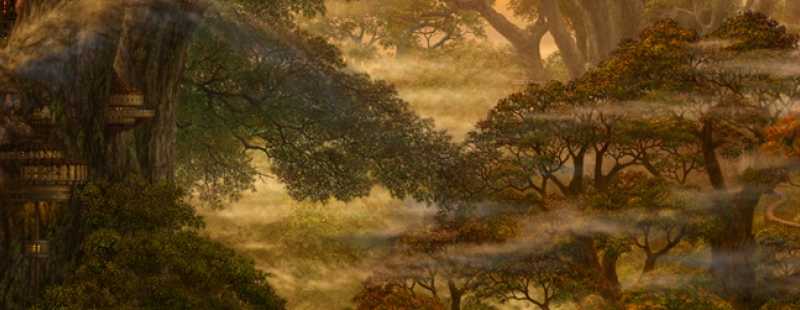
Arboreals live in the crowns of trees because the Great River undergoes regular cycles of flooding, and building dwellings on the ground in the heart of the Jungle is simply unwise. The massive trunks of the jungle giants are often hollowed out, and the cavities within are so large that an entire tribe can fit inside across two or three floors. The Arboreals tend to the trees they inhabit to ensure their “house” endures. They also build bridges, ladders, squares, and huts made of rattan across several levels of the branches, serving as dwellings as well as outposts and observation decks. Even more than harvested materials, they prefer to use living ones—branches, wicker, and vines—which they shape and adapt, as these have greater durability in the humid climate.
Regarding the appearance of the Arboreals, Princess Rukira repeatedly marvels at their natural beauty. They are about two palms shorter than humans but otherwise generally human in appearance. Rukira writes: “They have beautiful, strong arms and legs, and the graceful curves of dancers and athletes.” However, there are several features that distinguish them entirely from humans: first, they have prehensile feet with opposable toes and a long, prehensile tail. Second, their bodies are covered in a fine, very short down, similar to the fur of animal young, and their hair never grows longer than about a foot. This down features natural camouflage patterns—various white-green-yellow spots and stripes, similar to the markings on tigers or cheetahs—which are unique to each individual. This was how Rukira initially recognized them before she learned to distinguish their facial features.
They weave various flowers and the shimmering elytra of dead beetles into their hair as decoration; otherwise, they go entirely naked. Third, their facial features are distinctly different from humans—they have large eyes, overall rounder than human ones, a small flat nose, and the hairline on the face is not a sharp border but a fluid transition of gradually lengthening down. In her early notes, Rukira admires their beauty, speaking of “the most beautiful children of the woods with gentle eyes” and “beings from fairy tales.” Later, however, she witnesses their immense strength and certain customs that fill her with terror. Arboreals possess truly immense physical strength, capable of tearing a limb from a human or animal with their bare hands or feet.
One of the greatest puzzles for foreigners is the language of the Arboreals. Their communication has two entirely different levels and registers: the intimate and the public. Public communication is conducted via voice and rhythmic instruments and is not a language in the conventional sense. There is a rich palette of signals, various types of calls, and drumming that carry clear meaning, but one cannot form complex sentences in this language. It is rather a language of slogans, hymns, and warning signals that carry strong emotional and activating content, shared by the entire tribe. According to Rukira, “public life” and “political assemblies” take the form of a concert of various songs and hymns and communal dancing, where the whole tribe tunes into a shared frequency and experiences itself as an interconnected unity. If the tribe needs to collectively decide on something, it also takes the form of a competitive chanting of slogans, songs, and dances. A more successful candidate for chieftain is one who can make the tribe dance and sing better, a sign that he understands them better and should lead them. The vocabulary of this public language is relatively limited because there is only a specific group of things that interest all members of the tribe together.
Alongside the public speech of voice and rhythm, they have an intimate language of gestures in which the voice is not involved. This sign language is a true language in our sense; one can formulate sentences of any length and complexity on any topic. Compared to human speech, it is somewhat wilder and full of metaphors. The Arboreals perceive the voice as loud and meant for calling or warning, but they find something “shouting” and non-intimate about it. Meanwhile, hands and feet are skillful, capable of nuance and the crafting of small objects; likewise, it is the hands and feet that are capable of discussing things in detail and with subtlety. Because gesturing cannot be seen around corners and is only shared by those who see it directly, it is viewed as a private and intimate matter. They converse through gestures “between two faces” or in a small circle of friends. Arboreals have a clearly developed sense of the difference between public and intimate spaces and situations. Unlike humans, they can use both hands and feet simultaneously in their sign language, giving them a broader, faster, and more nuanced range of expression.
The Arboreals earned their name not only because they live in trees but because they are connected to them in other aspects of life. Special trees and locations within trees serve for births, initiation rites for young men and women, and for funerals. From Rukira’s notes, it is not entirely clear whether such places serve purely as ritual spaces or whether the trees play some other natural or magical role.
Our own distinction between the “natural” and the “magical” has no meaning for the Arboreals. For them, the growth of a tree or the transformation of wood into a tool, the birth of a person, or a communal tribal dance is as much magic as the various blessings and curses with which their culture is literally saturated. The entire Great Jungle consists of a rich network of “good” and “bad” places; it likely makes no difference whether a place is “bad” due to magical influence, the presence of venomous snakes, or because the tribe decided during a communal dance that the place is taboo.