Seals of the Five Elements
The Andals, together with the Azhars, are collectively known as the Arhants. Yet, they share neither a common origin nor a similar nature. The Andals are much younger deities, having arisen during the Age of the Azharians—the sixth age of the Boundary’s existence. At that time, five of the most powerful and wisest Azharian mages submitted to the burden of becoming eternal seals and bonds upon the world’s elements. The elements, which until then had been untethered and chaotic, thus became forces of Order, allowing a firm and clear world to come into being.
The Andals are like five pillars upon which the world rests; should they cease to be, the world would once again be swallowed by the Age of Elements, signifying its total destruction. The original mages who became the Andals traded their earthly existence for a lifelong vigil over the elements. Their bodies are now composed of elemental substance, and only their souls retain freedom. Their seat is Paraqurand, where the night is more beautiful than the day, and where no mortal man can survive the daylight.
Due to their original humanity (or elven nature), the Andals are closer to earthly beings and interact with them actively. In recent ages, it is they who form the primary opposition to the forces of the Zilaths. They prefer to manifest in human or elven form, as it is their original likeness.
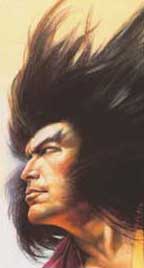
ATHORN: Andal of the Fifth Element. Among the elves, he is called Narsilwë; in the northern kingdoms, Uthaen, or simply Azhar. As an ancient mage and warrior, he was a noble prince of the Azharian race, closely related to the Lady of the High Circlet herself. In his human form, he appears as a tall, sinewy Azharian with black hair streaked with silver, a stern face, and violet eyes. He is usually clad in adamantium armor that shows signs of active use. Especially during the Age of Heroes, he involved himself deeply in worldly affairs. He once served as the Supreme Commander of the Siranian forces, and his tale is inextricably linked to the history of the Siranian Empresses, for he served as their secret tutor for long centuries. However, after his true nature was revealed, he withdrew, and Sirania has not seen him for a long time.
ANILAS: Andal of the Element of Air. In the Elven tongue, Sulwë; to human princes, Wayaen. Before accepting the burden of Andalship, he was a Firstborn of the elven race, making him the eldest of all the Andals. To humans, he appears as a tall, slender old man with long gray hair and a beard, dressed in an azure robe that seems frayed and torn by sharp winds. His only adornment is a silver belt from which hangs a long sword in a silvery sheath. Anilas is the unspoken leader of the Andals. Although he does not seek this position, in the council hall, all eyes eventually rest upon his calm face, awaiting his decision. He is not silent—his voice is simple and clear, yet it is the voice of a ruler, reaching the ears even of those not present. Like the other Andals, he is well-disposed toward men and elves, but he less frequently resorts to displays of authority, preferring to advise and persuade. He is the lord of gales and air currents, and of all that dwells between the stars and the treetops. Yet, in a storm, he meets all the other Andals, and there they are present all at once: Lightning, Gale, Fire, Water, and Earth.
AGNIR: Andal of the Element of Fire. In the Elven language, Anarwë; in the tongues of the West, Phaukas; to the Northmen, Fyrwaen. The current Agnir is the second mage to hold the role of Guardian of the Seal. His predecessor, an ancient sage from the Age of the Azharians, burned to ash during the terrible wars of the past while leading battle lines, and the current Agnir replaced him. Before becoming an Andal, Agnir was the Azharian High Priest of the Order, a bearer of great wisdom granted by the grace of the Lightbringer. In the Age of Maghavans, he became a Maghavan himself, yet he never embarked upon the Pilgrimage, remaining in the world to fight actively for the original Azharian cause. During the Age of Elves, he met a being named Suvarna, and they have remained the closest of friends ever since. It is said that when the previous Agnir perished during a celestial clash in the Age of Gods, Suvarna bore his burden for a short time until the Azharian assembly discerned that the office was destined for the current Agnir. He appears as a flawlessly beautiful Azharian with a bright brow and violet eyes, yet his face is unmistakably distinct due to a sense of unquenchable hope. His hair has the sweet color of rusted iron, and he is clean-shaven. He dresses in various ways, often in the priestly robes of his youth, sometimes not at all, and at other times in armor of Gandharan red gold. Agnir has two daughters: Scintilla and Ignis.
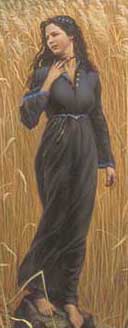
AMIRAT: Andal of the Element of Water. Besides the elven form Anwen and the northern Wasaeg, her Azhar name has variants such as Amereth and Lemaweth. Like Agnir, Amereth is not the first being to serve as the Andal of Water. Before her, it was a noble Firstborn of the elves, but she was seduced by the Zilaths during the conflicts of the Azharian Age’s birth and became one of them. A Great Saga tells of the struggle for the water element, which was temporarily under the full power of the Zilaths. They were in decline then, their lord having been recently deposed, and so, with the help of the Apisiryasid Queen Carisvand, water was reclaimed for the Order, and the Queen became the new Seal. Her rule over her people passed to her younger sister, Apiris. Amereth appears as a fair young maiden whose every movement—even a slight smile or a blink—mimics the perfect motion of water. Her eyes are gray, and her hair is as black as the sea at night. She is usually dressed in a green garment or any other attire.
ARAWAT: Andal of the Element of Earth .The Elves call her Daurien or Dawruen; humans call her Daona or Syria. Like Anilas, she has been an Andal from the very beginning. During the Age of Elements, she was a mage of the Lost People, a wise and admirable being whom her companions and followers already revered as a deity. Among all the Andals, she is considered the darkest figure, her stance being the furthest from the Azharian plan. Yet, in her distinctiveness, she remains faithful to her own order and remains a divine force to be reckoned with. She does not shy away from active influence, constantly speaking to men and elves and pushing their stories in unexpected directions. She appears in several guises: as a young girl with black eyes and hair entwined with bedstraw and forest grasses, wearing a tucked-up tunic and simple shoes; as a noble woman in a black, ornate robe decorated with patterns of ears of grain sprouting from dead bones; or as an old seeress leaning on a staff. Her power permeates the earth, its fertility, and its dimension as a dead mass. Her art is the awakening of the dead and the rebirth of those who have passed.